
By Nelson Santana and Emmanuel Espinal
November 25, 2026
Lea en español: 16 contra la violencia, memorias dominicanas: Minerva Mirabal
Next: 16 Days for Them: Patria Mirabal
November 25 is no ordinary date. It is the International Day for the Elimination of Violence against Women, declared in memory of the Mirabal Sisters (Minerva, Patria, and María Teresa), who were murdered by the Trujillo dictatorship on November 25, 1960. Since then, organizations throughout the world have observed the "16 Days of Activism," which ends on December 10, Human Rights Day. That span of time reminds us of an essential truth: violence against women is a human rights violation.
ESENDOM joins this effort with a special 16-part series, one installment per day, to name, remember, and demand. We honor Mamá Tingó (Florinda Soriano Muñoz), a peasant leader murdered for defending the land; Lucrecia Pérez Matos, a Dominican migrant murdered in Spain in a hate crime; and recent cases that stirred the public conscience, such as that of Emely Peguero. They are not statistics. They are lives, families, and communities scarred by femicide, assault, impunity, and institutional neglect.
Our position is clear: violence against women must end. Over these 16 days, we will offer brief profiles, historical context, legal background, and calls to action so that every reading becomes active memory and civic commitment. We invite you to read, share, educate, and demand effective policies for prevention, protection, and justice.
Because remembering is an act of love and of responsibility. For them and for all women: ni una menos, not one more.
This series is not a ranking. The order reflects editorial and chronological criteria. We honor each woman with equal respect. Violence against women must end.
Minerva Mirabal: The Law, the Word, and the Price of Dignity
ESENDOM series "16 Days for Them" (November 25–December 10)
Introduction
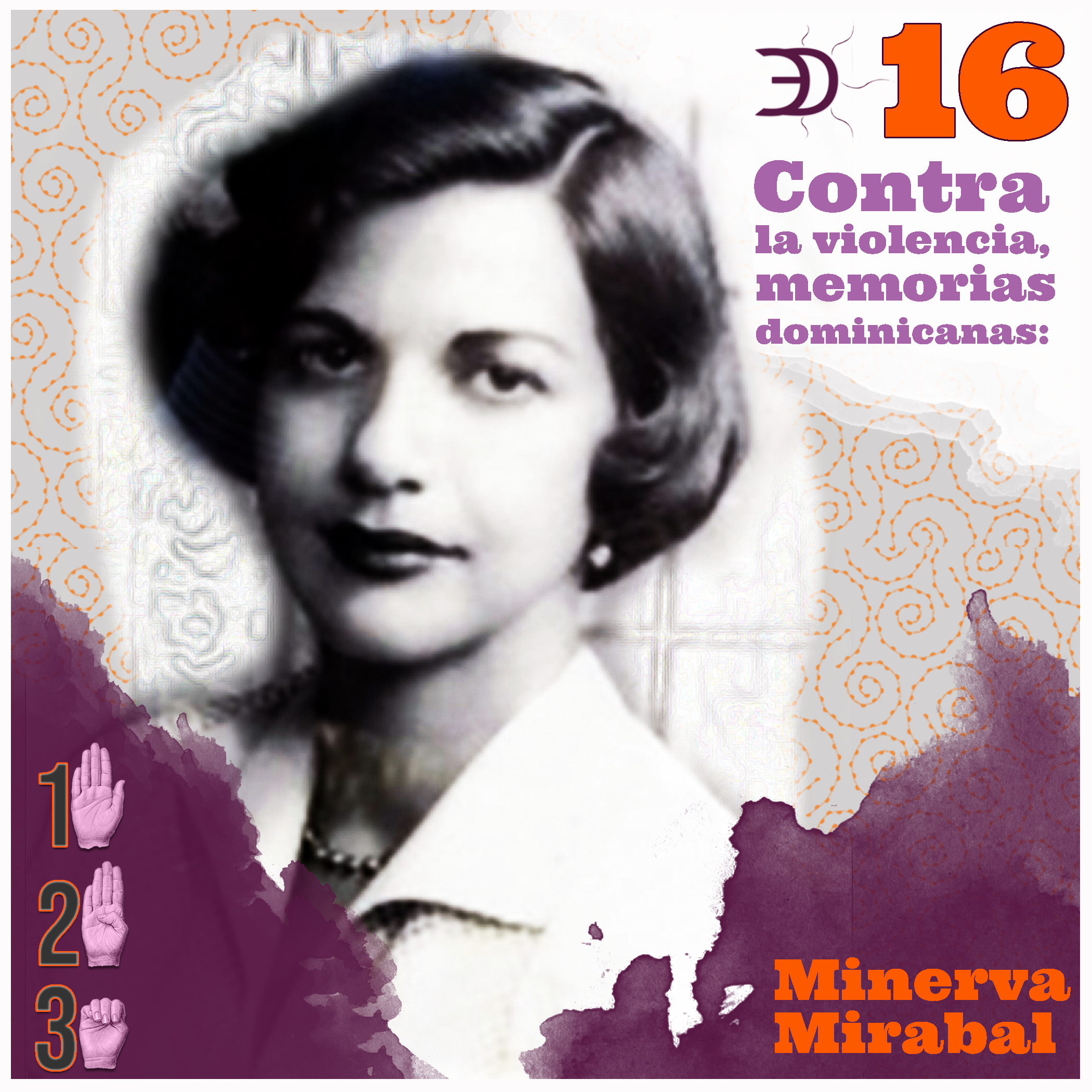
María Argentina Minerva Mirabal Reyes (1926–1960) was a lawyer, an activist, and one of the Mirabal Sisters murdered by the dictatorship of Rafael L. Trujillo. Her life shows how state violence targets women's bodies in order to silence their leadership. We open our 16 days of activism with Minerva to affirm what matters most: violence against women must end.
Why She Matters Today
Minerva's murder sparked a national and international awareness that lives on today in November 25, the International Day for the Elimination of Violence against Women. Her story links historical memory with human rights. It exposes the use of power to harass, surveil, and exterminate women who lead change. Naming her reminds us that impunity wounds generations and that states must guarantee truth, justice, and non-repetition.
What She Did / What Makes Her a Symbol
Minerva organized, studied, and confronted the regime. She publicly rejected the dictator's harassment, graduated with honors in law, and, together with Manolo Tavárez Justo, built the June 14th Movement. Her clandestine name, "Mariposa" (Butterfly), captures a kind of leadership that turned homes, classrooms, and prison visits into spaces of resistance. The crime that took her life, along with those of her sisters Patria and María Teresa, laid bare the brutality of the state and gave rise to a movement that lives on today in schools, museums, and murals, and every November 25.
Biographical Profile
Full name: María Argentina Minerva Mirabal Reyes de Tavárez
Born: Ojo de Agua (Salcedo), March 12, 1926
Died: Dominican Republic, November 25, 1960
Age: 34
Occupation/role: Lawyer, political activist
Type of violence: State political violence; extrajudicial killing
Perpetrators: The Military Intelligence Service (SIM) of the Trujillo regime
Family: Husband, Manuel Aurelio "Manolo" Tavárez Justo; children, Minerva Josefina (Minou) and Manuel Enrique
How she is remembered: Origin of November 25; the Mirabal Sisters House Museum; literary and film portrayals
Extended Biography
Minerva was born in Ojo de Agua, Salcedo, into a family with peasant roots and a strong commitment to education. The daughter of Mercedes "Chea" Reyes Camilo and Enrique Mirabal, she stood out from childhood for her gift for reading and recitation. At twelve she entered the Colegio Inmaculada Concepción in La Vega, where her intellectual curiosity and sense of justice took shape. As a teenager she discovered painting and poetry, not only as refuges but as tools for imagining the country she wanted.
By the late 1940s, when fear had become routine, Minerva reached a turning point. In 1949, at an "official" party, she rejected the dictator's advances. The retaliation was immediate: surveillance, detentions, house arrest, and obstacles to continuing her studies. Far from intimidating her, the experience strengthened her resolve. She moved to the capital, enrolled at the University of Santo Domingo, and graduated with honors in law in 1957. Although the regime barred her from practicing, the law remained an ethical horizon for her, a language with which to challenge abuse.
At the university she met Manolo Tavárez Justo. They married in 1955 and started a family. Together they carried the resistance from the personal to the collective. Inspired by the expedition of June 14, 1959, they built the June 14th Movement, which called for unity against the dictatorship in neighborhoods, classrooms, and the countryside. Minerva took the clandestine name "Mariposa" and brought her sisters Patria and María Teresa into the political work, combining the logistics of distributing materials, political education, and mutual care during times of persecution.
Repression came quickly: raids, imprisonment for the sisters, and the jailing of their husbands. The women were granted releases "by grace," not to demobilize the struggle but as a publicity calculation on the regime's part. Even so, Minerva and her sisters kept visiting the prisoners and sustaining families and community ties. On November 25, 1960, as they returned from seeing their husbands in prison, SIM agents intercepted them. The agents murdered them and staged an accident by pushing their vehicle off a cliff. The cover story convinced no one: the whole country knew that the Butterflies had been murdered. Six months later, on May 30, 1961, Trujillo was executed, and the fall of the regime became irreversible.
Over time, the sisters' house became a museum, their story inspired novels and films, and November 25 was recognized internationally as the day to eliminate violence against women. But Minerva's deepest legacy cannot be contained in an anniversary. It is the certainty that dignity, when organized, defeats fear.
Conclusion
Remembering Minerva Mirabal is not an act of nostalgia. It is a present-day commitment. Her life teaches us that violence against women, whether domestic, institutional, or state-sponsored, is not inevitable, and that meeting it with study, organization, and collective care can change history. That is why we open this 16-day series with her: to turn memory into action, to demand prevention, protection, and justice, and to say out loud what Minerva made part of her everyday life: no to abuse, no to silence, no to impunity. For Minerva and for all women: ni una menos.
⸻⸻
Related:
16 Days for Them: Introduction to the 2026 English Edition Dominican Women Against Violence
16 Days for Them: Minerva Mirabal
16 Days for Them: Patria Mirabal
El significado del 25 de noviembre: la eliminación de la violencia en contra de la mujer
16 contra la violencia, memorias dominicanas: Minerva Mirabal
16 contra la violencia, memorias dominicanas: Patria Mirabal
16 contra la violencia, memorias dominicanas: María Teresa Mirabal
16 contra la violencia, memorias dominicanas: María Trinidad Sánchez
16 contra la violencia, memorias dominicanas: Yanelis Arias
16 contra la violencia, memorias dominicanas: Sagrario Ercira Díaz
16 contra la violencia, memorias dominicanas: Rosaura Almonte «Esperancita»
16 contra la violencia, memorias dominicanas: Paola Languasco
16 contra la violencia, memorias dominicanas: Yocairi Amarante
16 contra la violencia, memorias dominicanas: Gladys Ricart
16 contra la violencia, memorias dominicanas: «Mamá Tingó» Florinda Soriano
16 contra la violencia, memorias dominicanas: Andrea Evangelina Rodríguez Perozo
16 contra la violencia, memorias dominicanas: Lucrecia Pérez
16 contra la violencia, memorias dominicanas: Anibel González Ureña
16 contra la violencia, memorias dominicanas: Anacaona
16 contra la violencia, memorias dominicanas: Emely Peguero
10 de diciembre: cuando los derechos humanos tienen nombre de mujer