
By Emmanuel ESpinal and Nelson Santana
November 26, 2026
Lea en español: 16 contra la violencia, memorias dominicanas: Patria Mirabal
Previous: 16 Days for Them: Minerva Mirabal
Next: 16 Days for Them: María Teresa Mirabal
November 25 is no ordinary date. It is the International Day for the Elimination of Violence against Women, declared in memory of the Mirabal Sisters (Minerva, Patria, and María Teresa), who were murdered by the Trujillo dictatorship on November 25, 1960. Since then, organizations throughout the world have observed the "16 Days of Activism," which ends on December 10, Human Rights Day. That span of time reminds us of an essential truth: violence against women is a human rights violation.
ESENDOM joins this effort with a special 16-part series, one installment per day, to name, remember, and demand. We honor Mamá Tingó (Florinda Soriano Muñoz), a peasant leader murdered for defending the land; Lucrecia Pérez Matos, a Dominican migrant murdered in Spain in a hate crime; and recent cases that stirred the public conscience, such as that of Emely Peguero. They are not statistics. They are lives, families, and communities scarred by femicide, assault, impunity, and institutional neglect.
Our position is clear: violence against women must end. Over these 16 days, we will offer brief profiles, historical context, legal background, and calls to action so that every reading becomes active memory and civic commitment. We invite you to read, share, educate, and demand effective policies for prevention, protection, and justice.
Because remembering is an act of love and of responsibility. For them and for all women: ni una menos, not one more.
This series is not a ranking. The order reflects editorial and chronological criteria. We honor each woman with equal respect. Violence against women must end.
Patria Mirabal: Faith, Family, and Courage in the Face of Terror
ESENDOM series "16 Days for Them" (November 25–December 10)
Introduction
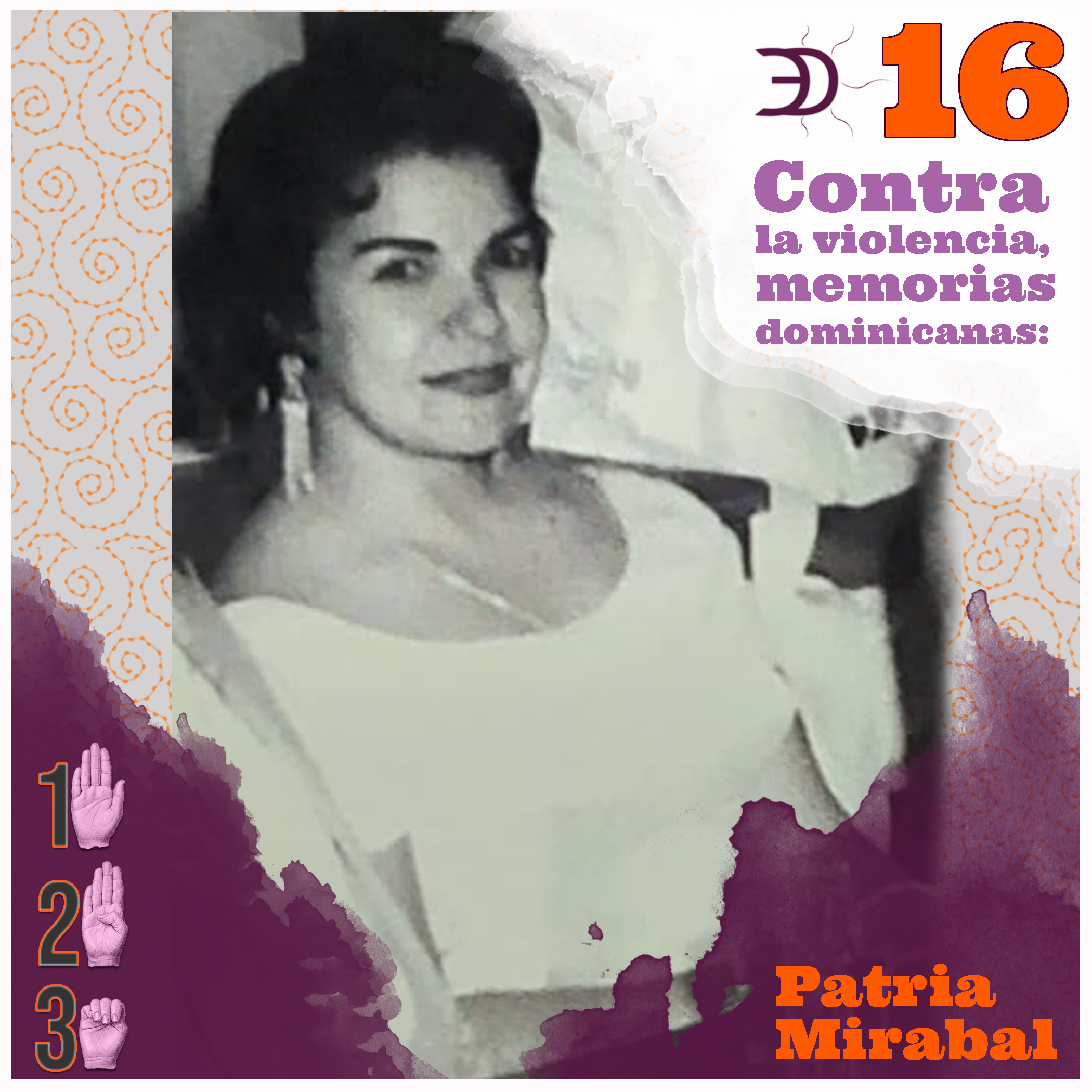
Patria Mercedes Mirabal Reyes (1924–1960) was an artist, a mother, and an activist. She was born on February 27, Dominican Independence Day, and her parents gave her a name that turned out to be her destiny: Patria means "homeland." With her sisters Minerva and María Teresa, she was one of "Las Mariposas" (the Butterflies), women who stood up to the dictatorship of Rafael L. Trujillo. On November 25, 1960, she was brutally murdered. Her death did not silence her. It spread her message further. We remember her during the 16 Days of Activism (November 25 to December 10) to affirm what matters most: violence against women must end.
Why She Matters Today
Patria embodies a resistance that turned the home into a stronghold of dignity. Her story connects the state's political violence with the forms of violence that run through women's daily lives, such as harassment, dispossession, and threats. It warns that without truth, justice, and non-repetition there can be no full citizenship. November 25, the day she and her sisters were murdered, is now the International Day for the Elimination of Violence against Women. Her life and death continue to teach generations, on the island and beyond.
What She Did / What Makes Her a Symbol
Patria sustained the resistance through domestic and community organizing. She offered shelter, handled logistics, cared for children, and supported political prisoners and their families. Despite the confiscation of her property and constant harassment, she kept a calm and steady commitment. Her moral voice is captured in words that still resonate decades later: "We cannot let our children grow up under this corrupt and tyrannical regime… I am willing to give everything, even my life if necessary." Her murder, along with those of Minerva, María Teresa, and their driver, Rufino de la Cruz, exposed the regime's brutality and sparked a social movement that hastened the end of the dictatorship.
Biographical Profile
Full name: Patria Mercedes Mirabal Reyes de González
Born: Ojo de Agua (Salcedo), February 27, 1924
Died: Santiago–Puerto Plata highway (near the Marapica bridge), November 25, 1960
Age: 36
Occupation/role: Homemaker, artist (painter), activist
Type of violence: State political violence; extrajudicial killing
Perpetrators: The Military Intelligence Service (SIM) of the Trujillo regime
Family: Husband, Pedro A. González; children Nelson Enrique, Noris Mercedes, Raúl Ernesto, and Juan Antonio (who passed away at five months)
How she is remembered: One of "Las Mariposas"; November 25; the family house museum; schools and murals
Extended Biography
Patria was born in Ojo de Agua, Salcedo, into a farming family deeply rooted in its values and its faith. From childhood, she was drawn to painting and found in color a private refuge from the anxieties of an era marked by fear. At fourteen, she entered the Colegio Inmaculada Concepción in La Vega with her sisters, where she completed her intermediate education and trained as a secretary. Her spirituality was not passive. It was a faith that looked injustice in the eye.
At sixteen, she married Pedro A. González, a farmer, and together they raised a family of four children. Motherhood did not distance her from reality. It made her more political. When the regime confiscated her home and the family's farm property, others might have given up, but Patria held firm. She provided for her family, supported her sisters, and stood by those who suffered persecution. Her home became a center of operations and care, a trench where resistance was also cooked, sewn, and listened to.
Her sisters' leadership, Minerva's above all, was fed by the energy Patria amplified: organizing prison visits, gathering supplies, passing messages, and offering emotional support. As the repression intensified, the arrests, raids, and death threats came. Patria did not romanticize the risk. She managed it. She prepared her children, supported her mother and Dedé, and persevered with a conviction whose simplicity is striking today: the children of the Republic deserve to grow up in freedom.
On November 25, 1960, Patria, Minerva, and María Teresa were returning from visiting their imprisoned husbands when Military Intelligence Service agents intercepted them. The agents pulled them from the vehicle, murdered them, and then staged an accident by throwing the jeep off a cliff near the Marapica bridge. No one believed it. Six months later, on May 30, 1961, the dictator was executed, and the fall of the regime became imminent. Patria did not live to see the victory, but her everyday courage, both domestic and public, remains a lesson.
Over the years, the family's old house became a museum, the international community recognized November 25, and murals, schools, and civic events keep her name alive. But Patria's legacy is not measured only in tributes. It is measured in every home where a woman decides that fear will not rule, and in every community that turns care into politics and grief into action.
Conclusion
To remember Patria Mirabal is to recognize the civilizing power of care and the quiet courage that sustains just causes. Her life shows that resistance also washes dishes, raises children, and organizes provisions, and [when the time comes, gives its life. During these "16 Days for Them," her name calls on us to turn memory into prevention, protection, and justice. For Patria and for all women: ni una menos.
⸻⸻
Related:
16 Days for Them: Introduction to the 2026 English Edition Dominican Women Against Violence
16 Days for Them: Minerva Mirabal
El significado del 25 de noviembre: la eliminación de la violencia en contra de la mujer
16 contra la violencia, memorias dominicanas: Minerva Mirabal
16 contra la violencia, memorias dominicanas: Patria Mirabal
16 contra la violencia, memorias dominicanas: María Teresa Mirabal
16 contra la violencia, memorias dominicanas: María Trinidad Sánchez
16 contra la violencia, memorias dominicanas: Yanelis Arias
16 contra la violencia, memorias dominicanas: Sagrario Ercira Díaz
16 contra la violencia, memorias dominicanas: Rosaura Almonte «Esperancita»
16 contra la violencia, memorias dominicanas: Paola Languasco
16 contra la violencia, memorias dominicanas: Yocairi Amarante
16 contra la violencia, memorias dominicanas: Gladys Ricart
16 contra la violencia, memorias dominicanas: «Mamá Tingó» Florinda Soriano
16 contra la violencia, memorias dominicanas: Andrea Evangelina Rodríguez Perozo
16 contra la violencia, memorias dominicanas: Lucrecia Pérez
16 contra la violencia, memorias dominicanas: Anibel González Ureña
16 contra la violencia, memorias dominicanas: Anacaona
16 contra la violencia, memorias dominicanas: Emely Peguero
10 de diciembre: cuando los derechos humanos tienen nombre de mujer