
By Emmanuel Espinal and Nelson Santana
November 25, 2025
Lea en español: El significado del 25 de noviembre: la eliminación de la violencia en contra de la mujer
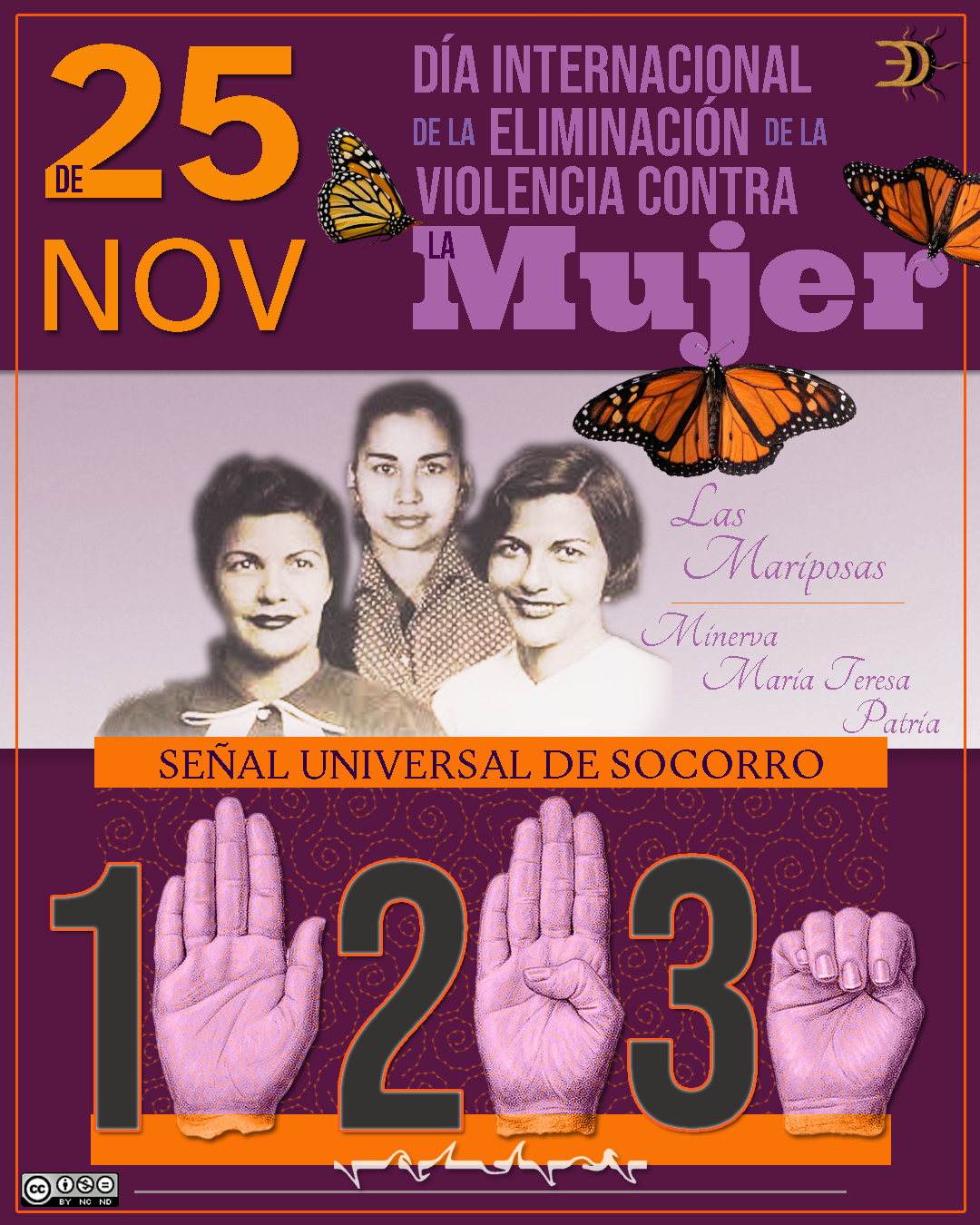
Every November 25th, the Dominican Republic faces an unflinching mirror. It is not just another date on the calendar; it was born of pain, courage, and a historical debt. The world marks the International Day for the Elimination of Violence against Women in honor of three Dominican women—Patria, Minerva, and María Teresa Mirabal—murdered by the Trujillo dictatorship in 1960.
In 1999, the United Nations formalized that tribute, recognizing that the crime against “Las Mariposas” was political but also misogynistic—a universal warning about what happens when power claims ownership over women’s bodies and voices.
ESENDOM joins with a special 16-part series—one woman, one story, each day—to name, remember, and demand justice. From Mamá Tingó (Florinda Soriano Muñoz), the peasant leader murdered for defending land rights, to Lucrecia Pérez Matos, a Dominican migrant killed in Spain in a hate crime, and more recent cases that stirred consciences, such as Emely Peguero. These are not statistics; they are lives, families, and communities marked by femicides, assaults, impunity, and institutional neglect. Each installment rescues from oblivion a woman whose story demands justice.
To speak of November 25th is to speak of them—and of all women. The Mirabal sisters did not die only for opposing Trujillo; they died for daring to be free women in a country designed to obey a dictator. Remembering them is not just repeating their names—it is understanding what they represented and what they continue to represent for the country, the region, and the Dominican community abroad.
The Butterflies: When Dignity Organizes
The four Mirabal sisters grew up in Ojo de Agua, Salcedo, in a family shaped by education and social conscience. In an era when fear was the official language, their homes did not display the dictator’s portrait: a small but telling act. Each found her path to resistance. Minerva, the most political and radical, helped ignite the June 14th Movement with Manolo Tavárez Justo. María Teresa followed from the university and youthful conviction. Patria, less visible on the front lines, offered her home, her faith, and her life to the cause. Dedé, the sister who survived, did not join the underground movement but carried a near-biblical mission afterward: to preserve memory, raise the children of her murdered sisters, and turn the family home into a living museum and archive.
Minerva embodied a Dominican dream: a professional, brave, forthright woman. She rejected Trujillo’s sexual advances, and that “no” carried the weight of the State. Her university record was smeared, her law license blocked, her family harassed. She did not yield. In a country where the dictator believed he owned women, Minerva defended the revolutionary idea that a woman is not territory to be occupied. Here begins the deeper meaning of November 25: it is not only about physical violence; violence is any structure that reduces a woman to obedience, silence, or a trophy.
The Crime that Changed History
On November 25, 1960, the three sisters—along with their driver Rufino de la Cruz—were returning from visiting their imprisoned husbands. The dictatorship intercepted them on the highway, beat them, strangled them, and left their bodies inside their jeep, pushed down a mountain to stage an accident. The message was clear: this is how a woman ends when she steps out of line.
But Trujillo miscalculated. The crime had the opposite effect: outrage swelled at home and abroad, and six months later the dictator was executed. The Mirabal sisters shook the regime’s machismo and showed that fear is not invincible when dignity gets organized.
November 25 is not only remembrance; it is a turning point. It marks the day when the state’s patriarchal violence was laid bare to the world. Since then, the date has opened the “16 Days of Activism against Gender-Based Violence,” through December 10, Human Rights Day. The logic is blunt: without safe lives for women, there is no full democracy and no real human rights.
From History to the Streets: The Butterflies’ March
In today’s Dominican Republic, the Mirabals’ legacy returns to the streets every year. Mass marches in Santo Domingo—under the cry of #NiUnaMás—confirm that violence is not a scar of the past but an open wound.
Lorena Espinoza Peña has captured several marches via her lens, including the Imágenes de la Marcha de las Mariposas en contra de la violencia machista and Imágenes de la marcha en contra de la violencia machista en R. Dominicana. Signs demanding punishment for femicides, substantive equality, and reproductive rights are not “imported fads”; they are historical continuity. The Butterflies did not fight to become statues; they fought so that other women could live without fear.
If the 1960 crime was a crime of the State, then today’s femicides, systematic harassment, wage inequality, judicial impunity, and the culture of “that’s a private matter” are also forms of structural violence. November 25 forces us to name them in the plural: physical, sexual, psychological, economic, and symbolic violence. The United Nations is clear: any act that causes or may cause harm because of gender is violence and therefore a violation of human rights.
Beyond Heroines: A Genealogy of Struggle
Historian Elizabeth Manley offers a crucial warning: Dominican memory often reduces women’s history to lists of exceptional heroines. And while the Mirabals are a beacon, they were not an isolated miracle. They were part of broad networks of women’s activism: teachers, writers, workers, mothers, militants. From Salomé Ureña, Ercilia Pepín, Abigail Mejía, Petronila Angélica Gómez and her magazine Fémina, to the women of the resistance in the 1940s and 1950s, the struggle has been dense, contradictory, transnational, and persistent.
That matters because November 25 does not only demand justice for three martyrs; it demands recognition for all who held the country together while the country made them invisible. Manley also reminds us that class and race shaped who could organize. Today, gender violence hits hardest women who are migrants, Afro-descendant, poor, living with disabilities, or who belong to sexual and gender dissidence. Commemorating November 25 requires looking at those intersections, not just repeating slogans.
A Butterfly Abroad: Lucrecia Pérez Matos
This year, November 25 also speaks to another Dominican story marked by violence: Lucrecia Pérez Matos, murdered in Spain 33 years ago by a neo-Nazi gang. Her killing was not “only racist”; it was racist, xenophobic, and deeply misogynistic. Woman, Black, and poor—three reasons the far right believed it could erase her. Remembering her now broadens our map of what we mean by violence against women.
Lucrecia represents thousands of Dominican migrant women who leave in search of life and run into systems that precarize, stigmatize, or target them. Her legacy—like the Mirabal sisters—did not end in tragedy: it activated anti-racist movements, inspired artistic works, and strengthened support networks for domestic workers and immigrants in Spain. The violence women face knows no borders; neither should November 25.
What Still Holds True
November 25 is a tribute, but also a mandate. It tells us that memory without action is an empty museum. It reminds us that violence is not inevitable or “natural”; it is a policy, a culture, an economy of power that can be dismantled. Every time a Dominican woman speaks out against abuse, every time a community protects a survivor, every time a court sentences fairly, every time a man unlearns machismo, “The Butterflies” take flight again.
At ESENDOM, as we commemorate this date, we do more than remember the past: we assert a possible future. The Mirabals did not fight to be remembered one day a year. They fought so that no November 25 would ever again be born of a murder, but of a victory. And until that is true—in the Dominican Republic, across the globe, in any place where a woman fears the walk home—November 25 will remain a day of mourning and of struggle. A day to say, with Minerva’s same resolve: we are not afraid.
⸻⸻
Related
The Paradox of Paternalism—Interview with Elizabeth Manley
Imágenes de la Marcha de las Mariposas en contra de la violencia machista
Imágenes de la marcha en contra de la violencia machista en R. Dominicana
66 Years Later: Honoring the June 14 Movement, José Mesón, and the Dominican Fight for Freedom
Remembering the Heroes of the June 14th Movement: José Mesón & the Freedom Fighters
Dominican Republic’s Desaparecidos Are Not Forgotten
Trujillo’s Machinery of Terror
Trujillo’s Death was the Beginning of Dominican Spring
Dominicans Fought Trujillo's Regime From Day One
Lucrecia Pérez Matos: 33 Years After Her Murder
«Nombre Secreto: Mariposas», el documental acerca de Las Hermanas Mirabal
16 contra la violencia, memorias dominicanas: Minerva Mirabal
16 contra la violencia, memorias dominicanas: Patria Mirabal
16 contra la violencia, memorias dominicanas: María Teresa Mirabal
16 contra la violencia, memorias dominicanas: María Trinidad Sánchez
16 contra la violencia, memorias dominicanas: Yanelis Arias
16 contra la violencia, memorias dominicanas: Sagrario Ercira Díaz
16 contra la violencia, memorias dominicanas: Rosaura Almonte «Esperancita»
16 contra la violencia, memorias dominicanas: Paola Languasco
16 contra la violencia, memorias dominicanas: Yocairi Amarante
16 contra la violencia, memorias dominicanas: Gladys Ricart
16 contra la violencia, memorias dominicanas: «Mamá Tingó» Florinda Soriano
16 contra la violencia, memorias dominicanas: Andrea Evangelina Rodríguez Perozo
16 contra la violencia, memorias dominicanas: Lucrecia Pérez
16 contra la violencia, memorias dominicanas: Anibel González Ureña
16 contra la violencia, memorias dominicanas: Anacaona
16 contra la violencia, memorias dominicanas: Emely Peguero
10 de diciembre: cuando los derechos humanos tienen nombre de mujer