
By ESENDOM
November 13, 2025
Lean en español: Lucrecia Pérez Matos: 33 años después de su asesinato
This article is based on ESENDOM’s article,“Lucrecia Pérez Matos: A 25 años de su asesinato,” originally published in 2017. This new version includes updated information.
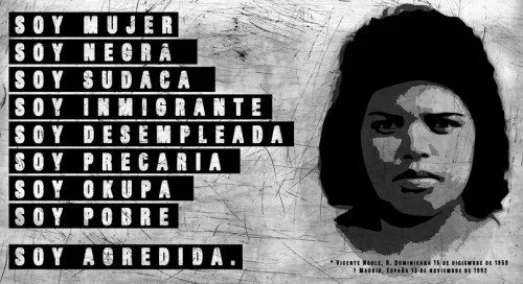
November 13, 2025 marks 33 years since the murder of Lucrecia Pérez Matos in Aravaca, Spain, at the hands of a neo-Nazi gang. The motive for the crime: her status as a foreign, Black, and poor woman.
Lucrecia had arrived in Spain in the early 1990s. Like many Latin American and Caribbean immigrant women, she left her homeland, the Dominican Republic, in search of better living conditions. In Iberian territory during those years, under the racist wave sweeping across Europe, Lucrecia encountered xenophobia and racism.
In Santo Domingo, Lucrecia’s murder generated new awareness about racism and African heritage. Debates were organized and new bibliographic contributions came to light, impacting an entire generation in their own way.
In Spain, commemorating the anniversary of the murder, anti-racist and anti-fascist organizations organize demonstrations rejecting all forms of racial discrimination and supporting immigrants. The Dominican Embassy has consistently honored her memory, holding significant tributes at the Unión General de Trabajadoras y Trabajadores (General Union of Workers) (UGT) headquarters in Madrid, including the 30th anniversary commemoration in 2022.
The Ongoing Struggle: Spain's Contradictions
Three decades after Lucrecia's death, Spain remains a country of contradictions. While the far-right anti-immigration party VOX has gained traction with its xenophobic rhetoric, there exists a robust anti-racist movement and a progressive government that maintains pro-immigrant policies. On the 29th anniversary of Lucrecia's murder in 2021, nearly a thousand people marched through central Madrid from Neptune to Sol Plaza, with diverse communities carrying colorful banners and flags, chanting "Madrid will be the tomb of racism!"
Dominican Women Leading the Fight
The legacy of Dominican women fighting for dignity in Spain extends beyond Lucrecia's memory. Rafaela Pimentel, who arrived in Madrid over thirty years ago, has become one of the most influential voices defending domestic workers' rights. Like Lucrecia, she came seeking better opportunities but found herself limited to domestic work - the only option available to Latin American immigrant women at the time.
In 2006, Pimentel founded Territorio Doméstico with domestic workers and feminists, creating the Jeanneth Beltrán Observatory in memory of an undocumented Nicaraguan worker who died in Spain due to a lack of medical attention. Her activism contributed to Spain's ratification of Convention No. 189 of the International Labour Organization (ILO), recognizing labor rights for domestic workers, though she continues fighting for recognition of work-related injuries and diseases that force them to "keep working with broken bodies."
Artists Remember Lucrecia
As a reaction to Lucrecia’s murder, in 1996 the Dominican rock group Toque Profundo expressed solidarity with the human drama suffered by immigrants with the song “Dios salve al viajero” (God Save the Traveler). The song, popularly known as “Viajero,” is one of the band’s most celebrated, led by Tony Almont.
In 1994, the late Andalusian poet and singer-songwriter Carlos Cano composed a moving song titled “Canción para Lucrecia,” and in 2000 the group Ska-P, in a different but equally supportive tone, remembered her with the song “Lucrecia.”
Black Spanish authors Francisco Zamora Lomboch, Rubén Bermúdez, Lucía Asué Mbomío Rubio, and Moha Gerehou have also referenced this hate crime in their respective works, with Zamora’s Como ser negro y no morir en Aravaca (How to Be Black and Not Die in Aravaca) published in 1994 as an early literary response. Lorgia García Peña has also referenced this murder in her scholarship (publications and presentations).
A Legacy in Memory and Media
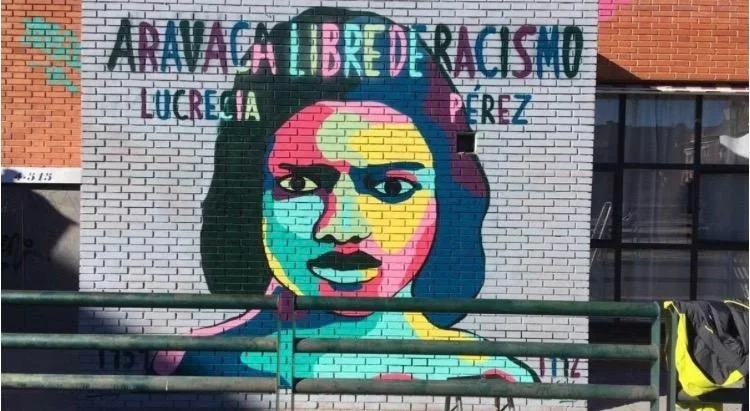
In Aravaca, the scene of the crime, a mural was painted in 2017 in remembrance of the victim, though it was controversially erased in 2022 by the Madrid City Council under Mayor José Luis Martínez-Almeida. However, neighborhood associations like Asociación Vecinal Osa Mayor and ACROLA continue to organize annual commemorations at the Plaza de Corona Boreal.
In 2024, Disney+ released a four-episode documentary series titled “Lucrecia: Un crimen de odio” (Lucrecia: A Murder in Hate), directed by David Cabrera and Garbiñe Armentia, which premiered on June 27, 2024, coinciding with the 30th anniversary of the trial. The series features archival footage and testimonies from Lucrecia’s family and friends, including her daughter Kenia, as well as police officers, investigating judges, journalists, and lawyers involved in the landmark case.
A book by Bernarda Jiménez, Lucrecia Pérez Matos: Una muerte anunciada y la primera inmigración laboral a España, has also documented this significant case in Spanish history.
A Daughter’s Perspective
Lucrecia left behind an orphaned daughter, Kenia Carvajal, who was just six years old at the time of her mother’s death. Kenia currently lives in Spain, seeking better living conditions like her mother once did. She has actively participated in memorial events, including speaking at the 29th anniversary commemoration in 2021. She has stated that the tragedy “has served to reduce racism.”
Lasting Impact
There is no doubt that Lucrecia’s murder impacted Spanish society profoundly. The perpetrators were caught and convicted, with civil guard Luis Merino Pérez receiving a 54-year sentence, and the case was judicially recognized as the first hate crime motivated by racism and xenophobia in democratic Spain.
Thirty-three years after the brutal act, her name has become a symbol of the fight against racism and the defense of immigrant rights. Her murder constitutes a fundamental turning point for conceptualizing both democratic Spain and its margins, particularly migrant populations whose attempted assimilation is countered with ultra-nationalist violence.
The legacy of Lucrecia Pérez Matos continues to resonate in contemporary Spain, serving as both a tragic reminder of the consequences of racism and xenophobia, and as an enduring inspiration for those fighting for a more just and inclusive society. Her story remains painfully relevant in an era of resurgent far-right movements across Europe, reminding us that the struggle against hate and discrimination requires constant vigilance and collective action.
⸻⸻
Related
Lucrecia Pérez Matos: A 25 años de su asesinato
The Borders of Dominicanidad—Interview with Lorgia Garcia Peña
Marcha en contra de la violencia machista en República Dominicana
Marcha de las Mariposas en contra de la violencia machista
Another March against Patriarchal Violence in the Dominican Republic
The Paradox of Paternalism—Interview with Elizabeth Manley
«Nombre Secreto: Mariposas», el documental acerca de Las Hermanas Mirabal