
By ESENDOM
August 7, 2026
Lea en español: 5 héroes de la Guerra de la Restauración que debes conocer: Benito Monción
Previous: Pedro Antonio Pimentel. Next: Gregorio Luperón
Unlike most countries, the Dominican Republic celebrates two moments of independence. The Dominican Restoration War of 1863–1865 represents one of the most heroic and defining episodes in the nation’s history. Following the controversial annexation to Spain proclaimed by Pedro Santana on March 18, 1861, the Dominican people confronted a renewed form of colonial domination that threatened their sovereignty and recently consolidated national identity.
On August 16, 1863, fourteen patriots crossed into Dominican territory from Ouanaminthe, Haiti, and raised the Dominican tricolor flag on Capotillo Hill. According to historical research and sources such as the Dominican Academy of History and the Compendio de la historia de Santo Domingo, the group’s core was led by Santiago Rodríguez, accompanied by Benito Monción and José Cabrera. Pedro Antonio Pimentel joined them at Capotillo for the raising of the flag.
What began as an uprising in the rural communities of the Cibao quickly developed into a national movement that united peasants, military veterans, and political leaders. During two years of intense fighting, legendary figures such as Gaspar Polanco, Gregorio Luperón, and José Antonio Salcedo led a resistance that sought not only to recover national independence, but also to reaffirm Dominican identity in the face of foreign powers.
The war reached its political conclusion on March 3, 1865, when Spain issued the royal decree repealing the annexation. It ended definitively with the evacuation of Spanish troops in July of that year, demonstrating to the world that the Dominican commitment to independence could not be broken.
At ESENDOM, we remember five of these heroes as we commemorate the 163rd anniversary of the Dominican Restoration War.
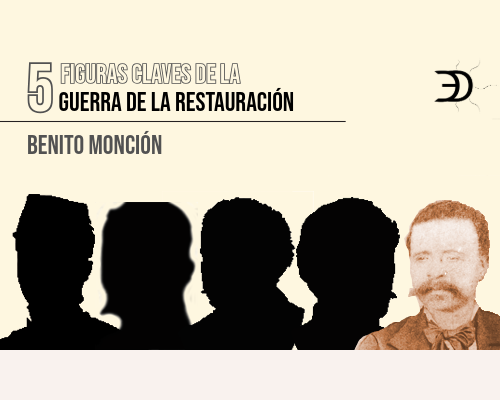
Benito Monción: The Eternal Sentinel of the Northwest
In the arid countryside of La Vega, where the rising sun illuminates extraordinary destinies, a child was born on March 29, 1826, who would become one of the most faithful guardians of Dominican freedom.
Benito Monción Durán, the son of José Monción and Sebastiana Durán, did not grow up amid the comforts of urban life. Instead, he was raised in the rugged environment of la línea noroeste (the Northwestern Line), the border region where each passing day added a quiet but crucial page to the history of the nation.
His childhood unfolded in La Visite, Dajabón, where the mountains whisper secrets between two nations and where the simple act of survival demands courage. In this land of contrasts, where patriotism required constant vigilance and loyalty was forged gradually through hardship, Monción developed the unbreakable resolve that would distinguish him throughout his life.
As a laborer on the lands of regional leader Santiago Rodríguez, he learned fundamental lessons that no military academy could teach: that true strength is born from honest work and that loyalty is the most valuable currency a man can offer.
The Baptism by Fire of a Natural Soldier
When the Dominican War of Independence erupted in 1844, the young Monción answered his country’s call with the instinctive understanding that certain historical moments require ordinary men to become heroes.
His baptism by fire came at the Battle of Beller in 1845, where his exceptional courage earned him promotion to sergeant in the grenadiers. There, amid the roar of artillery and the smoke of gunpowder, the true character of a leader was revealed—one who would never seek glory in political halls, but on the battlefields where the fate of nations is decided.
Monción’s rise through the military ranks was not the result of political influence or family connections. It came from the direct recognition of his courage and ability. He participated in the action at Escalante, where he attained the rank of second lieutenant, and by the decisive Battle of Sabana Larga in 1856, he wore the insignia of a captain. Each promotion represented more than recognition of his personal bravery. It also reflected the trust his commanders and fellow soldiers placed in a man whose word carried as much weight as his sword.
The Inextinguishable Flame of Resistance
The controversial annexation of the Dominican Republic to Spain in 1861 found Monción a mature patriot, hardened by battle and deeply conscious of the value of independence. His heart could not accept that, after so many sacrifices and victories, the Dominican flag would be lowered before the throne of a foreign power. On February 21, 1863, when Santiago Rodríguez led the insurrectionary movement in Guayubín, Monción was there, faithful to his convictions and prepared to risk everything for freedom.
Although the first uprising was suppressed by Spanish forces, the fire of resistance never died within him.
Temporarily exiled in Haiti, he used the period not to mourn defeat, but to plan a triumphant return. From Haitian territory, he relentlessly attacked Spanish forces, maintaining the momentum of the rebellion and demonstrating that a true patriot never accepts defeat as final.
Capotillo: The Moment That Defined a Life
On August 16, 1863, when the Cry of Capotillo echoed like a thunderclap of liberation through the Dominican mountains, Benito Monción was exactly where he needed to be: among the first to answer history’s call.
Alongside José Cabrera, Santiago Rodríguez, and Pedro Antonio Pimentel, he participated in the epic moment that marked the beginning of the Dominican Restoration War and permanently altered the destiny of the Dominican Republic.
The northwest, a region he knew as intimately as the palm of his hand, became his natural theater of operations.
From Guayubín to the banks of the Yaque River, his name inspired renewed confidence among Dominican patriots and justified fear among the Spanish invaders.
As military commander, he led the first resistance against the formidable Spanish general José de la Gándara after the latter landed at Monte Cristi in 1864. Monción demonstrated that knowledge of the terrain and patriotic determination could compensate for material disadvantages.
More Than a Soldier: The Borderland Strongman
The Dominican Restoration War did more than return sovereignty to the Dominican Republic. It also firmly established Monción as the undisputed leader of the northwestern region.
His authority in the Northwestern Line was unquestioned, built on solid foundations of respect earned in combat and loyalty demonstrated at critical moments.
His leadership style reflected his borderland formation: practical, direct, and deeply personal.
For Monción, command was not a privilege to be displayed, but a responsibility to be exercised through personal example. This philosophy earned him unwavering loyalty from his men and respect even from his political adversaries.
The Complexities of Political Leadership
Like many regional strongmen forged in the harsh environment of the borderlands, Monción’s later political career was shaped by the complicated realities of the nineteenth-century Dominican Republic.
He supported Pedro Antonio Pimentel in the overthrow of Gaspar Polanco, later rebelled against Pimentel while supporting José María Cabral, and eventually rose against Cabral as well.
These apparent contradictions, which some critics interpreted as political inconsistency, instead reflected the pragmatic outlook of a regional leader who sought to place his influence wherever he believed the frontier and the Republic could be strengthened.
In a country fragmented by decades of civil war and foreign intervention, political survival frequently required tactical alliances that transcended ideological purity.
The Final Service of a Patriot
In 1879, Monción was appointed governor of the maritime district of Monte Cristi, a position he exercised through the personal style of authority that had always characterized his leadership.
There, he built what his critics called a “political fiefdom,” but which in practice represented a form of authority based more on personal respect and administrative efficiency than on bureaucratic protocol.
On February 6, 1898, Benito Monción died in Guayubín, Monte Cristi.
With his death, the Northwestern Line lost a leader who for more than five decades had served as its most vigilant sentinel and its most prepared sword.
On June 24, 1972, by decree of President Joaquín Balaguer, his remains were transferred to the National Pantheon. The honor represented a belated but deserved recognition of the decisive role he played in defending Dominican independence.
The Eternal Legacy of a Borderland Soldier
Benito Monción was not a man of academic refinement or brilliant speeches.
His political contradictions and inclination toward regional strongman politics made him a complex and, at times, controversial figure. Yet he remained consistently authentic.
His record of military service—from the campaigns against Haiti to the final expulsion of Spain—establishes him as a patriot of action whose commitment to the nation was never in doubt.
In his native region, his honesty and courage were as widely recognized as his stern character. He did not kneel before danger or surrender to the temptations of comfort.
He knew how to live and die as a soldier of the frontier, with his eyes fixed on the land he defended and his ears alert to every sign of a threat against national sovereignty.
Benito Monción represents the essence of the Dominican patriot: a man who placed love of country above every personal consideration, who regarded military service not as a profession but as a vocation, and who understood that true glory does not reside in moral perfection, but in the unwavering consistency with which one serves the nation’s most sacred ideals.
Related
5 Heroes of the Dominican Restoration War You Should Know: Gregorio Luperón
5 Heroes of the Dominican Restoration War You Should Know: Santiago Rodríguez
5 Heroes of the Dominican Restoration War You Should Know: Gaspar Polanco
5 Heroes of the Dominican Restoration War You Should Know: Pedro Antonio Pimentel
5 Heroes of the Dominican Restoration War You Should Know: Benito Monción
5 héroes de la Guerra de la Restauración que debes conocer: Gregorio Luperón
5 héroes de la Guerra de la Restauración que debes conocer: Santiago Rodríguez
5 héroes de la Guerra de la Restauración que debes conocer: Gaspar Polanco
5 héroes de la Guerra de la Restauración que debes conocer: Pedro Antonio Pimentel
5 héroes de la Guerra de la Restauración que debes conocer: Benito Monción