
By ESENDOM
August 5, 2026
Lea en español: 5 héroes de la Guerra de la Restauración que debes conocer: Gaspar Polanco
Previous: Santiago Rodríguez Next: Pedro Antonio Pimentel
Unlike most countries, the Dominican Republic celebrates two moments of independence. The Dominican Restoration War of 1863–1865 represents one of the most heroic and defining episodes in the nation’s history. Following the controversial annexation to Spain proclaimed by Pedro Santana on March 18, 1861, the Dominican people confronted a renewed form of colonial domination that threatened their sovereignty and recently consolidated national identity.
On August 16, 1863, fourteen patriots crossed into Dominican territory from Ouanaminthe, Haiti, and raised the Dominican tricolor flag on Capotillo Hill. According to historical research and sources such as the Dominican Academy of History and the Compendio de la historia de Santo Domingo, the group’s core was led by Santiago Rodríguez, accompanied by Benito Monción and José Cabrera. Pedro Antonio Pimentel joined them at Capotillo for the raising of the flag.
What began as an uprising in the rural communities of the Cibao quickly developed into a national movement that united peasants, military veterans, and political leaders. During two years of intense fighting, legendary figures such as Gaspar Polanco, Gregorio Luperón, and José Antonio Salcedo led a resistance that sought not only to recover national independence, but also to reaffirm Dominican identity in the face of foreign powers.
The war reached its political conclusion on March 3, 1865, when Spain issued the royal decree repealing the annexation. It ended definitively with the evacuation of Spanish troops in July of that year, demonstrating to the world that the Dominican commitment to independence could not be broken.
At ESENDOM, we remember five of these heroes as we commemorate the 163rd anniversary of the Dominican Restoration War.
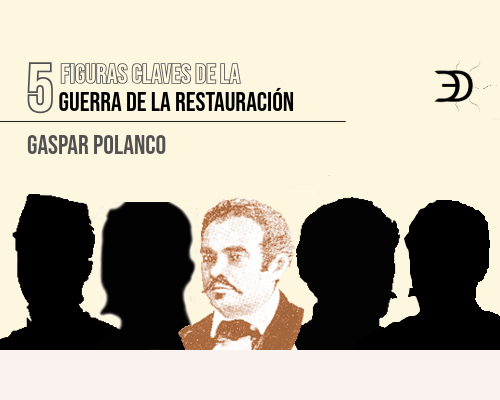
Gaspar Polanco: The First Sword Who Forged the Restorationist Victory
He could not read or write. He signed the decrees of his presidency with a cross. And for four months in 1863, he was the man on whom the fate of Dominican sovereignty turned.
Gaspar Polanco Borbón, the son of the prosperous Valentín Polanco and Martina de Borbón, grew up among cattle ranches and tobacco plantations. Through agricultural labor, he developed the practical abilities that he would later apply masterfully to the art of war.
His education did not come from academic halls or books on military strategy. Polanco learned to read the terrain before he learned to read words, to ride a horse before he learned to write his name, and to command men through the respect he earned in daily labor.
This practical formation proved to be ideal preparation for a leader who would confront one of the greatest military challenges in Dominican history.
The Polanco family was steeped in patriotism. His older brother, Juan Antonio, became a restorationist general; his sister Rita married Federico de Jesús García; and his niece Ana became the wife of future president Pedro Antonio Pimentel. Within this atmosphere of national commitment, Gaspar developed an early and profound awareness of his country’s destiny.
From the Independence of 1844 to the Dilemma of Annexation
The Dominican War of Independence in 1844 found Polanco ready to serve as a colonel in the Battle of Talanquera and the decisive Battle of March 30.
His troops, recruited from the rural communities of the Northwestern region (La Línea), distinguished themselves through their extraordinary mobility and intimate knowledge of the terrain. During the years that followed, Polanco established himself as one of the country’s most respected officers, fighting against Haitian incursions and attaining the rank of brigadier general in 1858.
The controversial annexation to Spain in 1861 placed Polanco in a difficult position. As a brigadier general and commander of the cavalry in La Línea, he initially supported the Spanish cause, influenced by Pedro Santana’s promises of stability.
When the reality of Spanish domination became apparent—with new taxes, foreign officials, and contempt for Dominican traditions—his patriotic conscience was decisively awakened.
The annexation to Spain in 1861 placed him on the wrong side of the story he is now remembered for. He remained a reserve officer in Spanish service. When anti-annexation uprisings broke out in Guayubín and neighboring towns in February 1863 — with his own brother Juan Antonio among the leaders — Polanco commanded the Creole troops that helped crush them. He was the man who captured Vidal Pichardo, executed by the Spanish days later.
Contemporaries suspected he was not a loyalist so much as a man waiting. One account from the period suggests he calculated that his brother's life could be saved by his own position, and that the conditions for a successful rising had not yet matured. Spanish officers of the moment recorded the same suspicion: that he was watching for his opportunity.
The Historic Moment: When the War Needed Its General
When the Dominican Restoration War erupted in August 1863, Gaspar Polanco occupied a unique position. He was the only surviving general from the independence campaigns of 1844 capable of bringing substantial military experience to the insurgent movement.
His decision to join the restorationists led by Pedro Antonio Pimentel, Juan Antonio Polanco, and Benito Monción represented a devastating blow to the Spanish authorities.
Within days, the movement’s regional commanders proclaimed him commander in chief. The appointment reflected not only his military experience, but also the nearly unanimous respect he inspired among restorationist leaders.
It marked the beginning of the most brilliant period of his military career and the moment when the Dominican Restoration War acquired the strategic leadership it required to prevail.
Santiago in Flames: The Strategy That Changed History
Polanco’s greatest moment of military glory came during the siege of Santiago in September 1863.
Confronted by the powerful San Luis Fortress, defended by well-equipped Spanish troops, Polanco made one of the most audacious decisions of the war: he ordered large sections of the city to be set on fire in order to deprive the enemy of shelter, cover, and resources.
Although painful for the local population, this scorched-earth tactic demonstrated his strategic brilliance.
Without adequate provisions or protection, Spanish forces were compelled to retreat. They were then harassed and systematically defeated at El Carril, El Limón, Gurabito, and Puerto Plata.
This sequence of victories definitively established Polanco as generalissimo and as a central figure in the restorationist struggle.
The historian and physician Alcides García Lluberes described him as “the first sword” of the war, while Juan Bosch recognized him as the Restoration’s true great military commander, emphasizing his tactical ability even above that of figures as respected as Gregorio Luperón.
The Burden of Power: A Presidency Between Glory and Controversy
On October 10, 1864, Polanco led a coup against restorationist president José Antonio “Pepillo” Salcedo, whom he accused of political hesitation and of attempting to negotiate with annexationist figures.
His brief presidency, which lasted from October 1864 to January 1865, sought to implement progressive economic and educational measures. His administration, however, was overshadowed by the controversial order to execute Salcedo at Maimón, Puerto Plata, on November 5, 1864.
Although other restorationist leaders approved the decision, it cast a lasting shadow of political intolerance over Polanco’s legacy.
His government also faced criticism for granting commercial privileges to associates connected to the tobacco trade. These decisions contributed to his removal from power in January 1865.
The End of a Legend
Following his fall from power, Polanco withdrew to his cattle properties, although he continued to participate in the turbulent politics of the Dominican Republic.
In 1867, while defending President José María Cabral during a confrontation in Sabaneta, Polanco was wounded in the foot. The wound became severely infected, and he died of tetanus in La Vega on November 28, 1867, in his late forties.
The Complex Legacy of a Military Genius
His remains rest in the National Pantheon, an honor reflecting the official recognition of his historical contributions.
The memory of Gaspar Polanco continues to occupy the complicated territory between admiration and controversy, military glory and ethical scrutiny.
For many historians, Polanco was the military architect who made the restorationist victory possible—the strategist whose tactical genius compensated for the material limitations of the Dominican army.
For others, he was a regional strongman whose personal ambition and extreme methods diminished achievements that might otherwise have been unquestioned.
What remains indisputable is that without Gaspar Polanco’s strategic genius, his personal courage at decisive moments, and his ability to transform peasants into effective soldiers, the history of the Dominican Republic’s definitive independence would have taken a very different course.
Gaspar Polanco Borbón remains in the national memory as “the first sword” of the Restoration—the general who demonstrated that courage, strategy, and love of country can defeat even the most powerful armies when they are united in the heart of a true leader.
[Tomorrow: Another name you will not want to miss.]
Related:
5 Heroes of the Dominican Restoration War You Should Know: Gregorio Luperón
5 Heroes of the Dominican Restoration War You Should Know: Santiago Rodríguez
5 Heroes of the Dominican Restoration War You Should Know: Gaspar Polanco
5 Heroes of the Dominican Restoration War You Should Know: Pedro Antonio Pimentel
5 Heroes of the Dominican Restoration War You Should Know: Benito Monción
5 héroes de la Guerra de la Restauración que debes conocer: Gregorio Luperón
5 héroes de la Guerra de la Restauración que debes conocer: Santiago Rodríguez
5 héroes de la Guerra de la Restauración que debes conocer: Gaspar Polanco
5 héroes de la Guerra de la Restauración que debes conocer: Pedro Antonio Pimentel
5 héroes de la Guerra de la Restauración que debes conocer: Benito Monción