
By ESENDOM
August 6, 2026
Lea en español: 5 héroes de la Guerra de la Restauración que debes conocer: Pedro Antonio Pimentel
Previous: Gaspar Polanco Next: Benito Monción
Unlike most countries, the Dominican Republic celebrates two moments of independence. The Dominican Restoration War of 1863–1865 represents one of the most heroic and defining episodes in the nation’s history. Following the controversial annexation to Spain proclaimed by Pedro Santana on March 18, 1861, the Dominican people confronted a renewed form of colonial domination that threatened their sovereignty and recently consolidated national identity.
On August 16, 1863, fourteen patriots crossed into Dominican territory from Ouanaminthe, Haiti, and raised the Dominican tricolor flag on Capotillo Hill. According to historical research and sources such as the Dominican Academy of History and the Compendio de la historia de Santo Domingo, the group’s core was led by Santiago Rodríguez, accompanied by Benito Monción and José Cabrera. Pedro Antonio Pimentel joined them at Capotillo for the raising of the flag.
What began as an uprising in the rural communities of the Cibao quickly developed into a national movement that united peasants, military veterans, and political leaders. During two years of intense fighting, legendary figures such as Gaspar Polanco, Gregorio Luperón, and José Antonio Salcedo led a resistance that sought not only to recover national independence, but also to reaffirm Dominican identity in the face of foreign powers.
The war reached its political conclusion on March 3, 1865, when Spain issued the royal decree repealing the annexation. It ended definitively with the evacuation of Spanish troops in July of that year, demonstrating to the world that the Dominican commitment to independence could not be broken.
At ESENDOM, we remember five of these heroes as we commemorate the 163rd anniversary of the Dominican Restoration War.
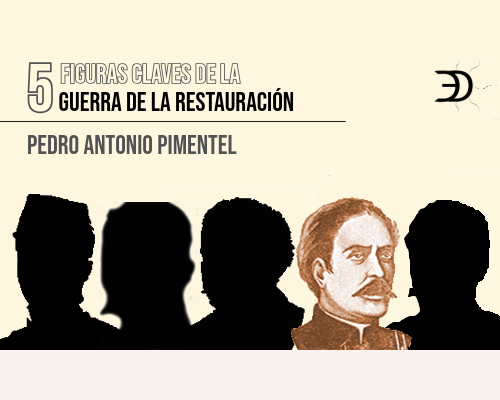
Pedro Antonio Pimentel: The Man Who Saved the Nation Three Times
Across the vast plains of Lozano, in the municipality of Castañuelas, Monte Cristi, where the wind carries stories of freedom and the horizon appears as limitless as the dream of independence, a man destined to write his name in gold in the annals of Dominican history was born in 1830.
Pedro Antonio Pimentel, the son of Jacinto Pimentel and Juana Chamorro, emerged from the cattle-ranching countryside to become one of the most consequential leaders of the Dominican Restoration War.
Gregorio Luperón, who understood the character of men forged in war, described him with almost poetic precision: “rebellious against discipline, ill-suited to the cabinet, but bold and farsighted in the Restoration War.”
The description captures the essence of a leader shaped more by the intensity of combat than by the halls of politics—a man whose greatness became most evident whenever his country needed him.
From Prosperous Rancher to Conspirator for Freedom
Before destiny called him into public life, Pimentel enjoyed a comfortable economic position as a prosperous cattle rancher in the Northwestern region. His lands provided stability, but the weight of history and his love of country proved stronger than personal considerations.
When Spain imposed its rule over Dominican territory, Pimentel understood that he could not remain a passive spectator.
In 1863, he actively participated in preparations for an uprising against the Spanish annexation. His involvement led to his imprisonment alongside Lucas Evangelista and other patriots.
His indomitable spirit, however, could not be contained. He escaped and sought refuge in Haiti, where he joined the restorationist movement with renewed determination following the historic Cry of Capotillo on August 16, 1863.
The Baptism by Fire of a Natural Leader
Pimentel experienced his baptism by fire while leading the audacious attack against the Spanish garrison at La Patilla on the day after the Capotillo uprising.
The operation demonstrated that Pimentel was not merely a patriot in words, but a man of action prepared to risk everything for his convictions.
Later, alongside Benito Monción, he participated in one of the most daring pursuits of the entire conflict: the harassment of Brigadier Manuel Buceta and his troops from Dajabón to Santiago.
The campaign revealed Pimentel’s tactical ability and his understanding that the Restoration War had to be fought through constant movement and relentless pressure.
The quality of his leadership was so evident that even his enemies recognized his exceptional qualities. Spanish captain Ramón González Tablas described him as a man of “blunt frankness and forceful determination” who “opposed any agreement that was not based on Spain’s abandonment of the island.”
Military Leader of the Restoration
During the war, Pimentel held several positions of significant responsibility. He served as commander in chief of the Eastern forces, chief operations delegate in the Northwestern Line, governor of Santiago in February 1864, minister of war, and representative for Santiago in the restorationist National Assembly.
His signature on the Declaration of Independence of September 14, 1863, was more than a ceremonial act. It represented his commitment to a principle he would defend until the end of his life: the uncompromising protection of Dominican sovereignty against every foreign power.
President During a Decisive Moment
On March 25, 1865, as the Dominican Restoration War entered its final phase, the National Convention assembled in Santiago elected Pimentel constitutional president of the Republic.
His election came at a critical moment. The country required a leader with sufficient determination to ensure that the military victory would result in a complete political triumph.
His resolve became evident when he rejected the Pact of El Carmelo, which contained provisions he considered humiliating to Dominican sovereignty. The decision demonstrated that Pimentel placed national dignity above political convenience.
During his administration, which he exercised with energy and authority, he did not hesitate to make difficult decisions. These included establishing a court-martial to try former president Gaspar Polanco.
His direct and centralizing leadership style, however, generated tensions with other restorationist leaders.
On August 13, 1865, after learning that José María Cabral and Eusebio Manzueta were leading a coup attempt in Santo Domingo, Pimentel chose to resign. His decision demonstrated that his ultimate loyalty was to the stability of the Republic rather than to his personal hold on power.
A Three-Time Hero: A Life Dedicated to the Nation
Pedro Antonio Pimentel’s greatness extends beyond his role in the Dominican Restoration War.
His political biography makes him a unique figure in Dominican history: a man who defended national independence on three separate occasions at critical moments.
First, he participated in the original struggle for independence that culminated in the proclamation of the Dominican Republic in 1844.
Second, he became a fundamental leader of the Dominican Restoration War, which recovered the sovereignty lost during the Spanish annexation.
Third, during the Six Years’ War of 1868–1874, he once again took up arms against the government of Buenaventura Báez and its efforts to annex the Dominican Republic to the United States.
As a guerrilla fighter along the frontier during this final conflict, Pimentel once again defended the nation’s territorial and political integrity. He was wounded several times but remained firm in his conviction that the Dominican Republic had to preserve its independence.
The Eternal Legacy of an Uncompromising Patriot
Pedro Antonio Pimentel died in 1874, bringing to a close a life devoted entirely to the service of his country.
His legacy cannot be measured solely by the battles he won or the offices he held. It is found instead in the consistency of a life dedicated to one fundamental principle: that the Dominican Republic must remain free, sovereign, and independent.
His story is that of a man who understood that freedom is not a gift received only once, but an achievement that must be defended continuously.
Whenever the nation was threatened, Pedro Antonio Pimentel answered the call, demonstrating that some people are born to serve ideals greater than themselves.
Within Dominican national memory, Pimentel remains an exemplary model of the complete patriot: one who did not fight only when it was convenient, but devoted his entire existence to defending principles he considered sacred.
His life demonstrates that greatness is not measured by personal success, but by the willingness to sacrifice everything for the common good and the dignity of the nation.
Final Years and Legacy
Poor, ill, and marked by the wounds and exhaustion of a life spent in military campaigns, Pimentel died in Quartier-Morin, Haiti, in 1874.
His response to a friend who expressed sorrow over his circumstances summarized his spirit:
“For the nation, everything—even life itself, if necessary.”
Following his death, the Puerto Plata newspaper El Porvenir wrote: “He was honorable and courageous, and for that reason he died in poverty.”
More than an epitaph, the statement represents a moral judgment on a man who surrendered his fortune, health, and life for Dominican independence.
Today, although his name does not enjoy the same prominence as those of Gregorio Luperón, Santiago Rodríguez, or Gaspar Polanco, Pedro Antonio Pimentel represents the archetype of the uncompromising patriot.
He was a man who refused to negotiate away national dignity and who understood freedom as an absolute commitment. His life and work remain a reminder that sovereignty is defended through actions, not merely through words.
[Tomorrow: Another name you will not want to miss.]
Related:
5 Heroes of the Dominican Restoration War You Should Know: Gregorio Luperón
5 Heroes of the Dominican Restoration War You Should Know: Santiago Rodríguez
5 Heroes of the Dominican Restoration War You Should Know: Gaspar Polanco
5 Heroes of the Dominican Restoration War You Should Know: Pedro Antonio Pimentel
5 Heroes of the Dominican Restoration War You Should Know: Benito Monción
5 héroes de la Guerra de la Restauración que debes conocer: Gregorio Luperón
5 héroes de la Guerra de la Restauración que debes conocer: Santiago Rodríguez
5 héroes de la Guerra de la Restauración que debes conocer: Gaspar Polanco
5 héroes de la Guerra de la Restauración que debes conocer: Pedro Antonio Pimentel
5 héroes de la Guerra de la Restauración que debes conocer: Benito Monción