
By ESENDOM
August 4, 2026
Lea en español: 5 héroes de la Guerra de la Restauración que debes conocer: Santiago Rodríguez
Previous: Gregorio Luperón Next: Gaspar Polanco
Unlike most countries, the Dominican Republic celebrates two moments of independence. The Dominican Restoration War of 1863–1865 represents one of the most heroic and defining episodes in the nation’s history. Following the controversial annexation to Spain proclaimed by Pedro Santana on March 18, 1861, the Dominican people confronted a renewed form of colonial domination that threatened their sovereignty and recently consolidated national identity.
On August 16, 1863, fourteen patriots crossed into Dominican territory from Ouanaminthe, Haiti, and raised the Dominican tricolor flag on Capotillo Hill. According to historical research and sources such as the Dominican Academy of History and the Compendio de la historia de Santo Domingo, the group’s core was led by Santiago Rodríguez, accompanied by Benito Monción and José Cabrera. Pedro Antonio Pimentel joined them at Capotillo for the raising of the flag.
What began as an uprising in the rural communities of the Cibao quickly developed into a national movement that united peasants, military veterans, and political leaders. During two years of intense fighting, legendary figures such as Gaspar Polanco, Gregorio Luperón, and José Antonio Salcedo led a resistance that sought not only to recover national independence, but also to reaffirm Dominican identity in the face of foreign powers.
The war reached its political conclusion on March 3, 1865, when Spain issued the royal decree repealing the annexation. It ended definitively with the evacuation of Spanish troops in July of that year, demonstrating to the world that the Dominican commitment to independence could not be broken.
At ESENDOM, we remember five of these heroes as we commemorate the 163rd anniversary of the Dominican Restoration War.
Santiago Rodríguez: The Man Who Lit the Fuse at Capotillo
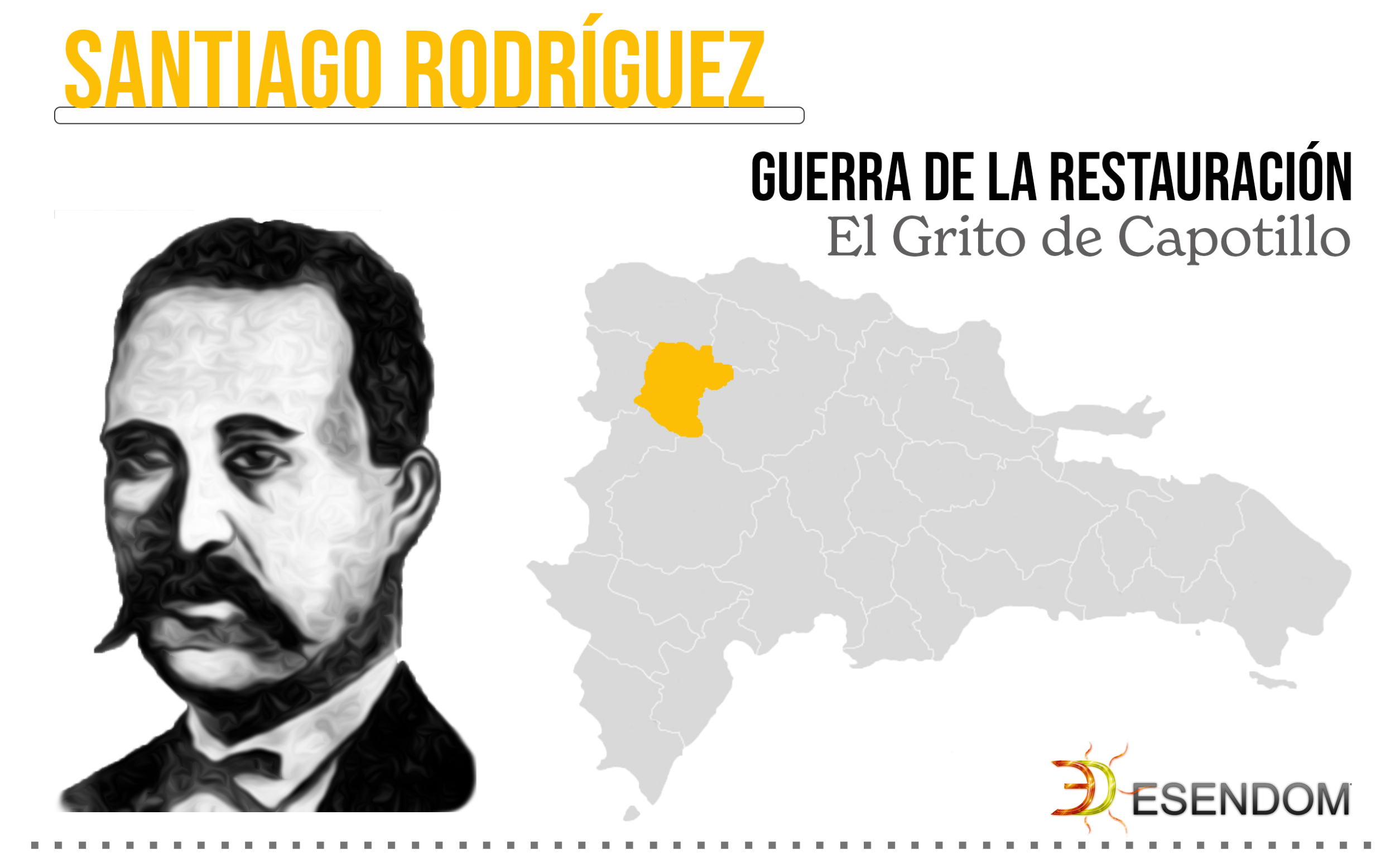
Santiago Rodríguez Masagó , commonly known as “Chago,” was born around 1809 and died in 1879. His life is embodied in a single verb: to begin.
A son of the borderlands and the tradition of transhumant cattle ranching, Rodríguez became a merchant and military leader out of necessity. His name would forever be associated with the Cry of Capotillo on August 16, 1863—the spark that ignited the Dominican Restoration War.
His precise birthplace remains disputed among historians. Some identify Cap-Haïtien or Fort-Liberté in Haiti, while others point to the area where Dajabón was later established. His biography, however, leaves little doubt about his historical identity: he was a powerful borderland leader whose networks, resources, and prestige allowed him to transform popular discontent into an organized insurrection.
The Roots of a Borderland Leader
Raised among cattle ranches and commercial routes connecting both sides of the island, Rodríguez knew every road, river, and community of the Northwestern Line.
This borderland region, where tobacco and coffee sustained networks of exchange that transcended political boundaries, became both his university and the training ground for the leadership he would exercise decades later.
His formation as a leader did not come from military academies or aristocratic salons. It emerged instead from cross-border commerce and transhumant cattle ranching.
These activities provided him with two resources essential to any revolutionary leader: economic capital generated by prosperous commercial exchange and invaluable social capital constructed through personal loyalties extending across the entire border region.
Following Dominican independence in 1844, the Central Governing Board recognized his regional leadership and commissioned him to help defend Dajabón and the national frontier.
From Supporter to Awakened Patriot
In 1861, Santiago Rodríguez served as the constitutional mayor of Sabaneta, a position that placed him at the center of one of the most controversial episodes in Dominican history: the annexation to Spain promoted by Pedro Santana.
Like many local notables of the period, Rodríguez signed declarations supporting the annexationist regime, persuaded in part by the economic promises Spain appeared to offer.
Reality, however, soon shattered those expectations.
New Spanish taxes suffocated local commerce, officials from the Iberian Peninsula displaced regional leaders, and abuses by the colonial administration multiplied. For a man accustomed to the dynamism of borderland commerce, these restrictions represented more than an economic obstacle. They constituted a direct attack on the way of life he had known since childhood.
Disappointment quickly became revolutionary fuel. Rodríguez came to understand that the promise of prosperity under Spanish rule had been an illusion and that the true wealth of his people rested in their freedom to determine their own destiny.
The Conspirator Who Wove the Network of Resistance
By early 1863, Santiago Rodríguez had organized coordinated uprisings in Guayubín and Sabaneta.
On February 21, his movement confronted repression by troops commanded by General José Hungría, forcing several leaders into exile or captivity. Rather than becoming discouraged by this initial defeat, Rodríguez demonstrated the tenacity characteristic of genuine leaders. He crossed into Haiti and meticulously rebuilt the conspiracy from exile.
On Haitian territory, alongside men such as Benito Monción, José Cabrera, and Pedro Antonio Pimentel, Rodríguez developed the strategy that would change Dominican history.
The plan was audacious in its simplicity: launch a rapid strike through Capotillo, raise the national flag, and advance immediately toward Santiago before the Spanish administration could respond effectively.
This conspiratorial phase revealed Rodríguez’s exceptional abilities as a political organizer.
More than an orator or a theoretician of revolution, he was a pragmatist who understood that successful revolutions require logistics, resources, and durable human networks. His intimate knowledge of the borderlands and his commercial connections became the foundations upon which the Dominican Restoration War would be built.
August 16: The Moment That Defined a Nation
At dawn on August 16, 1863, fourteen patriots crossed from Ouanaminthe toward Capotillo Hill.
As the architect of that historic moment, Santiago Rodríguez had coordinated every detail: escape routes, the supply of horses and provisions, and the local alliances that would guarantee immediate popular support.
When the Dominican flag was raised at Capotillo, it was not merely a symbolic gesture. It was the culmination of months of meticulous preparation.
The signal worked exactly as Rodríguez had anticipated. Spanish garrisons throughout the Northwestern Line began to retreat, while columns of peasants and military veterans spontaneously joined the liberation movement.
Rodríguez’s specific role during those critical days was that of strategic coordinator and expert on the terrain. Other leaders would later distinguish themselves in major battles or in the political direction of the movement. His singular contribution was to transform popular outrage into an organized and viable insurrection.
Beyond Capotillo: The Strengths and Shadows of a Complex Legacy
Like many protagonists of the Dominican Restoration War, Santiago Rodríguez’s later political trajectory reflects the contradictions and tensions of nineteenth-century Dominican history.
Following the restorationist victory, he was rewarded with military appointments and retained considerable influence in the border region. He also aligned himself with the political movement of Buenaventura Báez at decisive moments, even participating in the October 1867 rebellion against some of his former restorationist companions.
Viewed from a historical perspective, these decisions have generated debate among scholars.
Some interpret them as evidence that personal and regional loyalties carried more weight in Rodríguez’s political thinking than broader national projects. It is important, however, to understand that he operated in a context in which political survival frequently required pragmatic alliances that transcended ideological consistency.
The Eternal Legacy of the Initiator
Santiago Rodríguez died in Agua Clara, Sabaneta, in May 1879, but his legacy had already been firmly established in Dominican collective memory.
In 1948, the Dominican state honored his historical contribution by creating the province of Santiago Rodríguez, permanently inscribing his name into the national geography.
His historical importance transcends debates over the political choices he made after 1865.
Santiago Rodríguez embodies a fundamental principle behind every successful revolution: major historical transformations do not emerge from nothing. They arise from the convergence of local networks, material resources, and political will organized by visionary leaders.
If Gregorio Luperón represents mobile warfare and Gaspar Polanco represents military command at its peak, Santiago Rodríguez symbolizes something equally essential: the courage to disrupt the existing order and to take the first step when everything still appears impossible.
His action on August 16, 1863, demonstrated that sometimes all a nation needs in order to be reborn is for someone to possess the courage to ignite the first spark.
For that reason, every August 16, when the Dominican Republic commemorates the Cry of Capotillo, the name of Santiago Rodríguez resonates as that of the man who transformed a dream of freedom into the opening act of a revolution that restored dignity to his people.
[Tomorrow: Another name you will not want to miss.]
Related:
5 Heroes of the Dominican Restoration War You Should Know: Gregorio Luperón
5 Heroes of the Dominican Restoration War You Should Know: Santiago Rodríguez
5 Heroes of the Dominican Restoration War You Should Know: Gaspar Polanco
5 Heroes of the Dominican Restoration War You Should Know: Pedro Antonio Pimentel
5 Heroes of the Dominican Restoration War You Should Know: Benito Monción
5 héroes de la Guerra de la Restauración que debes conocer: Gregorio Luperón
5 héroes de la Guerra de la Restauración que debes conocer: Santiago Rodríguez
5 héroes de la Guerra de la Restauración que debes conocer: Gaspar Polanco
5 héroes de la Guerra de la Restauración que debes conocer: Pedro Antonio Pimentel
5 héroes de la Guerra de la Restauración que debes conocer: Benito Monción