
By Nelson Santana and Emmanuel Espinal
August 10, 2026
Lea en español: Top 20 dominicanos MLB por WAR: Miguel Tejada
Previous: Bartolo Colón Next: Cesar Cedeño
This article is part of a special ESENDOM series counting down, day by day, the 20 greatest Dominican baseball players of all time by WAR (Wins Above Replacement), the statistic that measures a player’s overall value to his team. NOTE: The list includes the WAR of baseball players up to the 2025 season, when the Spanish version of the series was published.
WAR (Wins Above Replacement) estimates how many additional wins a player contributes compared to a readily available Triple-A replacement who could fill the same roster spot. It has become the gold standard of modern baseball analysis because it combines every aspect of the game—offense, defense, baserunning, and pitching—into a single number, making it easier to distinguish players who truly change the outcome of games from those who simply occupy a roster spot.
The list includes players born in the Dominican Republic, such as Pedro Martínez and Juan Marichal, as well as United States-born players of Dominican heritage, including Alex Rodríguez and Moisés Alou. Through this series, we aim not only to revisit remarkable statistics but also to celebrate the cultural and athletic legacy these players have left on Major League Baseball and Dominican pride.
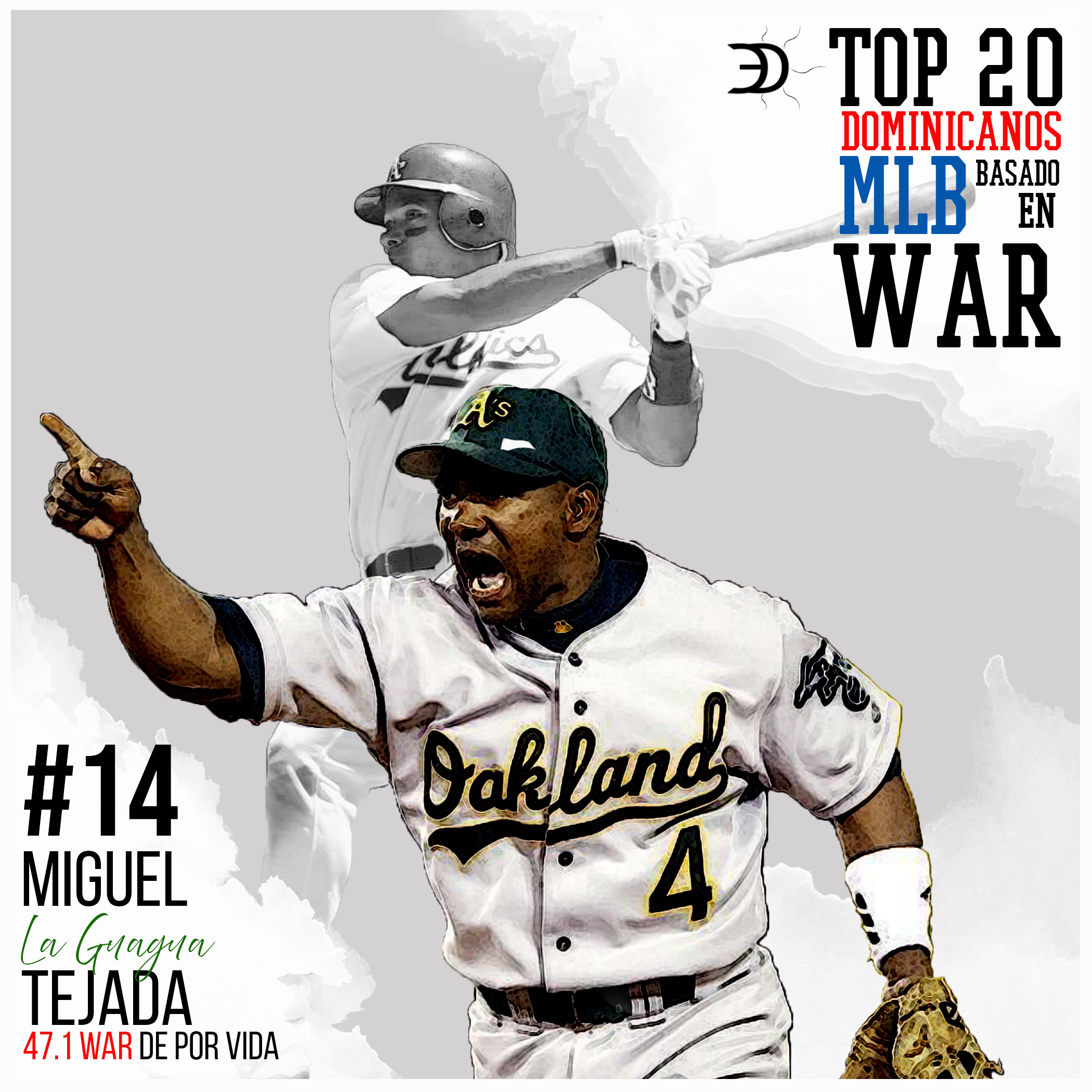
Miguel Tejada: “La Guagua” That Never Stopped Driving in Runs
Miguel Tejada was not just a shortstop—he was a living Caribbean institution. A kid from Baní who rose from the dusty fields of the Dominican Republic to win an MVP Award, collect more than 2,400 hits, and build an ironman reputation for showing up every day without asking for a break. “La Guagua” carried entire lineups in Oakland and Baltimore, and even today, at 50 years old, he remains involved in baseball as a manager in Mexico. Tejada is not some fortunate accident. This is pure Dominican baseball DNA.
Biography
Miguel Odalis Tejada was born on May 25, 1974, in Baní, a Dominican baseball hotbed in the southern part of the country. He grew up in extreme poverty, where baseball was not simply a recreational hobby—it was a way out.
As a kid, he watched Cal Ripken Jr. on a fuzzy television screen and saw more than a shortstop. He saw a model of unwavering endurance, rigorous discipline, and professional dignity. That example became permanently ingrained in him. Years later, Ripken would become his spiritual counterpart at the position, with Miguel emerging as an unmistakably Caribbean version of the Iron Man.
Oakland signed Tejada in 1993 as a raw prospect with unusual power for a traditional shortstop. He advanced quickly through an organization desperately searching for a new face of the franchise. He made his Major League debut with the Athletics on August 27, 1997, at just 23 years old.
He did not arrive as an immediate star—he batted just .202 in his first 26 games—but something different was already evident: relentless hunger, explosive strength in his swing, and absolutely no fear.
By 1998, Tejada was Oakland's unquestioned starting shortstop. By 2000, he was the beating heart of a young core that included Jason Giambi, Eric Chavez, and Tim Hudson. Oakland captured the American League West in 2000 and returned to October in 2001 and 2002. Tejada became a fundamental part of the offense: a timely home run, a clutch double, a hard line drive to left—whatever the moment demanded.
His coronation came in 2002. Tejada batted .308 with 34 home runs, delivered crucial hits during the Athletics' historic 20-game winning streak, and captured the ultimate individual prize: the American League Most Valuable Player Award. He stepped into the role vacated by Giambi without excuses or hesitation.
Then came the transformative contract.
In 2004, Tejada signed a six-year, $72 million contract with Baltimore, symbolically inheriting the position once occupied by his childhood idol, Cal Ripken Jr. In Baltimore, Tejada did not merely produce—he became a leader. In 2004, he drove in a staggering 150 runs, the most in Major League Baseball that season, and won his first Silver Slugger Award. In 2005, he was named All-Star Game MVP, all while continuing to play virtually every day without slowing down.
His career eventually took him to several other organizations, including Houston, San Diego, San Francisco, and Kansas City. His Major League career ended in 2013 after 16 seasons.
But one thing is essential to understanding Tejada: he never truly left the diamond.
He was not the type of retired legend who disappeared into a villa with a swimming pool. He remained active in Caribbean winter baseball, competitive baseball in Mexico, and demanding dugout roles. Today, he manages the Bravos de León in the Mexican League, still approaching the game with the intensity of a ballplayer rather than the detachment of a museum piece.
Statistics and Legacy
Miguel Tejada's official career numbers speak with authority: a .285 lifetime batting average, 2,407 hits, 307 home runs, 1,302 RBIs, and a .791 OPS across 2,171 games.
Those are elite offensive numbers for a shortstop.
Place them within the broader history of Dominican baseball and his stature grows even larger. Tejada accumulated 47.0 career WAR, placing him within an exclusive group of Dominican Major Leaguers. These were not simply players who reached the big leagues—they were players who defined eras.
Tejada was a six-time All-Star (2002, 2004–2006, 2008–2009). He won two consecutive Silver Slugger Awards (2004, 2005). He led all of Major League Baseball in RBIs in 2004. He was the 2002 American League MVP and the 2005 All-Star Game MVP.
He also won the 2004 Home Run Derby, blasting 27 home runs and breaking contemporary records in the competition.
In 2024, Tejada was inducted into the Athletics Hall of Fame, a direct acknowledgment from the franchise where he became “La Guagua”—the man who always brought everybody home.
But another statistic defines Tejada's personality more clearly than any slash line: 1,152 consecutive games played.
From Oakland to Baltimore, Tejada went more than seven years without voluntarily taking a day off. It remains one of the longest consecutive-games streaks in Major League history, placing him in rare company alongside ironmen such as Cal Ripken Jr. and Lou Gehrig.
That accomplishment elevated him from “Latin slugger” to a symbol of legendary endurance. In the Dominican Republic, that carries enormous cultural weight. In the neighborhoods, it becomes the kind of story that turns into folklore: that guy never breaks.
Tejada's career also contained unavoidable complications.
In 2009, he pleaded guilty to lying to Congress during an investigation involving performance-enhancing substances. In 2013, Major League Baseball suspended him for 105 games for amphetamine use, one of the longest drug-related suspensions in the sport at the time.
Those episodes are an undeniable part of his record, and they have affected how his career has been evaluated historically. His candidacy for Cooperstown disappeared quickly after he received less than one percent of the vote during his first year of eligibility, reflecting both the complicated voting politics surrounding baseball's steroid era and the lasting impact of those controversies on his résumé.
Even so, Tejada remains a towering cultural figure.
For Dominicans abroad, particularly in places such as Baltimore and Oakland, he represented something tangible: a powerful, proudly Dominican shortstop and vocal clubhouse leader who occupied one of baseball's most important positions.
For the island, he became living proof that Baní does not merely export baseball players—it produces leaders.
Conclusion
Miguel Tejada represents the enduring tradition of the Dominican ballplayer who never asks for permission.
He was “La Guagua” because he always seemed to bring everyone along with him: teammates, fans, and the pride of an entire country.
Yes, his career contained undeniable shadows. But it also produced more than 2,400 hits, an MVP Award, and an ironman streak that few players will ever replicate.
Today, as a manager in Mexico, Tejada remains aboard that same seemingly unstoppable bus.
And he never really seemed interested in getting off.
Related:
Top 20 Dominican MLB Players by WAR: George Bell
Top 20 Dominican MLB Players by WAR: Moisés Alou
Top 20 Dominican MLB Players by WAR: Nelson Cruz
Top 20 Dominican MLB Players by WAR: Felipe Alou
Top 20 Dominican MLB Players by WAR: Juan Soto
Top 20 Dominican MLB Players by WAR: Julio Franco
Top 20 Dominican MLB Players by WAR: Tony Fernández
Top 20 Dominican MLB Players by WAR: Bartolo Colón
Top 20 Dominican MLB Players by WAR: Miguel Tejada
Top 20 Dominican MLB Players by WAR: César Cedeño
Top 20 Dominican MLB Players by WAR: David Ortiz
Top 20 Dominican MLB Players by WAR: José Ramírez
Top 20 Dominican MLB Players by WAR: Sammy Sosa
Top 20 Dominican MLB Players by WAR: Vladimir Guerrero
Top 20 Dominican MLB Players by WAR: Manny Machado
Top 20 Dominican MLB Players by WAR: Juan Marichal
Top 20 Dominican MLB Players by WAR: Robinson Canó
Top 20 Dominican MLB Players by WAR: Manny Ramírez
Top 20 Dominican MLB Players by WAR: Pedro Martínez
Top 20 Dominican MLB Players by WAR: Adrián Beltré
Top 20 dominicanos MLB por WAR: George Bell
Top 20 dominicanos MLB por WAR: Moisés Alou
Top 20 dominicanos MLB por WAR: Nelson Cruz
Top 20 dominicanos MLB por WAR: Felipe Alou
Top 20 dominicanos MLB por WAR: Juan Soto
Top 20 dominicanos MLB por WAR: Julio Franco
Top 20 dominicanos MLB por WAR: Tony Fernández
Top 20 dominicanos MLB por WAR: Bartolo Colón
Top 20 dominicanos MLB por WAR: Miguel Tejada
Top 20 dominicanos MLB por WAR: César Cedeño
Top 20 dominicanos MLB por WAR: David Ortiz
Top 20 dominicanos MLB por WAR: José Ramírez
Top 20 dominicanos MLB por WAR: Sammy Sosa
Top 20 dominicanos MLB por WAR: Vladimir Guerrero
Top 20 dominicanos MLB por WAR: Manny Machado
Top 20 dominicanos MLB por WAR: Juan Marichal
Top 20 dominicanos MLB por WAR: Robinson Canó
Top 20 dominicanos MLB por WAR: Manny Ramírez
Top 20 dominicanos MLB por WAR: Pedro Martínez
Top 20 dominicanos MLB por WAR: Adrián Beltré