
By Nelson Santana and Emmanuel Espinal
August 17, 2026
Lea en español: Top 20 dominicanos MLB por WAR: Juan Marichal
Previous: Manny Machado Next: Robinson Canó
This article is part of a special ESENDOM series counting down, day by day, the 20 greatest Dominican baseball players of all time by WAR (Wins Above Replacement), the statistic that measures a player’s overall value to his team. NOTE: The list includes the WAR of baseball players up to the 2025 season, when the Spanish version of the series was published.
WAR (Wins Above Replacement) estimates how many additional wins a player contributes compared to a readily available Triple-A replacement who could fill the same roster spot. It has become the gold standard of modern baseball analysis because it combines every aspect of the game—offense, defense, baserunning, and pitching—into a single number, making it easier to distinguish players who truly change the outcome of games from those who simply occupy a roster spot.
The list includes players born in the Dominican Republic, such as Pedro Martínez and Juan Marichal, as well as United States-born players of Dominican heritage, including Alex Rodríguez and Moisés Alou. Through this series, we aim not only to revisit remarkable statistics but also to celebrate the cultural and athletic legacy these players have left on Major League Baseball and Dominican pride.
Juan Marichal: The “Dominican Dandy” Who Turned Pitching Into Art and Opened the Doors to Immortality
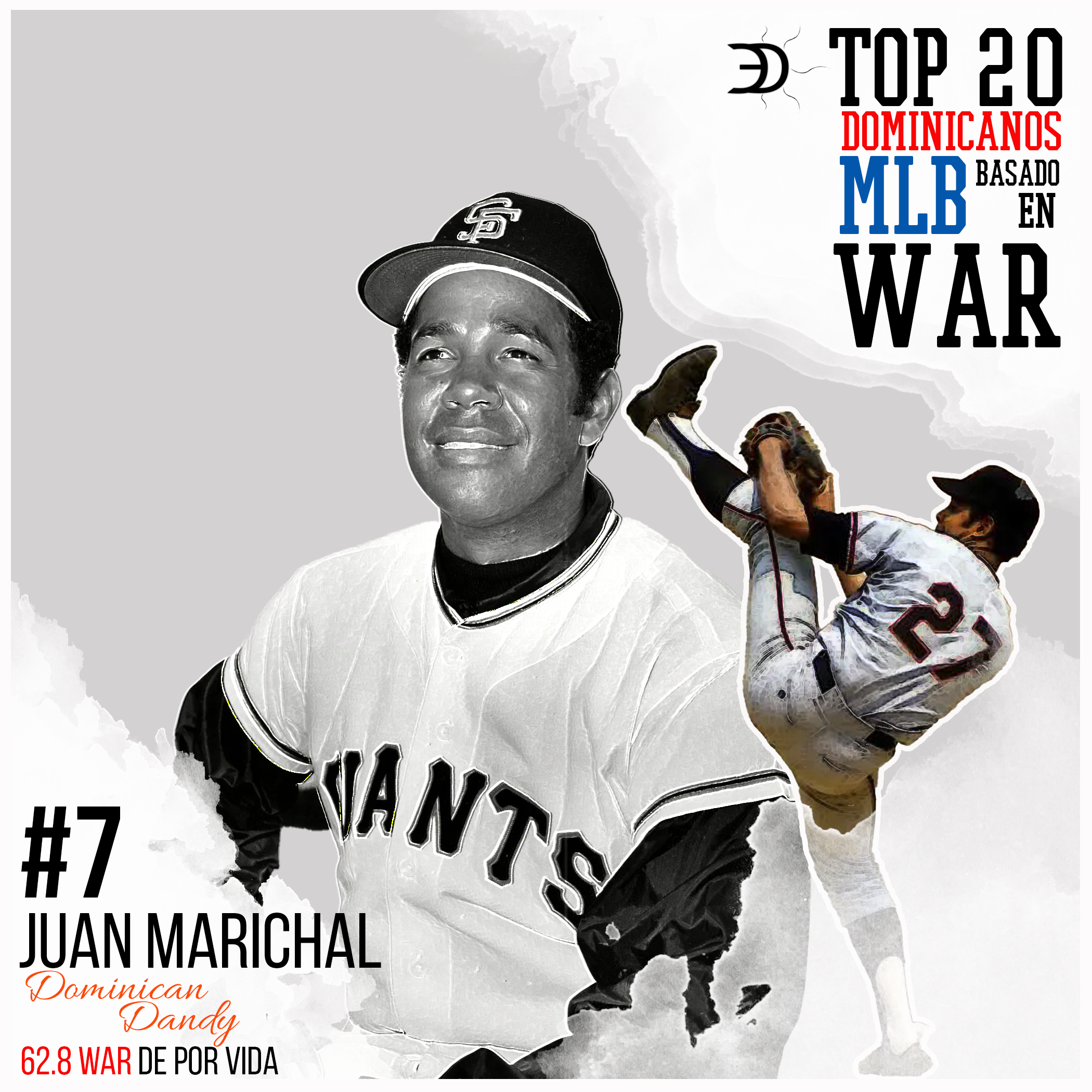
A glove, a mound, and a leg kick toward the sky immortalized his name forever. Juan Antonio Marichal Sánchez—the “Dominican Dandy”—did not merely dominate an entire decade; he redefined the aesthetics of baseball and, for decades, was unquestionably regarded as the greatest Dominican baseball player of all time.
With his iconic high leg kick, surgical command, and an arsenal delivered from seemingly impossible angles, Marichal recorded 191 victories during the 1960s, threw a no-hitter in 1963, and engaged Warren Spahn in an epic 16-inning pitching duel. In 1983, he broke the ultimate barrier by becoming the first Dominican inducted into the National Baseball Hall of Fame in Cooperstown, opening the doors to immortality for everyone who followed.
Biography
Juan Marichal was born on October 20, 1937, in Laguna Verde, Monte Cristi, Dominican Republic. The son of humble farmers, he grew up surrounded by horses, donkeys, and goats, without electricity but with an abundance of hard work and unwavering determination.
As a child, he spent hours along the banks of the Yaque del Norte. After suffering an illness that left him in a coma, he recovered with renewed strength. His brother Gonzalo taught him the fundamentals of baseball, and alongside friends who would later become legends—including the Alou brothers—Marichal learned to improvise: golf balls wrapped by the local shoemaker became baseballs, tree branches became bats, and old pieces of canvas became gloves.
From an early age, he dreamed of becoming a pitcher at a time when the idea of a Dominican succeeding in the Major Leagues still seemed almost impossible.
At 16, Marichal played in Monte Cristi and, inspired by pitcher Bombo Ramos, fully embraced pitching. Soon afterward, he was recruited to play for Aviación Dominicana (the Dominican Air Force) and attracted the attention of the San Francisco Giants, who signed him as an international free agent in 1957.
In the minor leagues, he won 21 games in 1958 and 18 in 1959, dominating with a precocious maturity that foreshadowed greatness. By 1960, he helped inaugurate Tacoma's Triple-A stadium before making the final leap to the Major Leagues.
His MLB debut on July 19, 1960, with the San Francisco Giants was both cinematic and prophetic: a one-hit complete game against Philadelphia with 12 strikeouts, producing a game score that still ranks among the finest Major League debuts ever.
In 1962, Marichal won 18 games and played a major role in helping San Francisco reach the World Series. What followed was a nearly unprecedented run of excellence: six seasons with at least 20 victories, a no-hitter against Houston on June 15, 1963, and the legendary 16-inning duel against Warren Spahn on July 2, 1963—two future Hall of Famers exchanging zeros until Willie Mays finally ended the game with a solo home run in the 16th inning.
Marichal's peak years came one after another. In 1965, he was named All-Star Game MVP; in 1966, he won 25 games with a remarkable 0.859 WHIP; and in 1968, he recorded 26 victories, a mark that remains the franchise record for the San Francisco era.
His dominance was so complete that in 1969, following the celebrated “Year of the Pitcher,” Marichal led the National League with a 2.10 ERA.
“In the dugout, when they wanted to remove him from the 16-inning duel, he remembered the age of his opponent, Spahn, and chose to keep going: pure Dominican warrior spirit.”
A fierce competitor, Marichal also experienced the controversy of August 22, 1965, involving Johnny Roseboro, a dark episode that he would later transform into a remarkable story of reconciliation. Roseboro himself eventually advocated for Marichal's induction into the Hall of Fame.
Following one final great season in 1971, Marichal concluded his career with brief stints in Boston in 1974 and with the Los Angeles Dodgers in 1975, retiring with the knowledge that he had changed the game forever.
Statistics, Legacy, and National Significance
The numbers are his permanent signature: a 243–142 record (.631 winning percentage), 2.89 ERA, 3,507.1 innings pitched, 244 complete games, 52 shutouts, 2,303 strikeouts, and an exceptional 1.101 WHIP.
His career WAR according to Baseball-Reference—62.9 overall and 61.9 as a pitcher—places him second among Dominican pitchers behind only Pedro Martínez, while also establishing him among the historical greats for his consistency and dominance within the context of his era.
Marichal led the National League in victories twice (1963 and 1968), in ERA in 1969, and in complete games and shutouts during multiple seasons. He was selected to 10 All-Star Games, and won the 1965 All-Star Game MVP Award after throwing three perfect innings to open the game.
He never won a Cy Young Award—at the height of his career, pitchers such as Sandy Koufax and Bob Gibson captured the award—but his sustained production remains the definition of a Cooperstown-caliber résumé.
The First Immortal Dominican
For decades, from the 1960s well into the 1990s, Juan Marichal was widely regarded as the greatest Dominican baseball player of all time.
That reputation was reinforced by his 1983 induction into the National Baseball Hall of Fame, when he became the first Dominican to receive baseball's highest honor.
That moment permanently transformed what it meant to be a Dominican baseball player. Before Marichal, Dominican players were often viewed as promising but secondary talents. After him, the door to greatness had been definitively opened.
His importance extended far beyond the diamond.
President Leonel Fernández appointed Marichal Minister of Sports and Physical Education of the Dominican Republic from 1996 to 2000, recognizing him not merely as a legendary athlete but as a cultural ambassador and national symbol.
In that role, Marichal worked to develop youth sports programs and improve the country's athletic infrastructure, understanding that sports could serve as an instrument of social transformation.
Deep Cultural Significance
For Dominicans everywhere—from the neighborhoods of Santo Domingo to the communities of New York, from Monte Cristi to Los Angeles—Marichal represents something deeper than statistics.
He is living proof that a boy from Laguna Verde, raised in a home without electricity, could stand before the greatest players in the world and dominate them with both elegance and ferocity.
His famous high leg kick—an almost vertical motion that concealed the delivery until the final instant—became a symbol of national identity, imitated on sandlots and in baseball academies throughout the Dominican Republic.
His No. 27 has been retired by the Giants, a statue of him stands at Oracle Park, and Estadio Quisqueya Juan Marichal in Santo Domingo proudly bears his name.
But his deepest legacy lives in the generations he inspired. Every Pedro Martínez, Bartolo Colón, and Luis Castillo who raises his leg high on the mound is, consciously or not, honoring the man who showed them that it was possible.
His reconciliation with Johnny Roseboro—who eventually became his friend and advocate after their infamous confrontation—transformed a dark moment into a lesson about character, humanity, and redemption. When Roseboro died in 2002, Marichal served as a pallbearer at his funeral, an image that says more about their reconciliation than any statistic ever could.
The Ultimate Pioneer
Marichal opened doors that once appeared sealed shut.
Before him, no Dominican had been seriously considered for Cooperstown. After him, the question changed from “Can a Dominican make it?” to “How many more will follow?”
His induction in 1983 wasn't merely a personal accomplishment—it was a national event. In the Dominican Republic, it became an unofficial day of celebration. Radio stations broadcast the ceremony live. Children in neighborhoods across the country understood that the dream was real.
In recognition of his contributions, the Dominican Professional Baseball League (LIDOM) dedicated its 2025–26 championship season to Don Juan Marichal.
As Minister of Sports, Marichal understood the historical responsibility he carried. He implemented programs that brought athletic equipment to rural communities, established structured youth leagues, and worked to prevent talent from being lost simply because opportunities were unavailable.
His vision was clear: baseball wasn't merely entertainment. It was national development, cultural identity, and a bridge to the wider world.
Conclusion
What made Juan Marichal unique?
It was the perfect combination of artistry and competitive edge. He changed arm angles, manipulated velocity with surgical precision, painted the corners, and transformed every pitch into a piece of Caribbean choreography.
During his legendary 16-inning duel, when the Giants considered removing him from the game, Marichal thought about the age of his opponent, Warren Spahn, and chose to keep pitching: pure Dominican warrior spirit.
But more than the victories, more than the strikeouts, and more than his iconic leg kick, Marichal gave Dominicans something invaluable: the absolute certainty that a Dominican could become the best in the world.
For decades, he stood as the Dominican Republic's only representative in Cooperstown, carrying that responsibility with unwavering dignity. He opened the door, paved the road, and demonstrated that the Caribbean doesn't merely play baseball—it makes baseball history.
Every time a Dominican enters Cooperstown, every time a Dominican pitcher dominates in October, and every time the Dominican flag flies inside a Major League stadium, the spirit of Juan Marichal is present.
He was the first, but he made sure he wouldn't be the last.
That is why, for generations of Dominicans, Juan Marichal isn't simply a Hall of Famer—he is the patriarch of Dominican baseball, the man who taught us that immortality could be reached from Laguna Verde.
Related:
Top 20 Dominican MLB Players by WAR: George Bell
Top 20 Dominican MLB Players by WAR: Moisés Alou
Top 20 Dominican MLB Players by WAR: Nelson Cruz
Top 20 Dominican MLB Players by WAR: Felipe Alou
Top 20 Dominican MLB Players by WAR: Juan Soto
Top 20 Dominican MLB Players by WAR: Julio Franco
Top 20 Dominican MLB Players by WAR: Tony Fernández
Top 20 Dominican MLB Players by WAR: Bartolo Colón
Top 20 Dominican MLB Players by WAR: Miguel Tejada
Top 20 Dominican MLB Players by WAR: César Cedeño
Top 20 Dominican MLB Players by WAR: David Ortiz
Top 20 Dominican MLB Players by WAR: José Ramírez
Top 20 Dominican MLB Players by WAR: Sammy Sosa
Top 20 Dominican MLB Players by WAR: Vladimir Guerrero
Top 20 Dominican MLB Players by WAR: Manny Machado
Top 20 Dominican MLB Players by WAR: Juan Marichal
Top 20 Dominican MLB Players by WAR: Robinson Canó
Top 20 Dominican MLB Players by WAR: Manny Ramírez
Top 20 Dominican MLB Players by WAR: Pedro Martínez
Top 20 Dominican MLB Players by WAR: Adrián Beltré
Top 20 dominicanos MLB por WAR: George Bell
Top 20 dominicanos MLB por WAR: Moisés Alou
Top 20 dominicanos MLB por WAR: Nelson Cruz
Top 20 dominicanos MLB por WAR: Felipe Alou
Top 20 dominicanos MLB por WAR: Juan Soto
Top 20 dominicanos MLB por WAR: Julio Franco
Top 20 dominicanos MLB por WAR: Tony Fernández
Top 20 dominicanos MLB por WAR: Bartolo Colón
Top 20 dominicanos MLB por WAR: Miguel Tejada
Top 20 dominicanos MLB por WAR: César Cedeño
Top 20 dominicanos MLB por WAR: David Ortiz
Top 20 dominicanos MLB por WAR: José Ramírez
Top 20 dominicanos MLB por WAR: Sammy Sosa
Top 20 dominicanos MLB por WAR: Vladimir Guerrero
Top 20 dominicanos MLB por WAR: Manny Machado
Top 20 dominicanos MLB por WAR: Juan Marichal
Top 20 dominicanos MLB por WAR: Robinson Canó
Top 20 dominicanos MLB por WAR: Manny Ramírez
Top 20 dominicanos MLB por WAR: Pedro Martínez
Top 20 dominicanos MLB por WAR: Adrián Beltré