
By Nelson Santana and Emmanuel Espinal
August 14, 2026
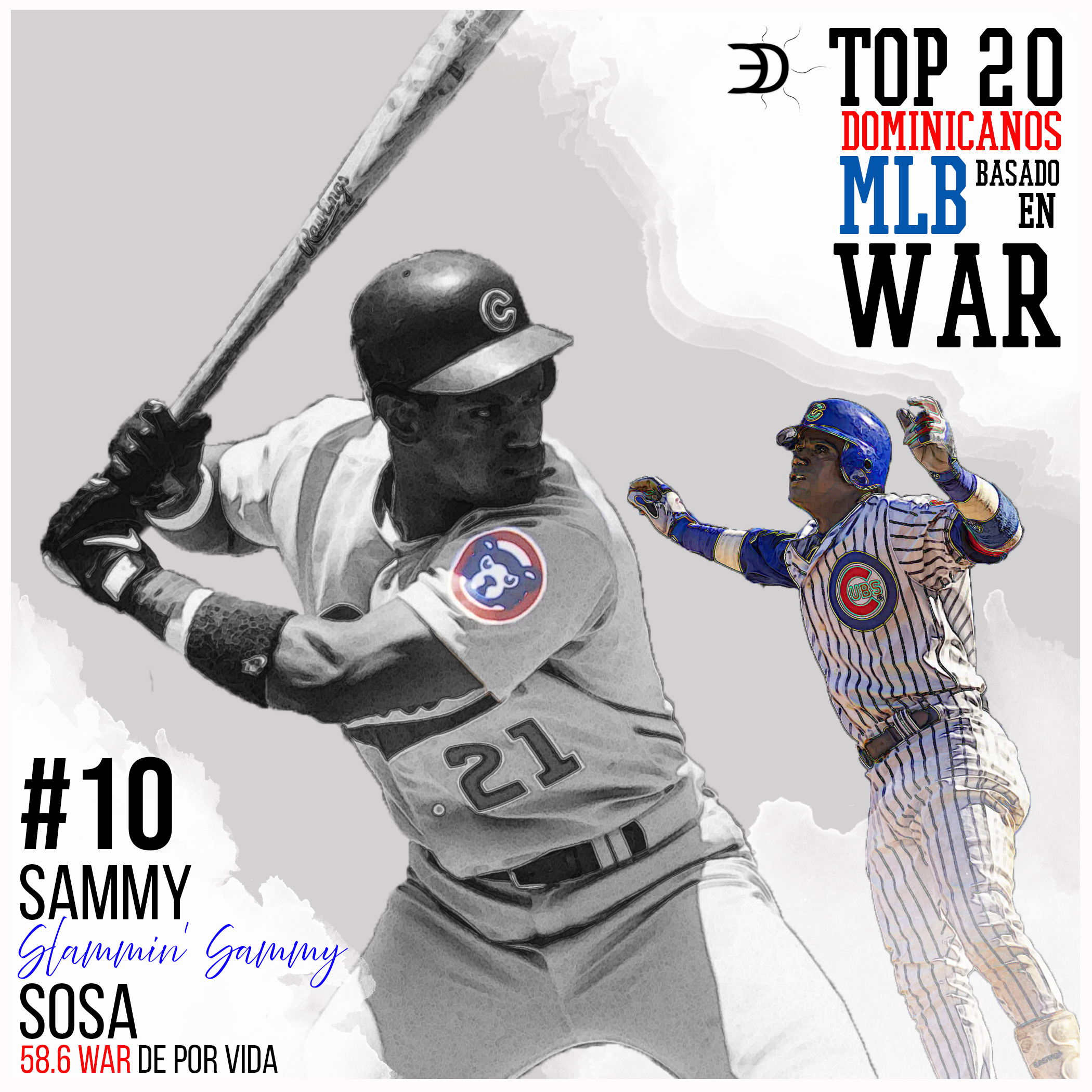
Lea en español: Top 20 dominicanos MLB por WAR: Sammy Sosa
Previous: José Ramírez Next: Vladimir Guerrero
This article is part of a special ESENDOM series counting down, day by day, the 20 greatest Dominican baseball players of all time by WAR (Wins Above Replacement), the statistic that measures a player’s overall value to his team. NOTE: The list includes the WAR of baseball players up to the 2025 season, when the Spanish version of the series was published.
WAR (Wins Above Replacement) estimates how many additional wins a player contributes compared to a readily available Triple-A replacement who could fill the same roster spot. It has become the gold standard of modern baseball analysis because it combines every aspect of the game—offense, defense, baserunning, and pitching—into a single number, making it easier to distinguish players who truly change the outcome of games from those who simply occupy a roster spot.
The list includes players born in the Dominican Republic, such as Pedro Martínez and Juan Marichal, as well as United States-born players of Dominican heritage, including Alex Rodríguez and Moisés Alou. Through this series, we aim not only to revisit remarkable statistics but also to celebrate the cultural and athletic legacy these players have left on Major League Baseball and Dominican pride.
Top 20 Dominican MLB Players by WAR: Sammy Sosa
Sammy Sosa: The Home Run King Who Turned Chicago Into a Dominican Island
Sammy Sosa was not just a power hitter—he was an unprecedented cultural phenomenon. A kid who emerged from a batey in the Dominican Republic and went on to hit a monumental 609 home runs in the Major Leagues, win the 1998 National League MVP Award, earn seven All-Star selections, and eventually receive Wrigley Field's lasting—if delayed—embrace. His historic home run chase against Mark McGwire in 1998 did not merely revive worldwide interest in baseball; it placed the Dominican flag at the center of the sporting spectacle.
Biography
Samuel Peralta Sosa was born on November 12, 1968, in Consuelo, a community surrounded by sugarcane bateyes in San Pedro de Macorís, Dominican Republic. His childhood was extremely difficult. After the early death of his father, Sosa helped support his family by washing cars and shining shoes.
For many Dominican ballplayers, baseball represents an abstract hope for a better future. For Sosa, it was literally his way out. Signed as a teenager by the Texas Rangers, Sosa quickly climbed through the minor leagues and made his Major League debut on June 16, 1989, starting in the Texas outfield. He hit his first Major League home run against none other than Roger Clemens.
That beginning—fierce, defiant, and fearless on the biggest stage—set the tone for everything that followed.
A few months later, Sosa was traded to the Chicago White Sox. Then, in 1992, he crossed town to the North Side. The Chicago Cubs had just acquired a raw talent without fully understanding what his name would eventually come to mean.
With the Cubs, Sosa stopped being merely a fast outfielder with a strong arm and occasional power. He transformed himself into a global icon.
In 1993, he hit 33 home runs and stole 36 bases, becoming the first player in franchise history to produce a 30-30 season. In 1995, he earned his first All-Star selection and won his first Silver Slugger Award. But what came next had no precedent.
1998 was the season.
As Mark McGwire pursued Roger Maris' single-season record of 61 home runs, Sosa emerged as the other half of baseball's greatest spectacle. In June alone, he blasted 20 home runs in a single month—a feat no other player in Major League history has matched.
He finished the season with 66 home runs, 158 RBIs, a .308 batting average, and a smile that became recognizable across an entire continent.
Sosa was voted National League Most Valuable Player and instantly became a cultural ambassador. He was invited to the U.S. Congress, celebrated in New York parades, embraced by crowds in Chicago, and elevated to legendary status in the Dominican Republic.
And there was more. Much more.
Sosa continued punishing pitchers with video-game consistency.
He hit 63 home runs in 1999. In 2000, he led the National League with 50. Then came perhaps the most complete season of his career in 2001: a .328 batting average, .437 on-base percentage, .737 slugging percentage, 64 home runs, 160 RBIs, and 146 runs scored.
Few players of that era combined raw power with overwhelming offensive production the way Sosa did.
Then, in 2002, he led the National League in home runs once again, this time with 49.
Although he never won a World Series and his departure from Chicago in 2004 was bitter—marked by injuries, internal conflict, and the infamous corked-bat suspension in 2003—his impact was already irreversible.
No player had transformed the Cubs into a worldwide attraction quite like Sammy Sosa. His trademark hop after a home run, the taps to his heart and chest as he acknowledged the crowd, and the Dominican flag waving throughout Wrigley Field became permanently etched into baseball memory.
Statistics and Legacy
From a purely statistical perspective, Sammy Sosa compiled a Cooperstown-caliber résumé.
He finished his career with 609 home runs, placing him in the exclusive 600-home run club alongside some of the greatest names in baseball history: Babe Ruth, Hank Aaron, Willie Mays, Alex Rodriguez, Barry Bonds, and Albert Pujols.
Of those 609 home runs, 545 came in a Cubs uniform.
Sosa also accumulated 2,408 hits, 1,667 RBIs, and a .273 career batting average. His 58.6 career WAR places him in the conversation among the most influential Dominican players ever to reach the Major Leagues, alongside figures such as Juan Marichal, Pedro Martínez, Adrián Beltré, Manny Ramírez, David Ortiz, Albert Pujols, and Alex Rodriguez.
Sosa was selected to seven All-Star Games (1995, 1998–2002, 2004), won six Silver Slugger Awards (1995, 1998–2002), received the Hank Aaron Award, and was named National League MVP in 1998.
He led the National League in home runs in 2000 and 2002, and in RBIs in 1998 and 2001.
To this day, Sosa remains the only player in Major League history to hit 60 or more home runs in three different seasons: 66 in 1998, 63 in 1999, and 64 in 2001.
Nobody else has done it.
Absolutely nobody.
But Sosa's greatness extends far beyond the raw numbers.
For the Dominican community—both on the island and throughout the diaspora—Sammy Sosa became a mirror.
He was a Black Caribbean ballplayer with a distinctive accent who spoke proudly and unapologetically about his country and waved the Dominican flag at the center of a sport whose history had traditionally been told through a very different voice.
At a time when Major League Baseball was still figuring out what “Latino marketing” even meant, Sosa became a global brand through the sheer force of his explosive personality.
The cultural history of modern baseball cannot be told without the 1998 home run chase.
That summer transformed baseball into an international spectacle again following the 1994 players' strike, which had left deep scars on the sport. For millions of young fans in Chicago, New York, Santo Domingo, and beyond, baseball became synonymous with Sammy Sosa.
Of course, his legacy also carries unavoidable complications.
Sosa's name became associated with baseball's steroid era, including reports of a positive test in 2003, as well as the corked-bat incident. During his career, he denied using banned performance-enhancing substances.
Years after retiring, however, Sosa publicly acknowledged having made “mistakes” in his efforts to remain on the field and maintain his strength throughout grueling 162-game seasons.
That ethical complexity has weighed heavily on the debate surrounding his candidacy for the National Baseball Hall of Fame in Cooperstown, where he never received more than 20 percent of the writers' vote.
Yet alongside the controversy remains genuine affection.
In 2025, after decades of distance and tension with the organization, the Chicago Cubs formally inducted Sosa into the franchise's Hall of Fame.
The organization, which had once maintained that a public apology was necessary before everyone could “turn the page,” ultimately recognized that Sosa was not merely a producer of home runs.
He was the emotional engine of an entire era.
Conclusion
Sammy Sosa always played as though he understood that millions of people were watching for reasons that extended far beyond the scoreboard.
For Dominican children, he proved that the dream was tangible.
For Chicago, he transformed a historically long-suffering team into a worldwide phenomenon.
For baseball, he became the spark that helped reignite the sport when it desperately needed one.
The statistics will live forever in the record books.
The legacy lives somewhere deeper: in every kid who taps his chest twice, looks toward the sky, and dreams of taking that perfect swing.
Related:
Top 20 Dominican MLB Players by WAR: George Bell
Top 20 Dominican MLB Players by WAR: Moisés Alou
Top 20 Dominican MLB Players by WAR: Nelson Cruz
Top 20 Dominican MLB Players by WAR: Felipe Alou
Top 20 Dominican MLB Players by WAR: Juan Soto
Top 20 Dominican MLB Players by WAR: Julio Franco
Top 20 Dominican MLB Players by WAR: Tony Fernández
Top 20 Dominican MLB Players by WAR: Bartolo Colón
Top 20 Dominican MLB Players by WAR: Miguel Tejada
Top 20 Dominican MLB Players by WAR: César Cedeño
Top 20 Dominican MLB Players by WAR: David Ortiz
Top 20 Dominican MLB Players by WAR: José Ramírez
Top 20 Dominican MLB Players by WAR: Sammy Sosa
Top 20 Dominican MLB Players by WAR: Vladimir Guerrero
Top 20 Dominican MLB Players by WAR: Manny Machado
Top 20 Dominican MLB Players by WAR: Juan Marichal
Top 20 Dominican MLB Players by WAR: Robinson Canó
Top 20 Dominican MLB Players by WAR: Manny Ramírez
Top 20 Dominican MLB Players by WAR: Pedro Martínez
Top 20 Dominican MLB Players by WAR: Adrián Beltré
Top 20 dominicanos MLB por WAR: George Bell
Top 20 dominicanos MLB por WAR: Moisés Alou
Top 20 dominicanos MLB por WAR: Nelson Cruz
Top 20 dominicanos MLB por WAR: Felipe Alou
Top 20 dominicanos MLB por WAR: Juan Soto
Top 20 dominicanos MLB por WAR: Julio Franco
Top 20 dominicanos MLB por WAR: Tony Fernández
Top 20 dominicanos MLB por WAR: Bartolo Colón
Top 20 dominicanos MLB por WAR: Miguel Tejada
Top 20 dominicanos MLB por WAR: César Cedeño
Top 20 dominicanos MLB por WAR: David Ortiz
Top 20 dominicanos MLB por WAR: José Ramírez
Top 20 dominicanos MLB por WAR: Sammy Sosa
Top 20 dominicanos MLB por WAR: Vladimir Guerrero
Top 20 dominicanos MLB por WAR: Manny Machado
Top 20 dominicanos MLB por WAR: Juan Marichal
Top 20 dominicanos MLB por WAR: Robinson Canó
Top 20 dominicanos MLB por WAR: Manny Ramírez
Top 20 dominicanos MLB por WAR: Pedro Martínez
Top 20 dominicanos MLB por WAR: Adrián Beltré