
By Emmanuel Espinal and Nelson Santana
August 12, 2026
Lea en español: Top 20 dominicanos MLB por WAR: David Ortiz
Previous: César Cedeño Next: José Ramírez
This article is part of a special ESENDOM series counting down, day by day, the 20 greatest Dominican baseball players of all time by WAR (Wins Above Replacement), the statistic that measures a player’s overall value to his team. NOTE: The list includes the WAR of baseball players up to the 2025 season, when the Spanish version of the series was published.
WAR (Wins Above Replacement) estimates how many additional wins a player contributes compared to a readily available Triple-A replacement who could fill the same roster spot. It has become the gold standard of modern baseball analysis because it combines every aspect of the game—offense, defense, baserunning, and pitching—into a single number, making it easier to distinguish players who truly change the outcome of games from those who simply occupy a roster spot.
The list includes players born in the Dominican Republic, such as Pedro Martínez and Juan Marichal, as well as United States-born players of Dominican heritage, including Alex Rodríguez and Moisés Alou. Through this series, we aim not only to revisit remarkable statistics but also to celebrate the cultural and athletic legacy these players have left on Major League Baseball and Dominican pride.
David Ortiz Was Not Just “Big Papi.” He Was the Voice, Power, and Heart of Two Islands
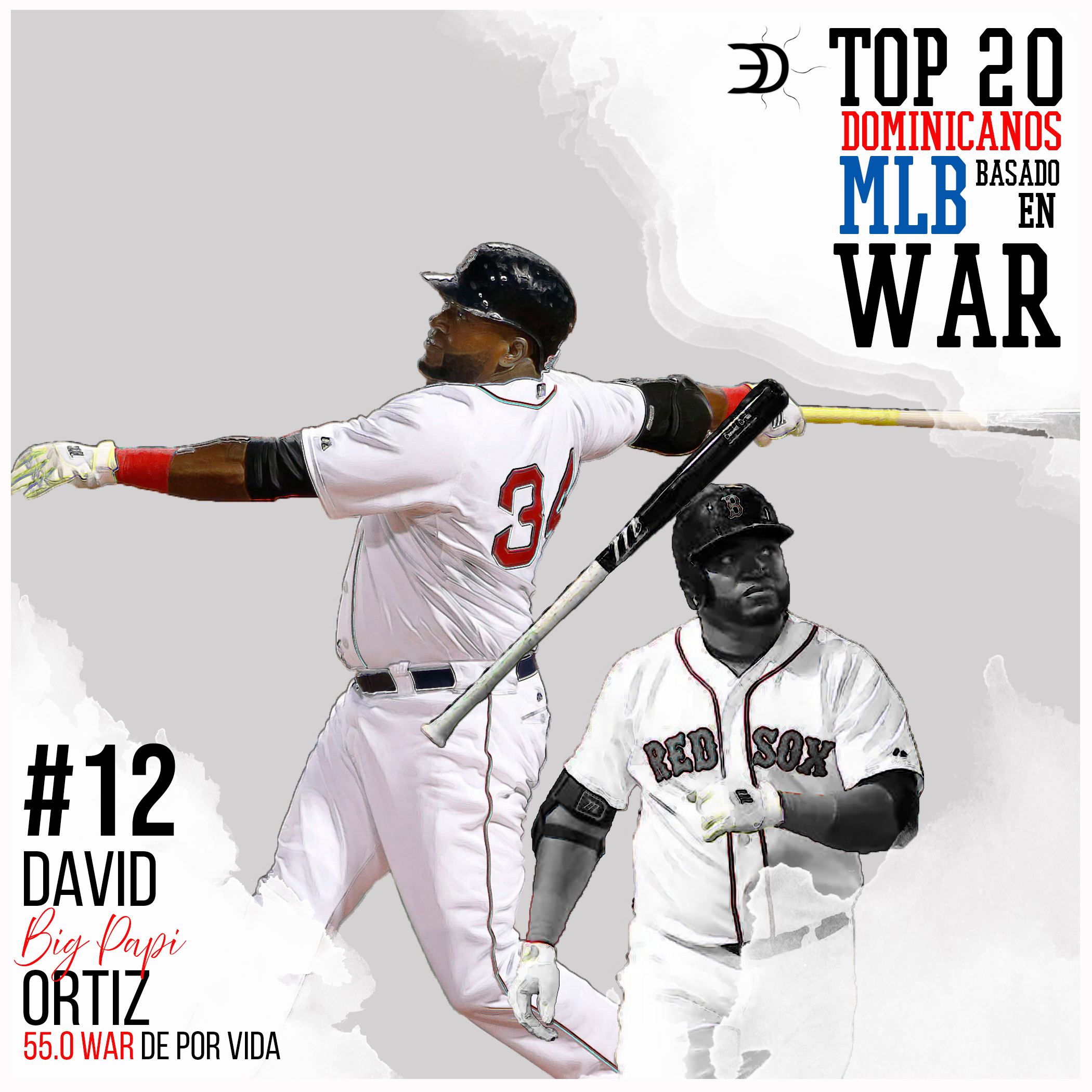
David Ortiz was the voice, power, and heart of two islands: the Caribbean island that gave him life and the red-brick island called Boston that adopted him forever. With 541 monumental home runs, three World Series championships, and one immortal phrase—“This is our fucking city”—the son of Santo Domingo didn't simply change the history of the Red Sox. He changed what it meant to be a Dominican player in Major League Baseball. Ortiz delivered when the world was watching, when Boston was grieving, and all the way through his final swing at age 40.
Biography
David Américo Ortiz Arias was born on November 18, 1975, in Santo Domingo, Dominican Republic, the eldest of four children of Enrique “Leo” Ortiz and Ángela Rosa Arias. He grew up watching the Martínez brothers—Ramón and especially Pedro—as Caribbean heroes on the mound, and from an early age understood that baseball could become a passport, a microphone, and a path toward a different future.
Tall and powerful, with quick hands and a smile that could light up an entire clubhouse, Ortiz began attracting attention as a teenager. Just 10 days after his 17th birthday, on November 28, 1992, he signed with the Seattle Mariners. They registered him as “David Arias,” the result of the familiar confusion surrounding Hispanic surnames, but his bat spoke clearly enough. He climbed through the organization by hitting for average, displaying natural power, and putting on home run shows that impressed established veterans.
In 1996, Seattle traded him to Minnesota as a player to be named later. There, now wearing his paternal surname—Ortiz—he began the difficult journey of a player who could clearly hit but whose organization never seemed entirely convinced of his future.
Ortiz debuted with the Minnesota Twins in 1997 and demonstrated his power, but he also battled wrist injuries, managers who questioned his defense at first base, and, as he later acknowledged, doubts about whether the organization truly viewed him as part of its future.
After the 2002 season, Minnesota released him in an effort to save money. That moment came during an especially painful period in Ortiz's life: his mother had passed away in an accident earlier that year. Yet his release ultimately became the turning point of his career.
Pedro Martínez picked up the phone. Boston listened.
The Red Sox signed Ortiz in January 2003, initially as something of a low-cost gamble. What followed became the history of a franchise, a city, and an entire nation of baseball fans.
In Boston, Ortiz became a starter, then a star, and eventually a living legend. He was a central figure in 2004, when the Red Sox finally broke their 86-year championship drought, thanks to a group of ballplayers who gelled well together, including the Dominican trio of Manny Ramírez, Pedro Martínez, and Ortíz.
Ortíz won another World Series in 2007 and led Boston to a third championship in 2013, by then an icon of the franchise.
That final championship came after the Boston Marathon bombing, when Ortiz took the microphone at Fenway Park and defended his adopted city with a raw declaration that became a rallying cry: “This is our fucking city.”
In 2022, Ortiz was inducted into the National Baseball Hall of Fame in Cooperstown in his first year on the ballot, providing the official seal on a career that had already achieved immortality.
Statistics and Legacy
Ortiz's numbers belong unquestionably to a superstar, but his legacy extends far beyond statistics. Across 20 Major League seasons from 1997 through 2016, Ortiz batted .286 with 2,472 hits, 632 doubles, 541 home runs, and 1,768 RBIs. His .931 career OPS reflects an exceptional combination of power and plate discipline.
According to Baseball-Reference, Ortiz accumulated 55.3 career WAR, placing him among the most valuable Dominican players of all time, in an elite group alongside Albert Pujols, Adrián Beltré, Manny Ramírez, and Vladimir Guerrero.
Ortiz spent most of his career as a designated hitter and still earned first-ballot induction into Cooperstown—something that, not long before his career, would have seemed almost unthinkable for a DH.
He was a 10-time All-Star, won seven Silver Slugger Awards and two Hank Aaron Awards as the American League's top offensive performer, and was named MVP of the 2013 World Series.
Ortiz led the American League in home runs with 54 in 2006, led the league in RBIs three times, and even led the league in slugging percentage during his final season—at age 40.
He collected three World Series rings: 2004, 2007, and 2013. But in October, his legend grew exponentially. Ortiz batted .289 with a .947 OPS across 85 postseason games, hitting 17 home runs and delivering the kind of clutch hits that left opposing teams slowly walking back toward their dugouts with their heads down.
In 2004, against the Yankees, he practically carried Boston through its historic comeback from a 3–0 deficit that had seemed like a death sentence. In 2013, against the Cardinals, he batted an astonishing .688 in the World Series, forcing St. Louis to treat him as though he had fire in his bat.
But reducing “Big Papi” to his swing means missing half the story.
Ortiz became a symbol of Dominican identity in New England. He brought the Dominican flag to Fenway, but he also helped humanize the Latino ballplayer for a city that, before Ortiz and Pedro Martínez, had not always understood—or embraced—Caribbean culture.
When he declared, “This is our fucking city” after the Marathon bombing, he wasn't speaking merely as a professional athlete. He was speaking as an adopted citizen—Ortiz became a U.S. citizen in 2008—a community leader, and the voice of a Latino population that could see itself reflected, perhaps for the first time, in the most beloved man in Boston.
For thousands of Dominicans, both on the island and throughout the diaspora, Ortiz demonstrated that a bat could break baseball curses—and cultural barriers as well.
Conclusion
The final image of David Ortiz isn't a swing. It is Ortiz standing in Fenway Park, his eyes filled with emotion as he saluted Boston following his final game in 2016, while a city that had once endured 86 years of baseball frustration celebrated him as an eternal hero.
He retired after leading the league in slugging percentage at age 40. He retired after hitting 38 home runs and driving in 127 runs in his final season, numbers better than many players produce in their prime. He retired knowing that Cooperstown was already waiting for him.
But what makes Ortiz unique isn't merely what he accomplished with a bat.
It is the image that followed so many of his trips across home plate: Ortiz looking toward the sky and pointing upward with both index fingers—a quiet reminder that all of this began with a kid from Santo Domingo who dreamed of honoring his mother and ultimately changed the history of the Boston Red Sox—and the place of Dominican pride in Major League Baseball.
Related:
Top 20 Dominican MLB Players by WAR: George Bell
Top 20 Dominican MLB Players by WAR: Moisés Alou
Top 20 Dominican MLB Players by WAR: Nelson Cruz
Top 20 Dominican MLB Players by WAR: Felipe Alou
Top 20 Dominican MLB Players by WAR: Juan Soto
Top 20 Dominican MLB Players by WAR: Julio Franco
Top 20 Dominican MLB Players by WAR: Tony Fernández
Top 20 Dominican MLB Players by WAR: Bartolo Colón
Top 20 Dominican MLB Players by WAR: Miguel Tejada
Top 20 Dominican MLB Players by WAR: César Cedeño
Top 20 Dominican MLB Players by WAR: David Ortiz
Top 20 Dominican MLB Players by WAR: José Ramírez
Top 20 Dominican MLB Players by WAR: Sammy Sosa
Top 20 Dominican MLB Players by WAR: Vladimir Guerrero
Top 20 Dominican MLB Players by WAR: Manny Machado
Top 20 Dominican MLB Players by WAR: Juan Marichal
Top 20 Dominican MLB Players by WAR: Robinson Canó
Top 20 Dominican MLB Players by WAR: Manny Ramírez
Top 20 Dominican MLB Players by WAR: Pedro Martínez
Top 20 Dominican MLB Players by WAR: Adrián Beltré
Top 20 dominicanos MLB por WAR: George Bell
Top 20 dominicanos MLB por WAR: Moisés Alou
Top 20 dominicanos MLB por WAR: Nelson Cruz
Top 20 dominicanos MLB por WAR: Felipe Alou
Top 20 dominicanos MLB por WAR: Juan Soto
Top 20 dominicanos MLB por WAR: Julio Franco
Top 20 dominicanos MLB por WAR: Tony Fernández
Top 20 dominicanos MLB por WAR: Bartolo Colón
Top 20 dominicanos MLB por WAR: Miguel Tejada
Top 20 dominicanos MLB por WAR: César Cedeño
Top 20 dominicanos MLB por WAR: David Ortiz
Top 20 dominicanos MLB por WAR: José Ramírez
Top 20 dominicanos MLB por WAR: Sammy Sosa
Top 20 dominicanos MLB por WAR: Vladimir Guerrero
Top 20 dominicanos MLB por WAR: Manny Machado
Top 20 dominicanos MLB por WAR: Juan Marichal
Top 20 dominicanos MLB por WAR: Robinson Canó
Top 20 dominicanos MLB por WAR: Manny Ramírez
Top 20 dominicanos MLB por WAR: Pedro Martínez
Top 20 dominicanos MLB por WAR: Adrián Beltré