
By Nelson Santana and Emmanuel Espinal
August 11, 2026
Lea en español: Top 20 dominicanos MLB por WAR: César Cedeño
Previous: Miguel Tejada Next: David Ortiz
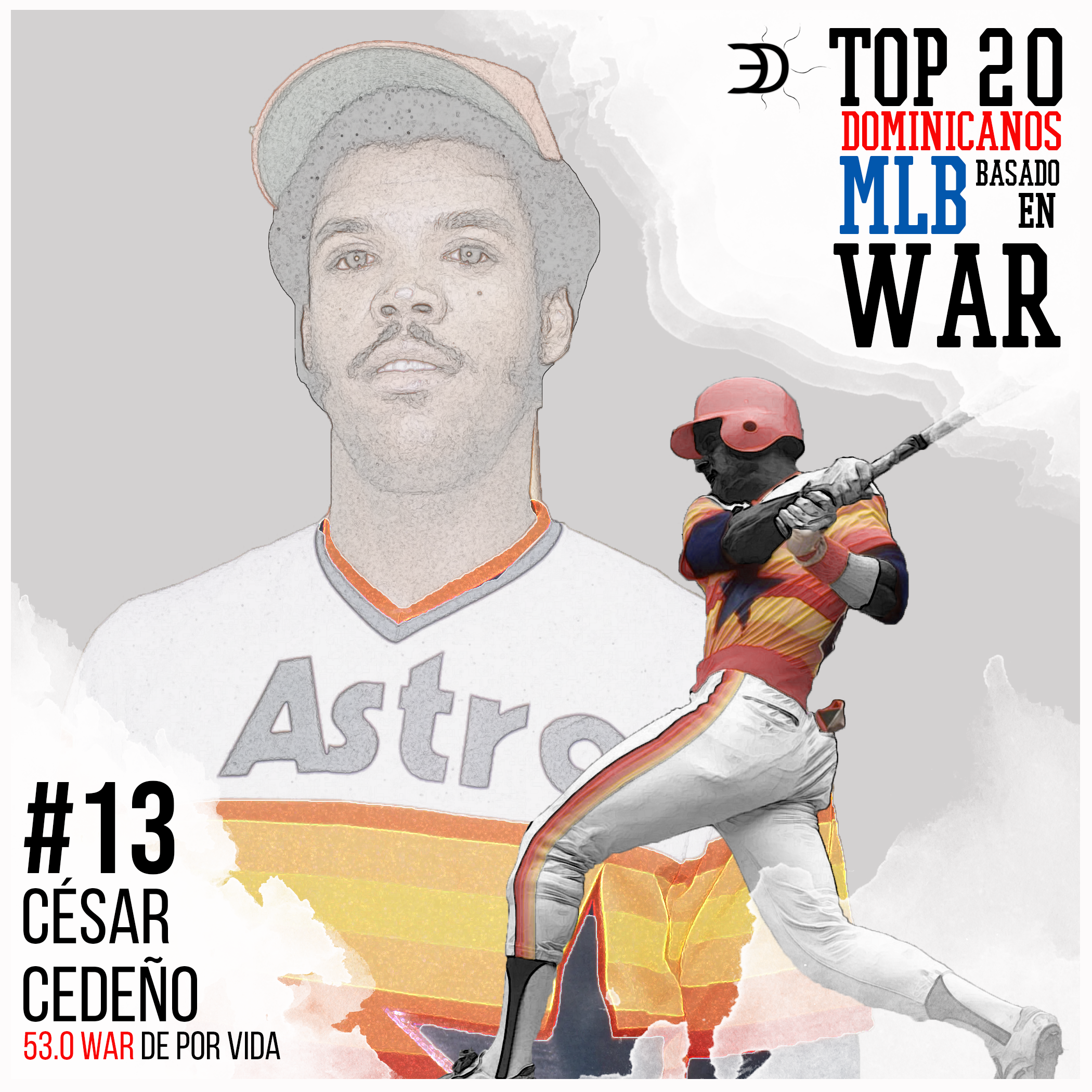
This article is part of a special ESENDOM series counting down, day by day, the 20 greatest Dominican baseball players of all time by WAR (Wins Above Replacement), the statistic that measures a player’s overall value to his team. NOTE: The list includes the WAR of baseball players up to the 2025 season, when the Spanish version of the series was published.
WAR (Wins Above Replacement) estimates how many additional wins a player contributes compared to a readily available Triple-A replacement who could fill the same roster spot. It has become the gold standard of modern baseball analysis because it combines every aspect of the game—offense, defense, baserunning, and pitching—into a single number, making it easier to distinguish players who truly change the outcome of games from those who simply occupy a roster spot.
The list includes players born in the Dominican Republic, such as Pedro Martínez and Juan Marichal, as well as United States-born players of Dominican heritage, including Alex Rodríguez and Moisés Alou. Through this series, we aim not only to revisit remarkable statistics but also to celebrate the cultural and athletic legacy these players have left on Major League Baseball and Dominican pride.
César Cedeño Was Not Fast. He Was Pure Electricity
Santo Domingo has produced plenty of historic bats, but in the 1970s, Houston introduced baseball to something different: a center fielder who seemed to play the game permanently in fast-forward. He consistently hit .300, stole 50 bases a year, fired laser-like strikes from center field, and swung the bat with legitimate power. Before the term “five-tool player” became commonplace in Latin American baseball circles, a Dominican was already doing everything at once: César Cedeño, electricity personified.
Biography
César Cedeño Encarnación was born on February 25, 1951, in Santo Domingo, Dominican Republic. He grew up during an era when Dominican talent was still fighting for basic respect, not merely lucrative contracts.
He signed with the Houston Astros as an amateur free agent in October 1967, when he was still a skinny 6-foot-2 teenager whose potential was far more developed than his frame. For Houston, he represented a calculated gamble. For Cedeño, it was the door to a different life.
He rose through the organization at remarkable speed.
Cedeño made his Major League debut on June 20, 1970, at just 19 years old. His first taste of the majors was anything but timid: he batted an impressive .310 and finished fourth in voting for National League Rookie of the Year.
From the beginning, the message was clear: this was not just another outfielder.
In 1971, Cedeño led the Major Leagues with 40 doubles. Then, in 1972, he exploded into superstardom. He batted a spectacular .320, hit 22 home runs, stole 55 bases, won his first Gold Glove Award as a center fielder, and earned an All-Star selection. At only 21 years old, he was already being compared directly to Willie Mays, a monumental comparison made by Houston manager Leo Durocher himself.
What made Cedeño truly remarkable was that this was not an isolated peak. From 1972 through 1974, Cedeño accomplished something no other player had done: hit at least 20 home runs and steal 50 bases in three consecutive seasons. It was a remarkable combination of power and speed.
The accolades continued. He won five consecutive Gold Gloves from 1972 through 1976, earned four All-Star selections, produced multiple .300 seasons, and routinely made spectacular defensive plays in center field at the legendary Astrodome.
In 1980, Houston finally experienced a historic breakthrough. With Cedeño as one of its central figures, the Astros captured their first National League West division title and reached the postseason for the first time in franchise history.
In 1985, now an experienced veteran, Cedeño was traded to the St. Louis Cardinals and helped propel the team to the World Series, where they ultimately fell to the Kansas City Royals. He never won a World Series ring, but he left his mark everywhere he played: with the Astros, Cincinnati Reds, Cardinals, and, briefly, the Los Angeles Dodgers.
After retiring in 1986, Cedeño remained involved in baseball as a hitting and fielding coach in the minor leagues and in Caribbean winter baseball. In 2020, Houston officially immortalized him with induction into the Astros Hall of Fame.
Statistics and Legacy
Cedeño's career numbers belong to an unquestionably elite player, not merely someone who was “good for his era.” Over 17 Major League seasons, Cedeño batted .285 with 2,087 hits, 436 doubles, 199 home runs, 976 RBIs, and 550 stolen bases. He finished with a career .790 OPS and a 123 OPS+, meaning his offensive production was 23 percent better than league average after adjusting for era and ballpark.
Defensively, he patrolled center field masterfully, finishing with a .985 fielding percentage in more than 1,400 games at the position.
According to Baseball-Reference, Cedeño accumulated 53.3 career WAR. That places him among the most valuable Dominican outfielders of all time and firmly within the historical conversation surrounding position players born in the Dominican Republic, a group that includes monumental names such as Albert Pujols, Robinson Canó, Sammy Sosa, and Adrián Beltré.
His collection of awards reinforces that standing. Cedeño was a four-time All-Star (1972–1974, 1976), won five consecutive Gold Gloves (1972–1976), and repeatedly received votes for National League Most Valuable Player, including a sixth-place finish in 1972 when he was only 21 years old.
He led the league in doubles in 1971 and 1972 and surpassed 50 stolen bases six times in seven seasons, including 55 steals in 1972. By 1976, before his 26th birthday, he had already accumulated more than 1,000 Major League hits.
That was a genuine Cooperstown pace. But Cedeño's legacy extends well beyond any box score.
For Houston, he became the franchise's first Latino superstar, the dynamic face of the Astros before Craig Biggio and Jeff Bagwell, and decades before José Altuve. More than four decades after his final at-bat with Houston, he remains the organization's all-time leader in stolen bases.
For the Dominican Republic, Cedeño offered living proof that Dominican players could do more than hit for power or throw blazing fastballs. A Dominican could also be the supreme athlete on the field—the most elegant defender and one of the most complete players in the league.
He was a Dominican patrolling center field with authentic swagger and seemingly superhuman range during the 1970s, when that kind of Latin American representation was still exceedingly rare.
His story also contains unavoidable complexity.
There were serious incidents away from the field, including the tragic 1973 case in which a woman died after a gun discharged in a room in the Dominican Republic. Cedeño was convicted of involuntary manslaughter and fined. The incident permanently affected his public image and his relationship with fans throughout the remainder of his career. That darker chapter, encompassing mistakes and tragedy, complicated the way his career was remembered and contributed to a Cooperstown Hall of Fame candidacy that never gained meaningful momentum.
In 2020, the Astros inducted Cedeño into their own Hall of Fame, formally recognizing an undeniable reality: the emergence of baseball pride in Houston cannot be fully understood without César Cedeño.
Conclusion
To talk about César Cedeño is to talk about natural potential operating at its highest level.
He possessed 30-30-caliber speed and power before the 30-30 combination became celebrated, a cinematic outfield arm, five Gold Gloves, and a bat capable of igniting rallies inside a stadium notorious for suppressing power.
He was the Dominican who helped establish Houston as a legitimate baseball city and became a prototype for the modern Latin American center fielder.
He may not have a plaque in Cooperstown, but he left behind an unmistakable blueprint.
And that blueprint speaks Spanish with a Dominican accent.
Related:
Top 20 Dominican MLB Players by WAR: George Bell
Top 20 Dominican MLB Players by WAR: Moisés Alou
Top 20 Dominican MLB Players by WAR: Nelson Cruz
Top 20 Dominican MLB Players by WAR: Felipe Alou
Top 20 Dominican MLB Players by WAR: Juan Soto
Top 20 Dominican MLB Players by WAR: Julio Franco
Top 20 Dominican MLB Players by WAR: Tony Fernández
Top 20 Dominican MLB Players by WAR: Bartolo Colón
Top 20 Dominican MLB Players by WAR: Miguel Tejada
Top 20 Dominican MLB Players by WAR: César Cedeño
Top 20 Dominican MLB Players by WAR: David Ortiz
Top 20 Dominican MLB Players by WAR: José Ramírez
Top 20 Dominican MLB Players by WAR: Sammy Sosa
Top 20 Dominican MLB Players by WAR: Vladimir Guerrero
Top 20 Dominican MLB Players by WAR: Manny Machado
Top 20 Dominican MLB Players by WAR: Juan Marichal
Top 20 Dominican MLB Players by WAR: Robinson Canó
Top 20 Dominican MLB Players by WAR: Manny Ramírez
Top 20 Dominican MLB Players by WAR: Pedro Martínez
Top 20 Dominican MLB Players by WAR: Adrián Beltré
Top 20 dominicanos MLB por WAR: George Bell
Top 20 dominicanos MLB por WAR: Moisés Alou
Top 20 dominicanos MLB por WAR: Nelson Cruz
Top 20 dominicanos MLB por WAR: Felipe Alou
Top 20 dominicanos MLB por WAR: Juan Soto
Top 20 dominicanos MLB por WAR: Julio Franco
Top 20 dominicanos MLB por WAR: Tony Fernández
Top 20 dominicanos MLB por WAR: Bartolo Colón
Top 20 dominicanos MLB por WAR: Miguel Tejada
Top 20 dominicanos MLB por WAR: César Cedeño
Top 20 dominicanos MLB por WAR: David Ortiz
Top 20 dominicanos MLB por WAR: José Ramírez
Top 20 dominicanos MLB por WAR: Sammy Sosa
Top 20 dominicanos MLB por WAR: Vladimir Guerrero
Top 20 dominicanos MLB por WAR: Manny Machado
Top 20 dominicanos MLB por WAR: Juan Marichal
Top 20 dominicanos MLB por WAR: Robinson Canó
Top 20 dominicanos MLB por WAR: Manny Ramírez
Top 20 dominicanos MLB por WAR: Pedro Martínez
Top 20 dominicanos MLB por WAR: Adrián Beltré