
By Emmanuel Espinal and Nelson Santana
August 18, 2026
Lea en español: Top 20 dominicanos MLB por WAR: Robinson Canó
Previous: Juan Marichal Next: Manny Ramírez
This article is part of a special ESENDOM series counting down, day by day, the 20 greatest Dominican baseball players of all time by WAR (Wins Above Replacement), the statistic that measures a player’s overall value to his team. NOTE: The list includes the WAR of baseball players up to the 2025 season, when the Spanish version of the series was published.
WAR (Wins Above Replacement) estimates how many additional wins a player contributes compared to a readily available Triple-A replacement who could fill the same roster spot. It has become the gold standard of modern baseball analysis because it combines every aspect of the game—offense, defense, baserunning, and pitching—into a single number, making it easier to distinguish players who truly change the outcome of games from those who simply occupy a roster spot.
The list includes players born in the Dominican Republic, such as Pedro Martínez and Juan Marichal, as well as United States-born players of Dominican heritage, including Alex Rodríguez and Moisés Alou. Through this series, we aim not only to revisit remarkable statistics but also to celebrate the cultural and athletic legacy these players have left on Major League Baseball and Dominican pride.
Robinson Canó: The Silky Swing That Ruled the Bronx and Now Reigns in Mexico
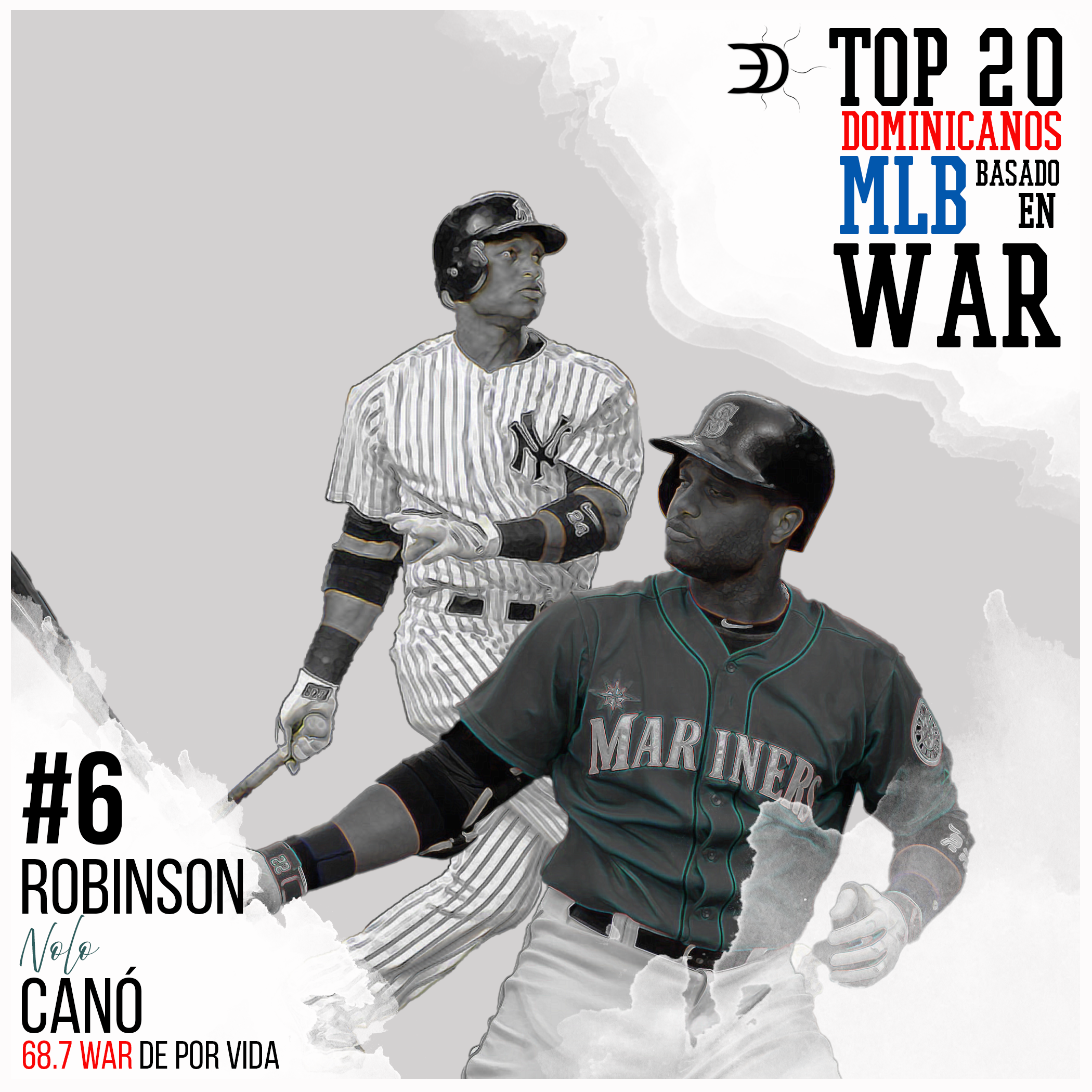
Forged in San Pedro de Macorís and named in honor of Jackie Robinson, Robinson Canó combined elegance and power like few others: a 2009 World Series champion with the Yankees, 2013 World Baseball Classic MVP, and eight-time All-Star. With a career .301 batting average, 2,639 hits, and 68.7 WAR, his second act with the Diablos Rojos del México confirms that his bat still commands respect across Caribbean baseball.
Biography
Robinson José Canó Mercedes was born on October 22, 1982, in San Pedro de Macorís, one of the Dominican Republic’s most prolific baseball hotbeds. The son of former pitcher José Canó—who reached the Major Leagues with Houston in 1989—he grew up between two countries: spending his childhood in the Dominican Republic and several formative years in Newark, New Jersey. After returning to San Pedro, he attended San Pedro Apóstol High School and eventually became a fixture in Dominican winter baseball with the Estrellas Orientales, a team he now captains. The name “Robinson” was no accident: it was a family tribute to Jackie Robinson that, over time, also became part of his competitive identity.
On January 5, 2001, Canó signed with the Yankees as an amateur free agent. His rise through the minor leagues was steady—including an appearance in the 2003 Futures Game—and his name even surfaced in trade rumors before he established himself as part of the Yankees’ future. He made his Major League debut on May 3, 2005, and quickly took control of second base in the Bronx. In 2006, he hit .342 and became an All-Star, making it clear that his compact, seemingly effortless left-handed swing would become his trademark.
Full validation arrived in 2009: 204 hits, a .320 batting average and, above all, a World Series ring, with Canó recording the final out against Shane Victorino. From 2010 through 2013, he enjoyed a Hall of Fame-caliber prime: four consecutive Silver Slugger Awards (2010–2013), two Gold Gloves (2010, 2012), 200-hit and 100-RBI seasons, and a third-place finish in the 2010 MVP voting.
At the end of 2013, he signed a 10-year, $240 million contract with Seattle, where he remained an elite player. He finished 2016 with 39 home runs and 103 RBIs, and in 2017 he was named All-Star Game MVP after hitting an extra-inning home run.
Canó returned to New York with the Mets following a 2018 trade. His 2019 season was inconsistent because of injuries, but in 2020 he posted his best OPS+ since leaving the Bronx. His career also includes significant blemishes: an 80-game suspension in 2018 for furosemide and a suspension for the entire 2021 season after testing positive for stanozolol. In 2022, he spent time with the Mets, Padres and Braves; that same year, his declining sprint speed reflected the approaching end of his MLB career.
Rather than fade away, Canó reinvented the final chapter of his playing career in Mexico. In 2024, he signed with the Diablos Rojos del México and hit an extraordinary .431/.475/.639 with 14 home runs and 77 RBIs in 78 games, winning the batting title, leading the league in hits and finishing the season as a Serie del Rey champion. He returned in 2025, helped lead the Diablos to an undefeated championship run in the Baseball Champions League Americas, and was named tournament MVP—all while maintaining his role as an emblematic figure for the Estrellas Orientales in LIDOM.
Statistics and Legacy
The numbers support the story: 68.7 WAR, a .301 career batting average, 2,639 hits, 335 home runs and 1,306 RBIs across 17 MLB seasons through 2022. Canó was an eight-time All-Star (2006, 2010–2014, 2016–2017), won five Silver Slugger Awards (2006, 2010–2013), two Gold Gloves (2010, 2012), and the 2011 Home Run Derby—with his father, José, pitching to him. He also won the 2017 All-Star Game MVP Award. During the 2010s, he accumulated 1,695 hits, more than any other Major League player, a statistic that illustrates his remarkable offensive consistency.
Internationally, his legacy is equally significant. Canó was a member of the undefeated Dominican Republic team that won the 2013 World Baseball Classic, and he was named tournament MVP. That placed him in a select group of players who can claim both a World Series championship and a WBC title. In Mexico, his 2024 batting championship and Serie del Rey crown, followed by the 2025 BCL Americas MVP award, have reinforced his continued competitiveness and leadership in demanding baseball environments.
Canó’s legacy has two dimensions: artistry and volume. The artistry was visible in that silky swing, his ability to use the inside part of the bat, and the seemingly effortless way he drove baseballs into the gaps. The volume is found in a statistical résumé that places him among the greatest Dominican players in baseball history.
Does his PED history damage his Cooperstown case? Yes. It is an unavoidable part of the discussion. Does it erase what he accomplished on the field for more than a decade? No. The technical and aesthetic quality of his hitting, along with the defensive excellence of his best seasons, remains undeniable.
Culturally, Canó embodies a binational identity naturally. He became a U.S. citizen in 2012 but never let go of the Dominican flag: a captain in San Pedro and a clubhouse leader wherever he has played. His philanthropy is also part of his résumé, including a pediatric rehabilitation unit bearing his name at Hackensack University Medical Center and a Montessori school established in his hometown in 2015.
His second spring in the Mexican League has also expanded the emotional geography of Dominican baseball fandom. Today, Robinson Canó’s hits draw attention to Mexico as another extension of the Caribbean baseball world.
Conclusion
Canó’s story transcends the stat sheet. It is living baseball memory: the final out of the 2009 World Series, the 2011 Home Run Derby with his father pitching to him, the MVP performance at the 2013 World Baseball Classic and, now, the image of a veteran captain still producing in Mexico while returning each winter to wear the green of the Estrellas Orientales.
The defining image is that unhurried swing that somehow arrived on time for nearly two decades. The message is simple: enduring style transformed into legacy. Wherever there is a baseball diamond, Robinson Canó’s swing seems to find a gap.
Related:
Top 20 Dominican MLB Players by WAR: George Bell
Top 20 Dominican MLB Players by WAR: Moisés Alou
Top 20 Dominican MLB Players by WAR: Nelson Cruz
Top 20 Dominican MLB Players by WAR: Felipe Alou
Top 20 Dominican MLB Players by WAR: Juan Soto
Top 20 Dominican MLB Players by WAR: Julio Franco
Top 20 Dominican MLB Players by WAR: Tony Fernández
Top 20 Dominican MLB Players by WAR: Bartolo Colón
Top 20 Dominican MLB Players by WAR: Miguel Tejada
Top 20 Dominican MLB Players by WAR: César Cedeño
Top 20 Dominican MLB Players by WAR: David Ortiz
Top 20 Dominican MLB Players by WAR: José Ramírez
Top 20 Dominican MLB Players by WAR: Sammy Sosa
Top 20 Dominican MLB Players by WAR: Vladimir Guerrero
Top 20 Dominican MLB Players by WAR: Manny Machado
Top 20 Dominican MLB Players by WAR: Juan Marichal
Top 20 Dominican MLB Players by WAR: Robinson Canó
Top 20 Dominican MLB Players by WAR: Manny Ramírez
Top 20 Dominican MLB Players by WAR: Pedro Martínez
Top 20 Dominican MLB Players by WAR: Adrián Beltré
Top 20 dominicanos MLB por WAR: George Bell
Top 20 dominicanos MLB por WAR: Moisés Alou
Top 20 dominicanos MLB por WAR: Nelson Cruz
Top 20 dominicanos MLB por WAR: Felipe Alou
Top 20 dominicanos MLB por WAR: Juan Soto
Top 20 dominicanos MLB por WAR: Julio Franco
Top 20 dominicanos MLB por WAR: Tony Fernández
Top 20 dominicanos MLB por WAR: Bartolo Colón
Top 20 dominicanos MLB por WAR: Miguel Tejada
Top 20 dominicanos MLB por WAR: César Cedeño
Top 20 dominicanos MLB por WAR: David Ortiz
Top 20 dominicanos MLB por WAR: José Ramírez
Top 20 dominicanos MLB por WAR: Sammy Sosa
Top 20 dominicanos MLB por WAR: Vladimir Guerrero
Top 20 dominicanos MLB por WAR: Manny Machado
Top 20 dominicanos MLB por WAR: Juan Marichal
Top 20 dominicanos MLB por WAR: Robinson Canó
Top 20 dominicanos MLB por WAR: Manny Ramírez
Top 20 dominicanos MLB por WAR: Pedro Martínez
Top 20 dominicanos MLB por WAR: Adrián Beltré