
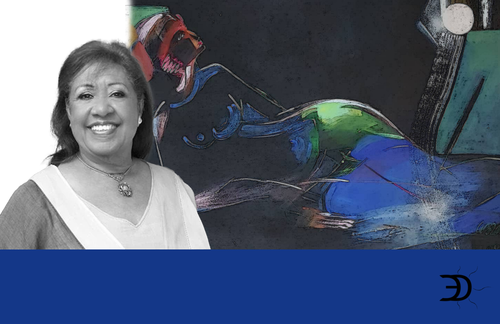
By Nelson Santana
January 5, 2026
Lea en español: Fallece en Miami Ada Balcácer, maestra del arte dominicano y arquitecta de un lenguaje caribeño propio
Key Points
Ada Balcácer died in Miami at the age of 95. Dominican media place her death on Thursday, December 25, 2025, although some online biographical records list December 24.
She received the National Prize for Visual Arts (2011) and was named a Cultural Reserve of the Nation (2017), honors that cemented her status as a central figure in the contemporary Dominican visual canon.
Her life was marked by early adversity: a horseback-riding accident led to gangrene and the amputation of her left arm, an event that did not halt a six-decade career.
Beyond her artistic production, she was a dedicated educator, teaching printmaking and drawing at key institutions and shaping multiple generations of artists.
Her legacy also carries a civic and social dimension. Banreservas highlighted both her artistic work and her program Women Integrated into the Artisanal Industry, developed with international support.
The death of Ada Balcácer in Miami brought several Dominican stories to a close at once: that of the artist who turned tropical light into method, the teacher who trained the eye through discipline, and a generation that understood art as both aesthetic practice and civic responsibility in a single stroke. The news was publicly confirmed by Joel Gonell, president of the Dominican College of Visual Artists (CODAP), who bid her farewell as a “master of light”—a phrase that, in her case, functions less as a metaphor than as a technical summary of her commitment to color and transparency.
Dominican press reports place her passing between December 24 and 25, 2025, in Miami. The discrepancy—possibly related to the time of death, family confirmation, or editorial cutoff—has yet to be fully reconciled among sources. The impact at home was immediate. This was not the passing of a merely “important” artist, but of a structural figure—one who organizes the narrative of Dominican art into a before and an after.
From the Countryside to the Studio: A Biography in Context
Ada Balcácer was born on June 16, 1930, in Santo Domingo and grew up in the countryside. This detail matters, because her work engages nature, popular religiosity, and sociocultural identity from a lived perspective, not a touristic one.
Her original path was not art. She dreamed of studying medicine until a horseback-riding accident fractured her arm. Complications led to gangrene and eventual amputation. In Dominican cultural memory, this episode has often been framed as tragedy. A more accurate reading is different: it was the rupture that redirected an unusually determined will toward artistic practice.
She trained at the Escuela Nacional de Artes Visuales en Santo Domingo (National School of Visual Arts in Santo Domingo), studying under influential teachers—Josep Gausachs, Celeste Woss y Gil, Manolo Pascual, Gilberto Hernández Ortega, and Luichy Martínez Richiez—in an environment shaped by European influences and a drive toward aesthetic modernization. In 1951 she emigrated to the United States, spending roughly twelve years in New York and studying at the Art Students League, an experience that expanded both her technical resources and formal ambition.
This back-and-forth—Santo Domingo / New York / return—is essential to understanding her from today’s vantage point. Balcácer belongs to a Dominican tradition of artists who did not leave in order to disconnect, but to acquire tools and return with a more robust visual language.
Teacher and Institution Builder
Upon returning to the Dominican Republic, her career extended beyond the exhibition circuit. She taught printmaking at the School of Fine Arts and drawing in the School of Architecture at the Autonomous University of Santo Domingo (UASD), institutions that have long functioned as training grounds for generations of creative professionals.
Her artistic trajectory unfolded through sustained series and processes of visual research. In 1972 she joined the group Nueva Imagen, and later produced bodies of work such as Participating Spaces (1973–1978) and Palmira (1979–1985), during which she executed murals and received recognition in the competition «Un mural para el Citibank» (“A Mural for Citibank”). This situates her squarely within a Dominican modernity that, amid urban and corporate expansion, sought a visual language capable of inhabiting public space without sacrificing symbolic depth.
Abstraction as Strategy in Political Times
A revealing detail appears in public biographies: it is often said that her turn toward abstraction functioned, in part, as a way to avoid censorship during the political turbulence of the Dominican Republic in the 1960s. This is not an easy claim to verify as a single causal fact—art is never explained by one reason alone—but it is historically plausible. In a country where politics has permeated everyday life, and where figurative art could be read as direct denunciation, abstraction offered a margin of freedom: to speak without naming, to denounce without slogans, to suggest without signing the conflict.
Within that tension, Balcácer remains strikingly contemporary. Her work reminds us that in the Dominican Republic the challenge has not only been to create, but to create autonomously and sustain an independent voice amid social, institutional, and political pressures.
Awards and the Social Dimension of Her Legacy
Her institutional recognition was extensive: first prize in drawing (1966), mural competition award (1983), an honorable mention in Cali (1986), a tribute at the United Nations in New York (1989), the National Prize for Visual Arts (2011), and designation as a Cultural Reserve of the Nation (2017). Banreservas had honored her earlier, in 1985, and in 2017 presented her with a plaque recognizing her as an “Artistic Reserve” of the country, emphasizing not only her originality but also her social work, including the program Women Integrated into the Artisanal Industry, developed in coordination with the World Bank.
This detail anchors her figure in a core Dominican cultural debate: art not as an elite showcase, but as a tool for development, skilled labor, and community sustainability.
Wings and Roots: A Retrospective That Defines a Country
If there is a single moment when her legacy was most clearly systematized for the public, it was the retrospective Wings and Roots: Ada Balcácer, conceived as an anthological exhibition spanning six decades, with emphasis on her social commitment and her theoretical contributions to Caribbean art. Critical reception at the time emphasized that her trajectory revealed Dominican “myths and realities,” sometimes from within and sometimes from without, and that the exhibition catalogue itself functioned as a toolbox for understanding her visual language.
In a country that too often remembers its artists only at death, Wings and Roots was the opposite: an act of living memory. Today it serves as a map for those who follow—students, curators, collectors, and a public still learning how to look at Dominican art without demanding that it be “pretty” before it is truthful.
What Remains
Balcácer died in Miami, but her story did not relocate with her. Her work is studied, exhibited, and debated as part of an ongoing Dominican conversation about identity, myth, nature, popular religiosity, and the female universe—subjects she explored with uncommon consistency, moving between figuration and abstraction.
The public farewell offered by her daughter, Marian Balcácer, added another layer: that of the artist as mother, guide, and intimate force, reminding us that behind the “name” stands a life that sustained family, craft, and country simultaneously.
The brutal truth, in the end, is this: Ada Balcácer is no longer here to produce the next series, but she left behind enough structure—work, pedagogy, method, archives, exhibitions—that Dominican culture has no excuse. The question is not whether she will be remembered. The question is whether the country will know how to use her legacy—study it, teach it, and defend it as part of who we are.
________
Related
Muestra Cultural de Portugal y República Dominicana
Family Spices with Cuban Dominican Artist Julisa Mugica
José Cestero: The Expressionist Soul of Dominican Visual Art
José Cestero: El alma expresionista de la plástica dominicana
«Identify, Identify» Entrevista a Thimo Pimentel
«Especias Familiares» con Julisa Marie Mugica, artista dominico cubana
Peña Gómez y Ñico Lora cobran vida en Mao: murales que pintan memoria, identidad y futuro
Firelei Báez rompe récord en subasta: primera dominicana en superar el millón de dólares