
By ESENDOM
December 9, 2025
Lea en español: Embarazo adolescente en República Dominicana: 11,961 casos en 2025 revelan mapa de desigualdad
11,961 Adolescent Pregnancies in Nine months: The Dominican Republic is Making Progress, but Still Carries a Social Debt
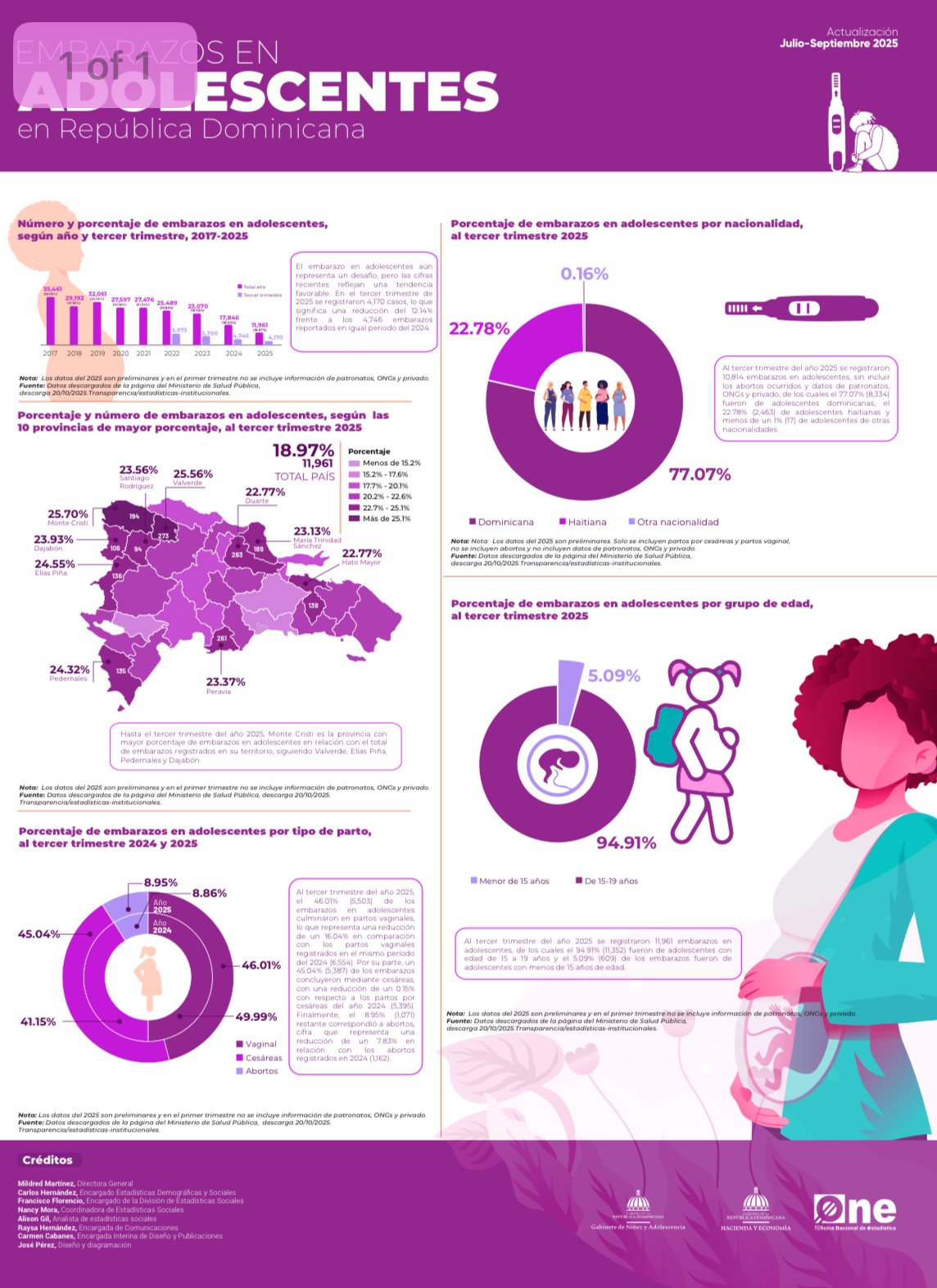
In a country that aspires to cement itself as the Caribbean’s tourism and services hub, teen pregnancy figures reveal that the real development indicator is not cruise counts but the opportunities afforded to its girls. Between January and September 2025, the Dominican Republic recorded 11,961 adolescent pregnancies, according to the National Statistics Office (ONE). Behind that number lie interrupted plans, empty classrooms, and girls compelled to take on motherhood before finishing adolescence.
Of these pregnancies, 77.07% involve Dominicans and 22.78% Haitians: 2,726 Haitian teens who face not only early motherhood but also racism, precarious immigration status, and social exclusion. Less than 1% belong to other nationalities. Teen pregnancy here has a Caribbean, border, and impoverished face.
Signs of Progress Amid the Crisis
Despite the gravity, the data show improvement. In the third quarter of 2025 alone, 4,170 adolescent pregnancies were recorded—12.14% fewer than the 4,746 during the same period in 2024. The recent-year trend is clear: from 27,476 in 2021 down to 11,961 in 2025. It is a significant drop, though the country still maintains one of the region’s highest rates.
The Border as the Epicenter of Inequality
The provincial breakdown confirms a familiar pattern: where poverty is higher, so is teen pregnancy. Monte Cristi leads with 25.7% of its pregnancies occurring among adolescents, followed by Valverde (25.5%), Elías Piña (24.5%), Pedernales (24.3%), and Dajabón (23.93%). All are border provinces or tied to informal commerce and migration.
Other provinces with elevated figures include Santiago Rodríguez (23.56%), María Trinidad Sánchez (23.13%), Duarte (22.77%), and Hato Mayor (22.77%). In these areas, low incomes, informal work, limited access to sexual and reproductive health services, and cultural norms that normalize early unions create favorable conditions for early motherhood.
In marginalized neighborhoods of Greater Santo Domingo, pressure to “be independent” through early unions, school dropout, and gender-based violence complete the picture. Teen pregnancy is not an “individual accident”; it is a symptom of a social system that continues to fail.
Girls, Not Mothers
Of the total recorded pregnancies, 94.91% (11,352 cases) involve teens between 15 and 19. But 609 pregnancies—5.09%—occurred among girls under 15. Each one represents a violation of fundamental rights.
UNICEF has warned that teen pregnancy is among the leading causes of mortality for adolescents worldwide, and that four out of ten young women aged 15–19 who wish to avoid pregnancy lack access to contraception. In the Dominican Republic, these statistics reflect the absence of comprehensive sexual education in schools, social resistance to discussing sexuality with adolescents, and a health system that does not always recognize them as rights-bearing subjects.
Among girls under 15, pregnancy is often linked to sexual abuse, incest, or forced unions with adult men. These are stories that rarely make headlines but linger in prosecutors’ files, hospitals, and statistics presented as charts.
Births, C-Sections, and Abortions: What the Numbers Reveal
Of total pregnancies through the third quarter of 2025, 46.01% (5,503) ended in vaginal births—a 16.04% reduction compared to 2024. However, a nearly equal share—45.04% (5,387)—ended in C-sections. That nearly half of teen births are surgical raises questions about quality of care, medical indications, and institutional pressures within an already overburdened health system.
The remaining 8.95% (1,071 cases) were abortions, a 7.83% decrease from 2024. These figures capture only the visible fraction: they do not include abortions outside the public system or data from charitable hospitals, NGOs, and private centers. In a country where abortion remains criminalized in nearly all forms, many procedures likely occur clandestinely, posing serious risks to adolescents.
A Rights Challenge, Not Just a Health Issue
Addressing teen pregnancy in the Dominican Republic requires analyzing both public policy and culture. The persistence of gender roles that tether women’s worth to motherhood, the normalization of early unions with older men, and the lack of educational and job opportunities transform pregnancy into a social destiny for many young women.
The migration component adds complexity. Haitian adolescents—nearly a quarter of all cases—live in greater vulnerability: incomplete or nonexistent documentation, discrimination, language barriers, and limited access to health services. Any serious policy must place them at the center, not in the footnotes.
In recent years, the Dominican State has implemented prevention and education initiatives, and the figures indicate change. But as long as thousands of girls leave school to raise children, the country will carry a massive social debt. Teen mothers are less likely to finish high school, access formal employment, and break the cycle of family poverty.
From Statistic to Commitment
This means comprehensive sexual education, real access to contraception for adolescents, adolescent-friendly health services, effective protection against sexual violence, and campaigns that challenge the idea that “growing up” means pairing off and giving birth early. It also means looking to the borderlands, the bateyes, and working-class neighborhoods, and recognizing that the country’s future is being defined there—in the lives of girls and teens who today show up as “cases,” but tomorrow could be professionals, community leaders, artists, or scientists.
For now, the statistics indicate teen pregnancy is decreasing. The true victory will come when every Dominican girl can decide when, how, and whether she wants to be a mother.
⸻⸻
Related
The Significance of November 25: Eliminating Violence Against Women
16 contra la violencia, memorias dominicanas: Rosaura Almonte «Esperancita»
Yaneisy y Yanerys: madre e hija víctimas del matrimonio infantil
Crisis de la infancia: Cuando los protectores se vuelven verdugos
El Torito vuelve a pedir la solidaridad de sus colegas, esta vez contra los feminicidios
Maribel Núñez habla de la lucha por los derechos reproductivos de la mujer en República Dominicana
Imágenes de la Marcha de las Mariposas en contra de la violencia machista
Imágenes de la marcha en contra de la violencia machista en R. Dominicana