

By Emmanuel Espinal and Nelson Santana
August 10, 2025
Lea en español: 15 artistas dominicanos del Top 25 de ESENDOM que debes conocer: Miguel Braho
From Santiago’s mountain tops to the corners of The Bronx, Dominican music has produced artists that have marked generations, challenged genres, and conquered global stages. At ESENDOM, we celebrate the cultural power of our music with a special list: “15 Dominican Artists from ESENDOM’s Top 25 That You Should Know”—a selection curated with both heart and musical insight, where each name represents not only talent, but history, identity, and legacy.
Our list is based on ESENDOM’s Top 25, a list we publish weekly featuring the hottest songs in the music scene.
Over the coming days, we will reveal one by one the names that make up this list, with in-depth profiles that honor their trajectory, impact, and cultural relevance. This is not a ranking; it is a living tribute.
Today we continue our list with Miguel Braho, one of the most prolific composers in history.
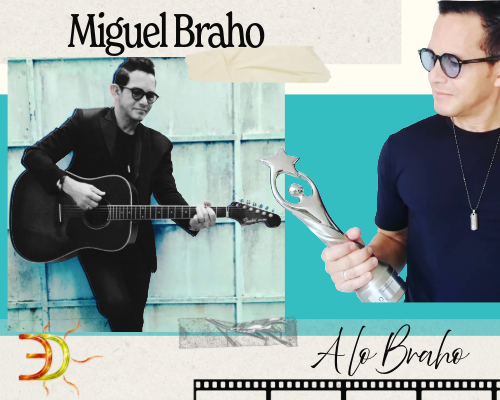
🎤 Today we present the tenth of our fifteen: Miguel Braho: The Alchemist of Words Who Turned Pain into Musical Medicine
In El Firme, a mountainous enclave of Castillo in the province of Duarte—where the peaks embrace the clouds and each dawn whispers ancestral secrets to those who know how to listen—was born an artist destined to prove that true musical greatness lies in the ability to transform personal wounds into collective balm. Miguel Braho is not merely a singer-songwriter; he is an emotional architect, building bridges between souls with words as raw material and melodies as spiritual mortar, showing that authentic music holds healing powers that transcend superficial entertainment.
His upbringing in Puerto Plata—a city he reveres as his “prelude to glory”—forged the poetic sensitivity that would define his future work. In those coastal streets, where the sea breeze carries tales of love and heartbreak, he found the primordial inspiration to compose songs that would shape entire generations of listeners thirsty for emotional authenticity.
The founding of Grupo Braho with his brother Berny in the 1990s was more than a family alliance—it was the crystallization of an artistic vision that fused the deep sentiment of the ballad with the contagious rhythm of bachata, creating a musical synthesis that redefined the expressive possibilities of the contemporary bachata genre.
His emblematic compositions—“Quemo la cama,” “Diccionario,” “El amor no tiene lógica,” and “Pa’ los perros”—serve as emotional X-rays, exposing the complexities of the human soul with brutal honesty. “Todo por Luna,” dedicated to his premature daughter whose fight for life became his creative driving force, exemplifies how personal pain can be transmuted into universal art that consoles while it moves.
His prolific output of more than 600 songs—200 of which have been immortalized by giants like Frank Reyes, Raulín Rodríguez, Antony Santos, Elvis Martínez, and Luis Vargas—constitutes an emotional archive documenting human passions with surgical precision. His international reach into Mexico and Spain, where artists like El Conjunto Agua Azul and José Lara have interpreted his lyrics, confirms that authentic emotions transcend both geographical and cultural boundaries.
His training as a clinical psychologist at the Universidad de la Tercera Edad was no career accident; it was a conscious search for scientific tools to complement his innate artistic intuition. His book Salvado por el Café (Saved by Coffee), where he recounts his battle with depression, reveals the heroic vulnerability of one who turns private wounds into public testimonies of resilience.
The creation of the concept “El Conferencierto”—a fusion of concert and conference—demonstrates his revolutionary understanding of music’s therapeutic power when paired with conscious messaging. This innovation positions Braho as a pioneer of a new artistic modality that transcends entertainment and enters the realm of collective healing.
Miguel Braho has proven that true artistic greatness is not measured in sales or accolades, but in the ability to transform suffering into hope, pain into medicine, and words into bridges connecting wounded hearts to the possibility of healing. His work stands as a living testimony that composing is not merely making music—it is making people feel, heal, and transcend human limitations through the redemptive power of authentic art.
______________
Related
15 Dominican Artists from ESENDOM's Top 25 That You Should Know: Elvis Martínez
15 Dominican Artists from ESENDOM's Top 25 That You Should Know: La Fiera Típica
15 Dominican Artists from ESENDOM's Top 25 That You Should Know: Zacarías Ferreira
15 Dominican Artists from ESENDOM's Top 25 That You Should Know: El Rubio Acordeón
15 Dominican Artists from ESENDOM's Top 25 That You Should Know: Shelow Shaq
15 Dominican Artists from ESENDOM's Top 25 That You Should Know: El Varón de la Bachata
15 Dominican Artists from ESENDOM's Top 25 That You Should Know: Natti Natasha
15 Dominican Artists from ESENDOM's Top 25 That You Should Know: Teodoro Reyes
15 Dominican Artists from ESENDOM's Top 25 That You Should Know: Ozuna
15 Dominican Artists from ESENDOM's Top 25 That You Should Know: Lomiiel
15 Dominican Artists from ESENDOM's Top 25 That You Should Know: Los Hermanos López
15 Dominican Artists from ESENDOM's Top 25 That You Should Know: Chris Lebrón
15 Dominican Artists from ESENDOM's Top 25 That You Should Know: Luis Vargas
15 artistas dominicanos del Top 25 de ESENDOM que debes conocer