
By ESENDOM
Decemebr 1, 2025
Lea en español: Población dominicana en Nueva York cae 13% desde 2021, pero sigue marcando el pulso latino de la ciudad
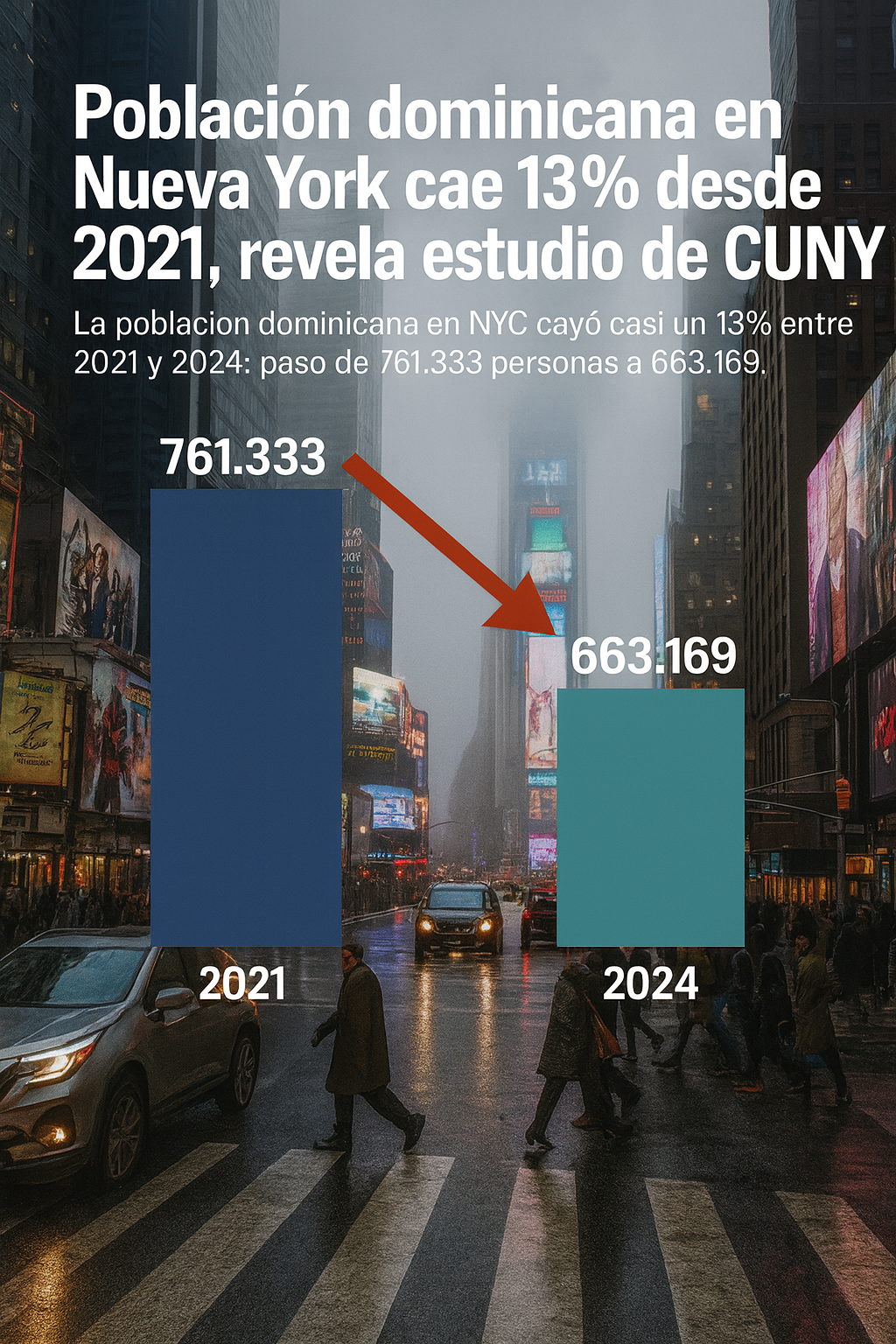
New York. The city that for decades called itself “the Dominican Republic’s second capital” is chaning. A new report from the Center for Latin American, Caribbean, and Latino Studies (CLACLS) at the CUNY Graduate Center finds that New York City’s Dominican population fell by nearly 13% between 2021 and 2024—from 761,333 to 663,169. It is not that fewer Dominicans are arriving from the island; instead, more Dominicans are leaving the city for other parts of the United States.
New York City’s Dominican population: 761,333 (2021) → 663,169 (2024), a drop of ~13%.
2021–2023: an estimated 100,000 Dominicans left the city and 123,875 left New York State.
Where they live: 48% in The Bronx, 22% in Manhattan; nearly 20% hold a college degree.
Income: Dominican households have the lowest median income among the five largest Latino groups ($64,000); 65% of households are headed by women.
The report projects the Dominican population in NYC will likely continue to decline in the coming years.
From Washington Heights to a More Dispersed Dominican Map
Historian Laird W. Bergad’s study for the Latino Data Project confirms what many Dominican families already knew: relatives are moving to other states in search of lower rents, better schools, or new opportunities.
If in the 1980s and 1990s Washington Heights was shorthand for a “Little Dominican Republic,” today the demographic center has shifted to The Bronx. In 2023, almost half (48.1%) of Dominicans in the city lived there, compared with 22.3% in Manhattan, 14.8% in Brooklyn, and 13.5% in Queens. Dominican identity still shapes neighborhoods, bodegas, and barbershops—but now that identity is spreading across more ZIP codes and more states.
Not Fewer Arrivals from the Dominican Republic—More Exits from New York
The population decline is not driven by fewer immigrants from the Dominican Republic. Between 2011 and 2023, arrivals stayed high—10,000+ annually in several periods—even after 2020.
The difference is out-migration: 2021–2023, about 123,875 Dominicans left New York State. Since roughly 80% of Dominicans in the state live in the city, the report estimates about 100,000 left the five boroughs in just two years.
While the study does not quantify the pandemic’s share, the backdrop is clear:
Housing costs and gentrification on the rise
Precarious jobs against a climbing cost of living
Other states offering cheaper housing and growing Latino communities—what you pay in New York for an apartment might cover a house elsewhere
Dominican identity is not fading; it is relocating on the U.S. map.
More College Degrees, Tighter Wallets
The socioeconomic picture is mixed. Educational attainment has surged: nearly 20% of those 25+ now hold at least a bachelor’s degree, compared to just 1.6% in 1980. Thousands of immigrants’ children moved from factory floors and bodegas to CUNY graduation stages.
But those gains have not turned into broad economic stability. Among the five largest Latino groups, Dominican households post the lowest median income: $64,000 a year. Income is also top-heavy:
Only 9% of households earn $200,000+, yet they control 32% of total Dominican household income.
Adding those who earn $100,000–$199,999, just 31% of families control 66% of the income.
Meanwhile, one-quarter live below the poverty line.
Women-Led Households and the Gender Gap
Dominicans have the highest share of female-headed households among the largest Latino groups: 65.2% in 2023.
The gender gap hits community finances directly. Median income: $65,000 for male-headed households versus $40,000 for female-headed ones. In addition, 79% of households are led by foreign-born individuals, with lower incomes as well.
The result: a community that blends educational progress and migrant resilience with a structure where women sustain Dominican households with fewer resources.
Bilingualism, Citizenship, and What’s Next
Despite geographic dispersion, Dominican culture remains anchored in New York:
76% are U.S. citizens (by birth or naturalization).
62% speak English well or very well, while 8 in 10 still speak Spanish at home.
CLACLS projects the Dominican population in NYC will keep shrinking. That does not mean its cultural and political weight will fade. It pushes the city to rethink what “Dominican New York” means today: not only Washington Heights or The Bronx, but an extended network linking the island, the five boroughs, and new Dominican enclaves across the United States.
⸻⸻
Related
Amanda Séptimo: From South Bronx Activist to Architect of Zohran Mamdani’s Latino Breakthrough
Yovan S. Collado: First Time Commissioner Redistricting Through Learning and Enlightenment
Caught in the Crossfire: Dominican Communities Under ICE's Shadow
¿Dónde viven los dominicanos en EE.UU.? Una comunidad que se reubica sin perder identidad