
Por ESENDOM
17 de noviembre de 2025
Lea en español: Dominicanos en el exterior superan los 2.8 millones en 2024: ¿sostienen la economía nacional?
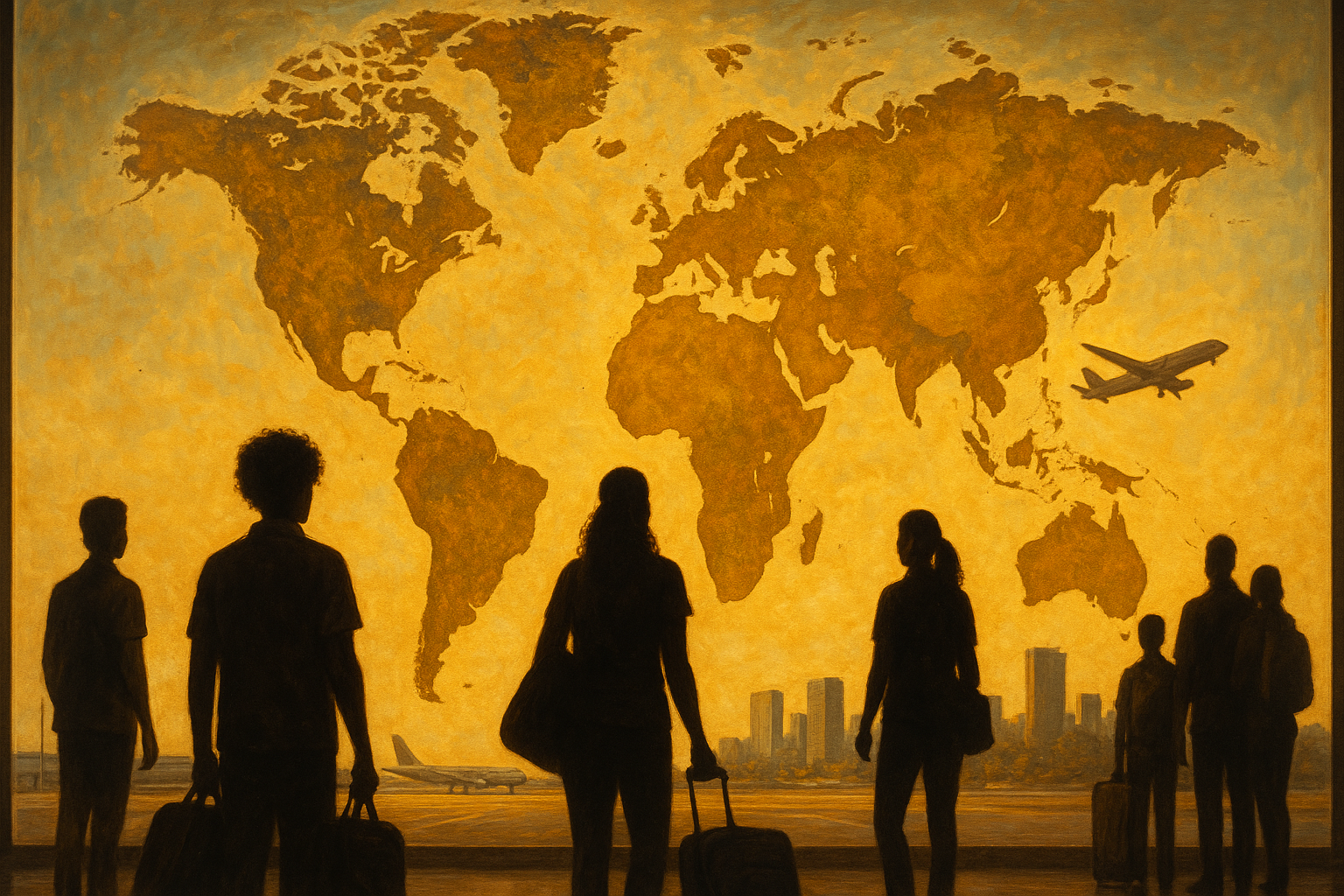
As of the end of 2024, 2,874,124 Dominicans officially reside outside national territory, according to the INDEX Sociodemographic Registry. In a country of 11.4 million inhabitants, that is roughly one in four Dominicans. More than a statistic, it is evidence of a transnational nation stretching from the fields of the Cibao to the avenues of New York, Madrid, and Santiago de Chile.
The Diasporic Map
The Americas host 89.9% of Dominicans abroad (2,580,924 people), while Europe accounts for about 10% (288,515). The United States remains the main destination: 2,398,009 Dominicans live there, concentrated in New York (848,560), New Jersey (380,143), and Florida (312,604), with sizable communities in Pennsylvania, Massachusetts, and Rhode Island.
Spain ranks second with 201,162 Dominicans, mainly in Madrid (68,448) and Barcelona (40,353), and growing hubs in the Balearic Islands, Asturias, A Coruña, and Zaragoza. Other notable destinations include Italy, Chile, Canada, the Netherlands, Venezuela, Mexico, and Panama.
The registry covers 119 jurisdictions across 95 sovereign states and 24 dependent territories, incorporating Egypt, the United Arab Emirates, and Qatar for the first time—offering a more complete snapshot of Dominicans’ global presence.
Profile: Women
Women comprise the majority: 1,480,252 (53.5%) versus 1,284,882 men (46.5%). 37.2% are 25 or younger, while people 55+ represent 19.1%.
Recent Dominican migration has a young, female face. These are women raising children in multicultural settings, working in services, health, and commerce, and maintaining emotional and economic ties with the island. They are young people who grew up with bachata in The Bronx or Madrid, yet who still celebrate mangú, baseball, and inherited traditions.
This reality demands public policies not only for emigrants, but also for the children of Dominicans born abroad, who grow up among multiple cultural references and claim their belonging to the nation.
Economic Engine
In 2024, the Dominican Republic received US$10.756 billion in remittances, a 5.9% increase over the previous year. About 80% of those transfers came from the United States, followed by Spain.
Behind these figures are families finishing houses in their hometowns, students paying university tuition with the monthly “chequecito,” and small businesses—colmados, salons, call centers—that start up or survive with capital sent from abroad.
Alongside tourism and free-trade zones, remittances have become a third pillar supporting consumption, family investment, and social stability. Designing development policy without considering the Dominican community abroad is to ignore a fundamental economic actor.
Political Power
The Dominican community abroad is also a political actor. In several countries, they have become influential voters, candidates for public office, and diplomatic bridges through community associations, chambers of commerce, and professional networks.
In the Dominican Republic, they vote and have overseas constituencies to elect representatives—though debate continues over how effective that representation is on issues such as labor-rights protections, dual-citizenship facilitation, streamlined consular services, and investment channels from abroad.
Dominican politics is no longer confined to the nation’s 48,442 km²: it extends to neighborhoods in New York, Madrid, Miami, and Barcelona.
Cultural Identity
The cultural weight of the community abroad is immense. Merengue, bachata, and dembow have found new audiences and fusions in foreign cities. Dominican literature and cinema are nourished by transnational experiences, with characters raised in Washington Heights or stories that move between Santo Domingo and Madrid. Baseball has made Dominican flags 2025 wave in MLB stadiums, reinforcing collective pride.
All of this reframes an essential question: what does it mean to be Dominican today? Birthplace is not enough. Identity is also built through the experience of living, working, and raising children elsewhere—without cutting the thread to the island.
Ongoing Challenges
Major challenges persist: precarious work, racism, discrimination, difficulties regularizing immigration status, deportations, forced returns due to economic or family crises, and second- and third-generation cultural friction—young people who feel Dominican but are sometimes not recognized as such anywhere.
INDEX notes that the Sociodemographic Registry is a tool to design more inclusive public policies and strengthen the protection of rights.
An Expanded Nation
That nearly three million Dominicans live abroad does not mean they are “far away.” On the contrary: they expand the nation’s borders. Their economic, political, cultural, and emotional contributions confirm that the Dominican map is no longer drawn only by the island’s outline.
Today, the Dominican Republic is also written in New York’s trains, Madrid’s squares, the neighborhoods of Santiago de Chile, and beauty salons in Amsterdam. To recognize, understand, and serve that community is not symbolic—it is essential to thinking about the country’s present and future.
⸻⸻
Related
Amanda Séptimo: From South Bronx Activist to Architect of Zohran Mamdani’s Latino Breakthrough
Yovan S. Collado: First Time Commissioner Redistricting Through Learning and Enlightenment
Caught in the Crossfire: Dominican Communities Under ICE's Shadow