
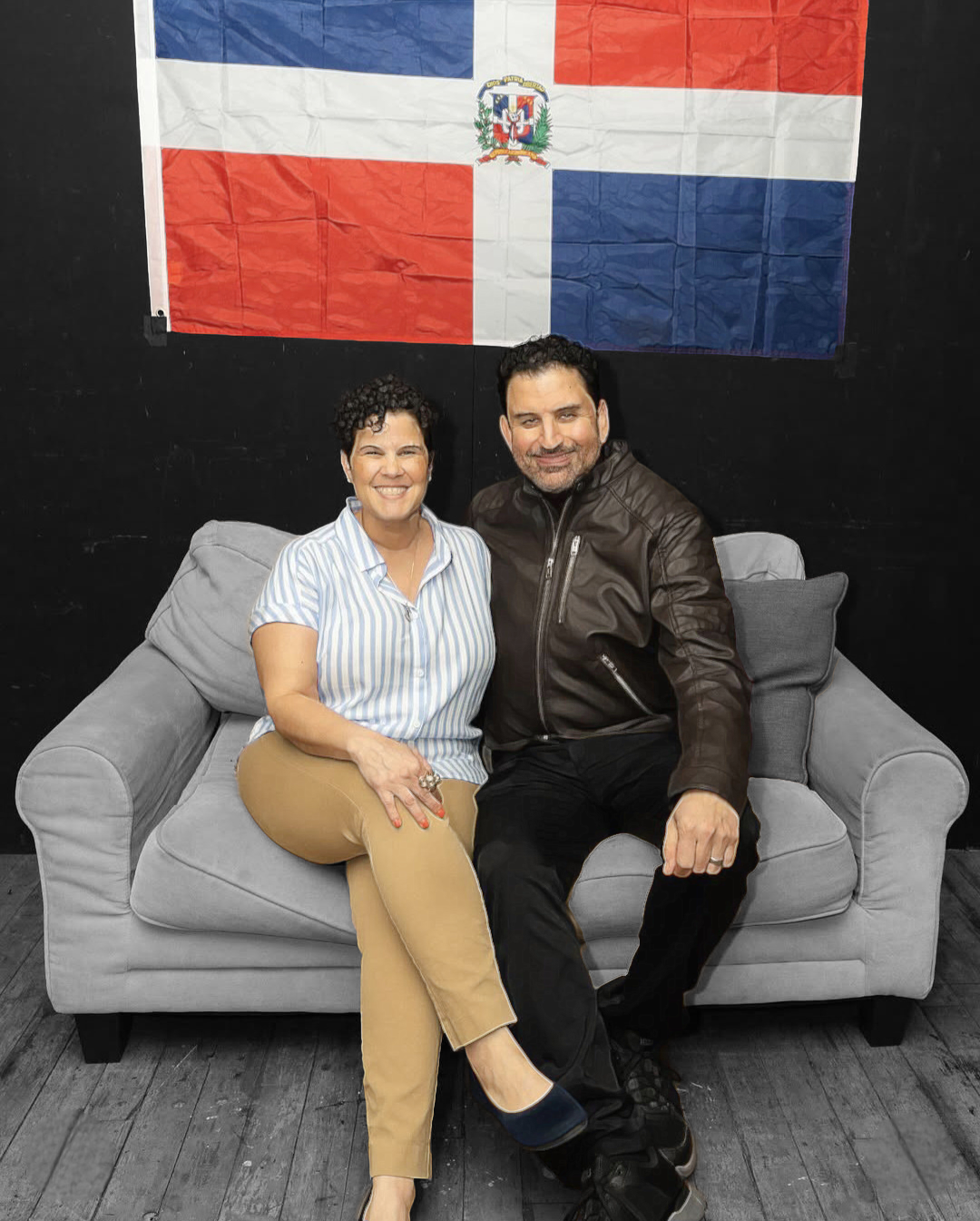
Mino Lora and Marco Antonio Rodríguez
Photo: courtesy of Mino Lora
The creative process has many aspects that interconnect and through a refining process create a final product for consumption. Writing is usually an individual exercise but in specific situations the muse is best developed in a group setting. This is the case for Domino Effect, a play that is the vision of the Dominican director Mino Lora and the pen of Dominican playwright Marco Antonio Rodríguez. They both kindly responded a few questions for us in an interview that follows.
By Emmanuel Espinal
April 21, 2025
Congratulations Marco Antonio for another incredible job and project with Domino Effect. I overheard Mino Lora say that initially she had a vague idea of the play with about fifteen pages and then was able to get you to form part of the team. She alluded that with you joining the team got the development of the work flowing. How did you get to be part of the team and integrate yourself in the project? What initially captivated you about the idea?
Marco Antonio:
The People's Theatre Project Executive Artistic Director, Mino Lora, knows my work and contacted me about commissioning a piece that tackles the subject of intergenerational, Queer immigrant experience. We then began to brainstorm ideas. I shared how when I was growing up, I would go visit my father on 190th street off the A train. Fort Tryon Park is right off that train line and I would often see folks engaged in a game of dominos. Sometimes it would be very heated games, others were just about sharing in community; playing music and eating while they played. Mino remembered watching her dad playing the game in the Dominican Republic. We felt it was the perfect setting for a group of individuals from various backgrounds and generations to come together and engender conflict as well as healing.
I know that it took two years to complete, how was it to work with Mino Lora? How was the dynamic between the both of you and what was something that impressed you of her as a director?
Marco Antonio:
Mino's dynamic leadership and generosity continues to impress myself and everyone around her. Her energy is contagious. The support given to me during these last two years went above and beyond. Mino encourages collaboration and pushes us to think outside limitations and go beyond the obvious. Through her humanity and many artistic talents, she empowers imagination as well as activism. As a director, she has a flexible vision that allows for others to contribute openly and freely. Her empathy and curiosity makes her a formidable force in executing challenging text for the masses. Her superpower is always staying true to the credo that art should be accessible to all.
What were the biggest challenges you faced in writing this play?
Marco Antonio:
The biggest challenge I faced with such a topical piece was for it not to become heavily didactic or preachy. What kept me focused and on target was always going back to the humanity of these characters, their hearts and their core truths as human beings. This is the thing that is universal and goes beyond politics or religious beliefs.

Left to right: Shadi Ghaheri, Tony Macy-Pérez, Wille the Genius and Angela Reynoso
Photo: Emmanuel Abreu
To my understanding, the actors and actresses were part of the creative process of the play. How did you decide that the characters would be of four different generations and even one would be of Iranian descent? How is the participation of the actors in the creative process reflected in the final cut of the play that is exhibited on stage?
Mino Lora:
The concept and vision for this play from the start was to create a multigenerational immigrant story that presented different perspectives and cultures. As The People’s Theatre, I knew two of the characters would be an older and younger Latino and then the other two, we wanted very different perspectives. For these roles, we invited Shadi, who is a brilliant actor and director originally from Iran, and Willie Raya, a Black Trans woman artist, to complete the ensemble for Domino Effect because we had worked with them at The People’s Theatre (TPT) in the past and they are part of our artistic ensemble.
In our devising process at TPT we use prompts and activities to encourage actors to share their own personal stories and experiences as we develop these characters. Marco Antonio took a lot of what they offered and included it in this powerful script.
For you as a playwright and actor, what difference was there in including the actors in the creative process than when you have written one exclusively by you?
Marco Antonio:
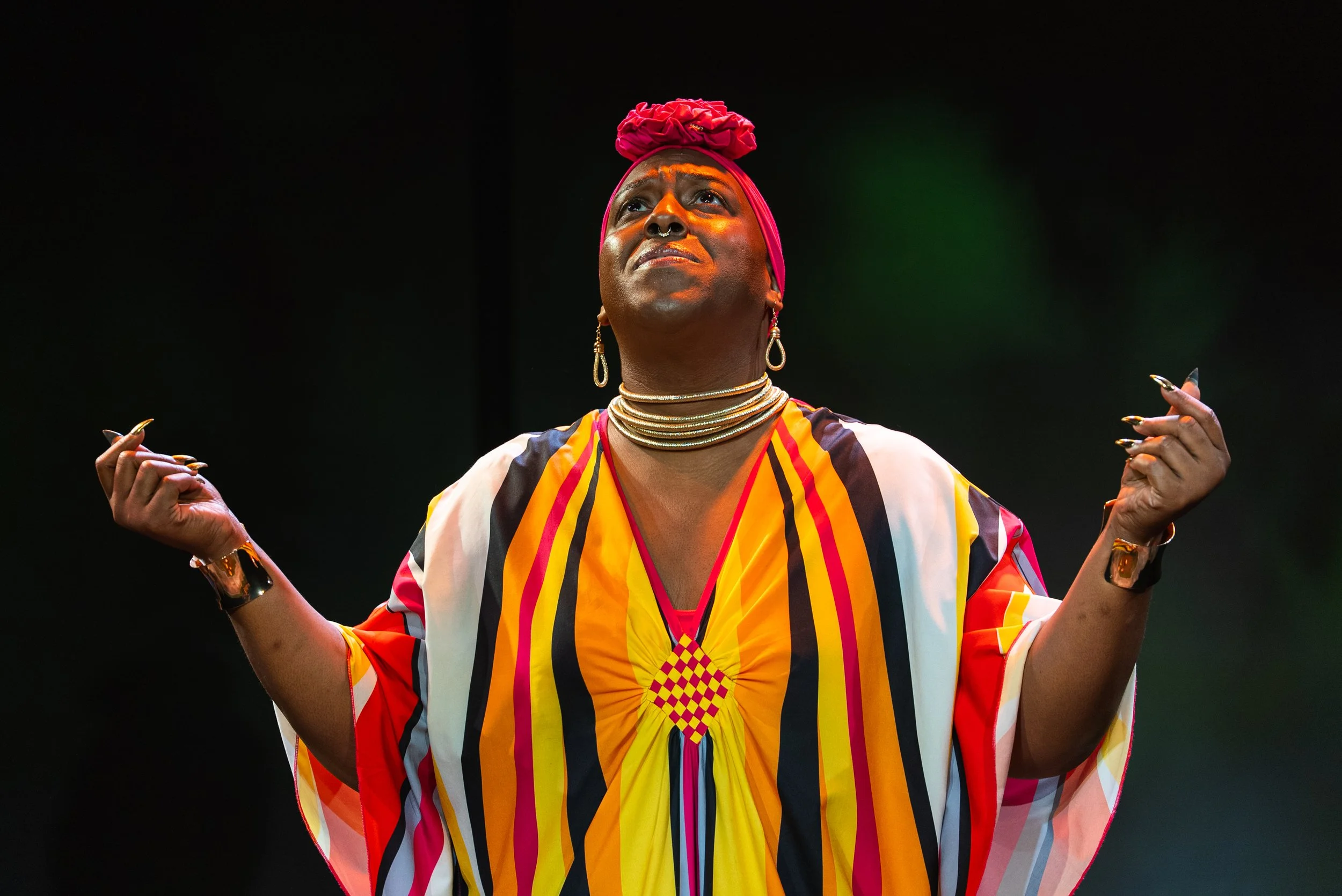
Willie the Genius as Pepper Malveaux
Photo: Emmanuel Abreu
Actors had a lot of input in what went into the script. Led by another artist who had access to my story outline for the play, we did a lot of improvisation and personal sharing exercises. I observed and would often ask questions of the actors. They would also make sure things were accurately represented in the script in regards to cultural nuances and references. This process was a truly collaborative one. I'm used to the writing process being very isolating. In many ways, it was a relief to have a collaborative team where I could receive and bounce off ideas. I also had immediate access to resources. If I needed more information on what it meant to be a Black Transwoman, it was immediately available as we intentionally cast a Black Transwoman knowing we wanted that perspective in the play.
In this play, contrary to many of your other plays, there are many political references in the form of jokes. (It is said that there is some truth in every joke.) This is a new facet that was well executed. What made you decide to go down this route and include them directly?
Marco Antonio:
Indeed this is a very topical play filled with political ideas and philosophies but it was important to all of us that this not overburden the play. The characters have difficult, messy, chaotic conversations but at the end of the day, what brings them together is their humanity. They are not as different as they care to think. I never meant for the play to be political. I always wanted to focus on my strengths as a writer, which is layered characters with a lot of humanity; but as Mino pointed out, the fact that we are doing this play with these specific characters during these challenging times is a political statement in itself, a call to action. The play does not take sides. We present these conversations that take place over a game of dominos then leave audiences to ponder, meditate and discuss. What's interesting is that early on in my career, when I still lived in Texas, I wrote quite a bit of irreverent, political satire. In many ways, this felt like a homecoming.
In between laughs and moments of pure reflective silences, there are spaces where many in the audience cry. What reflections do you want the audience to take away from the play?
Mino Lora:
Our hope is for the audience to connect to the characters’ humanity with their own. That the audience to take a moment to listen and to “feel the feelings” as the character Mandi says. Our world today is so divided; there is such pain and violence all around us, and it feels much easier to separate and not engage. But in order for all of us to find our own peace and joy, we recognize how connected we are to each other’s liberation. Even with those that in appearance may seem so different than us. We hope our audiences, like the characters in the play, all leave feeling a bit more connected and hopeful.
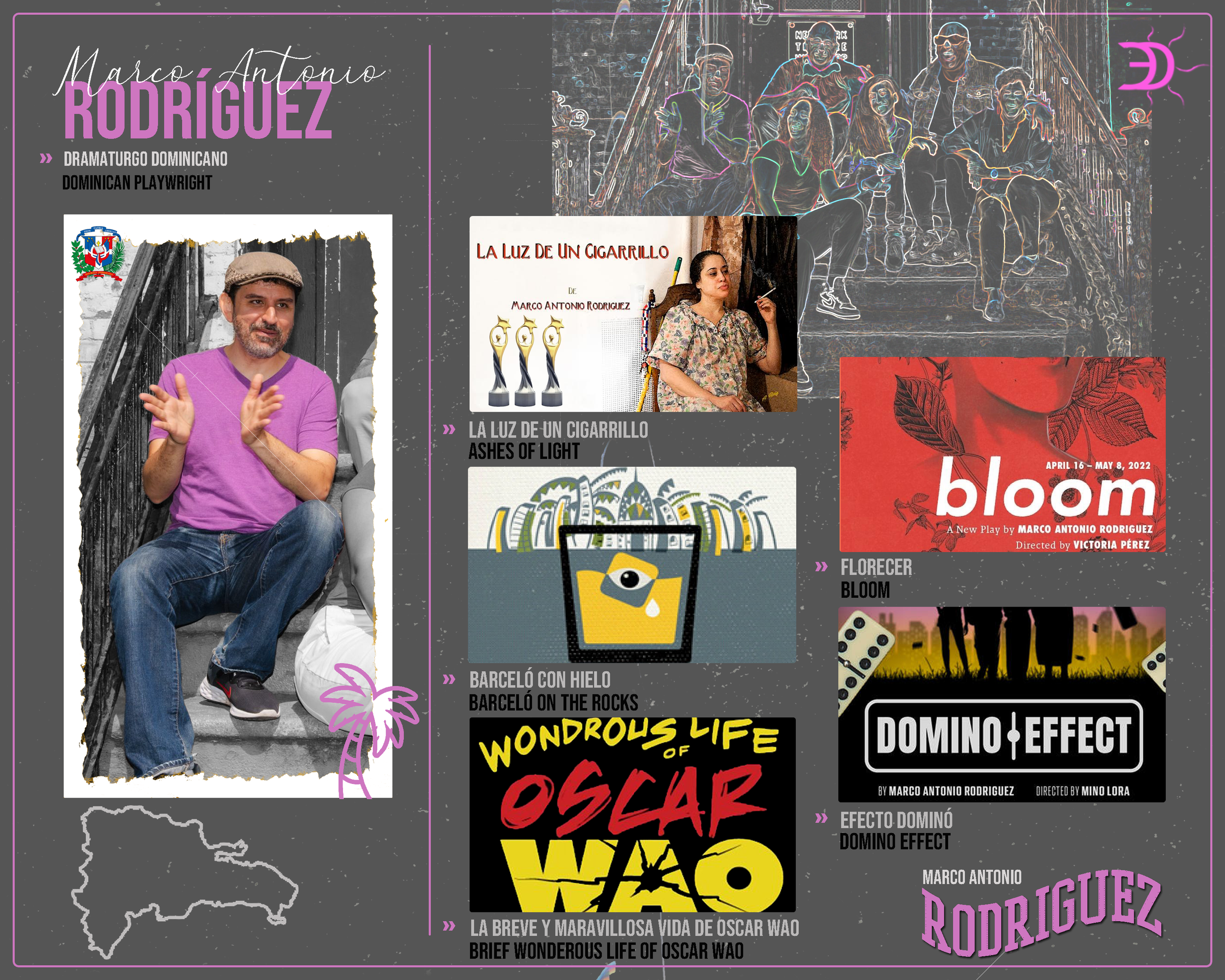
Marco Antonio Rodríguez plays we have covered of the years.
Collage: Emmanuel Espinal
Finally Marco Antonio, what new projects do you have on queue?
Marco Antonio:
I am currently recording Season 3 of the PBS Kids Emmy Nominated Animated series, Alma's Way, in which I voice Uncle Nestor. The English version of The Brief Wondrous Life of Oscar Wao will have its world-premiere as part of Chicago's Goodman Theatre Centennial celebration in February, 2026.
For more information on that visit: https://www.goodmantheatre.org/show/the-brief-wondrous-life-of-oscar-wao/