
By Nelson Santana
June 26, 2025
Leer en español: El Gringo de la Bachata: De la injusticia a la redención musical
A story of survival that transcends music
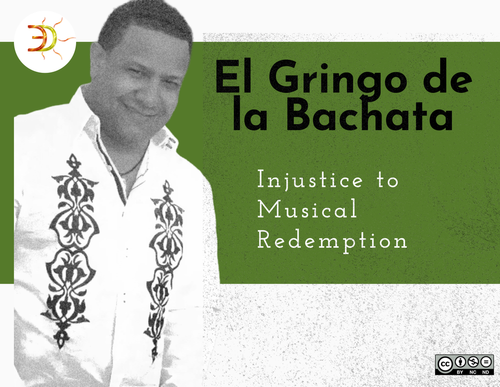
Ramón Alberto Gálvez Castillo has turned pain into music and adversity into strength. Eleven years after an unjust accusation that led him to spend 48 days in one of the world’s worst prisons, El Gringo de la Bachata continues to prove that the truth always prevails.
In a revealing interview with José Peguero, the veteran bachatero with a 30-year career shared the darkest moments of his personal life and musical journey. He disclosed never-before-heard details about his time in prison and how he managed to clear his name from a federal drug trafficking accusation that turned out to be a horrific case of mistaken identity.
The Beginning: Building a Career on Authenticity
Ramón Alberto launched his career in 1994, when he was unknown in the world of bachata. From the start, his philosophy was that, “If you’re paying to see El Gringo, don’t ask me to sing a song by El Chaval.”
His commitment to performing original material set him apart in a genre where many artists relied on covers to fill their sets: “I started singing bachata when no one knew who I was. I introduced people to my first album, which as a commercial success was a total failure—because only my family and I listened to it,” he recalls with his trademark brutal honesty.
That honesty has served him well. Over three decades, he has recorded 18 albums and over 450 songs, building a repertoire so extensive he can perform for five hours straight without repeating a track. His greatest hits include “Gringo muere de dolor,” “Un poquito de amor,” and “A esos hombres,” now considered anthems from his repertoire.
The Day Everything Changed: October 2013
El Gringo de la Bachata’s life took a dramatic turn on October 7, 2013. While at the airport in Panama, enjoying a successful moment in his career, his world suddenly collapsed. An Interpol warrant stopped him without clear explanation, launching a nightmare that would change his life forever.
He was taken to La Joya, a Panamanian prison designed for 300 inmates but housing over 900. In a cell built for nine, 14 people were crammed together. Ramón had to improvise a sleeping spot over the bathroom.
“I was in a prison—one of the worst in the world,” he says with chilling precision. For an artist used to applause and bright lights, the reality of prison was a brutal shock.
Brotherhood in Hell
Amid the nightmare, he found a ray of hope in Alberto de la Cruz, a fellow Dominican who became a brother-in-arms:
“When I arrived, they welcomed me immediately. He brought me to his cell and said, ‘You’ll sleep here. Nothing will happen to you.’”
Survival required creativity. El Gringo, who learned to cook as a child from his mother, became the group’s chef. “With just one electric burner, I made it work. I cooked chicken, beef—we always ate well.”
Food became a form of survival and a way to preserve dignity in a place where it was easily lost.
The Cry for Help That Changed Everything
After a month of detention without clear answers, he had a crucial breakthrough. Borrowing a phone, he sent a desperate message to singer Ramón Rijo (Monchy, from Monchy & Alexandra):
“I’m being held unjustly in a Panamanian prison. I fear for my life. I’m being accused of drug trafficking.”
The message went viral on Dominican social media, creating a media storm that pressured authorities and fast-tracked his voluntary extradition to the U.S. In the age of social media, truth finally had a way to reach the surface.
The Fight for Truth
In the U.S., things got even more serious. He faced federal charges for alleged heroin trafficking, weapons possession, money laundering, and conspiracy. The prosecutor threatened him with 15 years in prison.
For most, that would be the end. But El Gringo made a decision that changed everything:
He spent $3,500 to hire a voice analysis expert. It was a risky bet—using the little money he had—but it proved to be the winning move. “The expert said, ‘How are they accusing you when it’s not even your voice?’ I even spent an hour on the phone with him, recording myself to compare voices,” he explains. Forensic science became his salvation.
On May 16, 2014, a month before his scheduled trial, he received the email that changed his life: “We understand that you are not the person we are looking for.”
The Greatness of Forgiveness
Although he had every legal right to sue for millions in damages, El Gringo made a decision that revealed his true character:
“I didn’t want that—I just wanted peace. It was enough for me to show the world I was innocent.”
That response says more about the man behind the music than any song could. In an age where legal revenge is common, he chose peace over profit.
Living With the Scars
Eleven years later, the scars remain. “There are still people who think I’m in jail,” he says with a mix of resignation and strength. In the digital age, accusations travel faster than exonerations, and El Gringo continues to deal with that reality. But his response has been to keep doing what he does best: making music.
His latest track, “El amor de su vida,” is a cover of a song by Mexican band Grupo Frontera—proof that he continues to evolve without losing his essence.
A Legacy Bigger Than Music
The story of El Gringo de la Bachata transcends rhythms and melodies. It is the testimony of a man who faced the cruelest injustice the legal system can offer—and emerged not just intact, but stronger.
His experience in La Joya, the betrayal of friends he once trusted, and the epic battle to clear his name turned him into more than a musician: they made him a symbol of resistance. “He who has nothing to hide, fears nothing. I walk with my head held high,” he declares with the confidence of someone who has walked through fire and emerged purified.
Like the greats of bachata who have turned suffering into art, Ramón Alberto Gálvez Castillo has shown that truth, though delayed, always finds a way to shine.
His story reminds us that injustice may temporarily break us, but it can never destroy the spirit of someone with a clear conscience.
Moving Forward
El Gringo de la Bachata continues touring in Europe, showing that even after 30 years, his voice is still vital to the world of bachata. His tour schedule from August to September proves that, despite everything, music remains his refuge and his strength.
In a world where celebrities often crumble under far lesser trials, the story of El Gringo de la Bachata stands out as a beacon of authenticity, resilience, and redemption. This isn’t just a survival story—it’s a masterclass in how to maintain dignity when everything seems lost.
His legacy won’t be measured just by albums sold or concerts performed, but by the fact that he showed the world that truth and personal integrity can overcome even the most powerful systems.
In the world of bachata—where stories of pain and redemption are the norm—his stands as one of the most powerful ever told.
This article is based on an interview by José Peguero.
Brief Biography of El Gringo de la Bachata
In the fertile lands of San Francisco de Macorís, birthplace of many talented individuals who have enriched the Dominican Republic’s cultural landscape, Ramón Alberto Gálvez was born—a man who would later become an iconic figure under the stage name El Gringo de la Bachata. His story represents not only the personal triumph of an artist but also the evolution of a musical genre that has transcended borders and captured hearts across Latin America.
From an early age, Ramón Alberto was blessed with a melodious and finely tuned voice—an instrument that would resonate at family gatherings and intimate celebrations. His childhood unfolded amid the rhythm of music and the bohemian atmosphere that defined his home. This artistic environment was no coincidence: his father, Manuel de Jesús Gálvez, had carved out his own path as a renowned bachata singer during the 1960s and 1970s, a golden era in which the genre began to shape its unique identity.
His father’s influence played a decisive role in Ramón Alberto’s development. He witnessed firsthand the passion, discipline, and dedication that the art of bachata demanded, watching as his father navigated the challenges of being a musician at a time when the genre still struggled to earn respect and recognition within Dominican society.
The Journey Toward the American Dream
Like so many Dominicans of his generation, El Gringo embarked on a journey to New York City, which had become a second home for millions of fellow countrymen seeking opportunity. It was in this cosmopolitan metropolis that he achieved his first dream: recording his debut album. However, this initial work had limited reach, circulating mostly within the Dominican community in New York and leaving the artist with a sense of an unfinished mission.
El Gringo’s true aspiration went beyond local success abroad. His goal was to return to his roots, to be recognized on his home soil, and to take his place among bachata greats. This determination fueled his perseverance, as he understood that genuine recognition must begin at home.
The Rise to Musical Glory
The turning point came with the release of “Paz en la cama”, a production that became his formal introduction to Dominican and regional audiences. This album not only opened doors for him in the Dominican Republic but also resonated in Panama, Puerto Rico, Saint Martin, and other Caribbean nations, establishing El Gringo as a significant voice in the international bachata scene.
His musical catalog grew richer with hits that became etched in the collective memory: “Un poquito de amor,” “Cómo te voy a olvidar,” “Quiéreme,” and “El osito dormilón.” Each of these songs not only won over audiences in the Dominican Republic but also found a deep connection with Latin American communities around the world, demonstrating the universal power of bachata as a vehicle for shared emotions and experiences.
Legacy and Vision
El Gringo de la Bachata represents a perfect blend of tradition and innovation, of Dominican roots and global projection—transforming his personal story into a living testament to the transformative power of music and the endurance of artistic perseverance.