
By ESENDOM
June 24, 2026
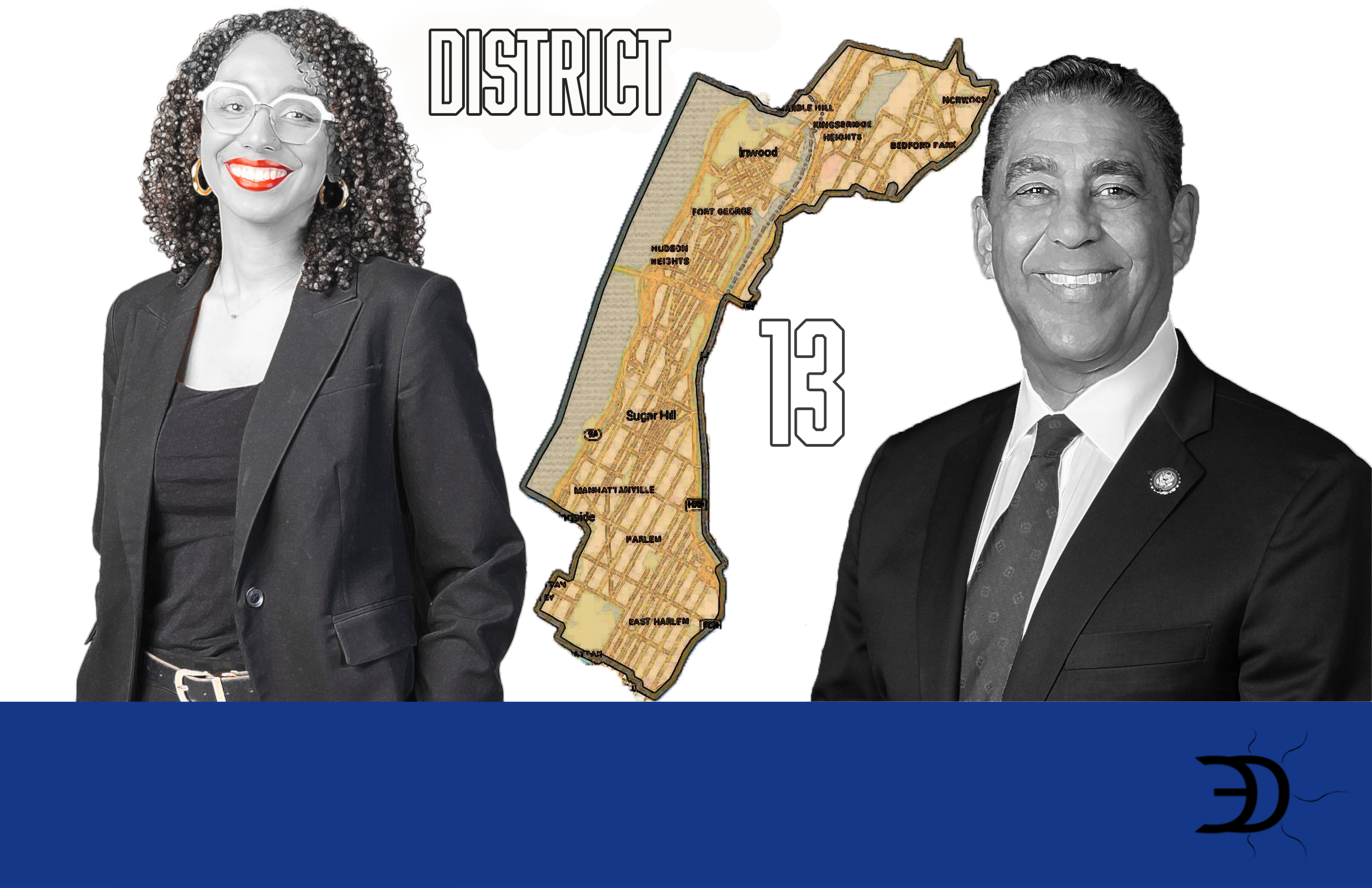
Darializa Ávila Chevalier has won. At 10:38 p.m. on Tuesday, June 23, with 88 percent of ballots counted, the Associated Press declared the 32-year-old community organizer and democratic socialist the winner of the Democratic primary for New York’s 13th Congressional District. The tally stood at 32,734 votes (49.4%) to Adriano Espaillat’s 30,399 (45.9%) — a margin of roughly 2,300 votes — and the congressman conceded the same night. In a district this deeply Democratic, the primary winner almost always goes on to win in November, which means Ávila Chevalier is now widely expected to become the district’s next member of Congress once the general election is held.
Her victory ends the House career of the only Dominican ever elected to Congress — and the first formerly undocumented immigrant to serve there — a five-term incumbent and chair of the Congressional Hispanic Caucus. Few saw it coming even a few weeks ago.
The reaction across the district has been mixed and, in places, jubilant. Some residents who long felt overlooked or abandoned by Espaillat have welcomed the change, openly relieved that he will no longer represent them. Others are celebrating Ávila Chevalier outright, treating her primary win as the moment a new representative was effectively chosen.
Her upset was also the most dramatic piece of a larger story. She was one of three House candidates endorsed by Mayor Zohran Mamdani — alongside Brad Lander, who unseated Rep. Dan Goldman in the 10th District, and Claire Valdez, who took the open 7th — and all three won. Ávila Chevalier, a public defense investigator who had never held office, ran with the backing of Mamdani, Senator Bernie Sanders and former Rep. Jamaal Bowman, plus the Democratic Socialists of America. Espaillat had the establishment behind him: Minority Leader Hakeem Jeffries, Gov. Kathy Hochul and Attorney General Letitia James.
The two had met in several debates — including one in Spanish on Telemundo 47, one in English on NY1 — that showed how much they actually agreed on (abolishing ICE, protecting public housing, expanding health care and affordability) and where they genuinely split. The sharpest divide was Gaza: Ávila Chevalier called Israel’s conduct a genocide, while Espaillat declined to use the word. He also leaned hard on the argument that Congress demands experience, not academic credentials — “this is not a PhD program,” he often said of his opponent, who has a Ph.D. in sociology.
But two of Espaillat’s central lines of attack appear to have backfired. He spent heavily relitigating her old social-media posts, and his campaign’s orbit went further, working to cast doubt on Ávila Chevalier’s very identity as a Dominican-descended New Yorker. That second effort turned ugly: a senior adviser, since placed on unpaid leave, pushed a narrative on Spanish-language media questioning whether she was “really” Dominican and trafficking in anti-Black, anti-Haitian and Islamophobic tropes — rhetoric that City & State reported and that Mamdani and other officials publicly condemned, with the mayor calling the use of “Haitian” as a slur unacceptable. Rather than disqualify her, the attacks seem to have generated sympathy and energized her supporters. The harder the establishment pushed on who counts as Dominican, the more the question rebounded on Espaillat.
The flashpoint came on primary day itself, when Ávila Chevalier walked out of an interview on La Mega 97.9’s morning show El Vacilón de la Mañana after the hosts pressed her to apologize to the Dominican community over the old posts. It cut both ways. Walking off was not a flattering look for a candidate seeking to represent that very community. But repeatedly demanding a public apology was not a flattering look for the program, either. El Vacilón is well known for turning up the heat on the artists and public figures it invites on — and this was not the first guest to walk off — so longtime listeners likely read the exchange as par for the course, while viewers unfamiliar with the show’s combative style could easily have interpreted it very differently.
What it all means now is both historic and bittersweet. Dominican voters decided the election, choosing one of their own over another. For many in the community, the takeaway is not loss but agency: a generation that once barely appeared on the ballot is now numerous and confident enough to pick its own direction. Barring a surprise in November, that direction has a name — Darializa Ávila Chevalier.