
By Guillermina Nin
7 de mayo de 2026

Under the slogan “agua si, oro no” (“Yes to Water, No to Gold”), a mass, grassroot movement in the southern Dominican province of San Juan de la Maguana scored a major environmental win on May 4 when it forced Dominican President Luis Abinader to backtrack on a mining exploration project that, if it were to be implemented, it would have had devastating consequences for the region, neighboring Haiti and the Caribbean.
This popular victory is not only a crushing defeat to President Abinader’s extractivist economic model, but also a setback for Goldquest, a Canada-based mining company with significant Dominican investor participation. Known as the Romero mining project, Goldquest envisioned an underground mining operation based on the use of a copper concentrate containing gold and silver through mineral separation.
The megamining project in San Juan de la Maguana is not the first of its kind. Since 2012, the Canada-based Barrick Gold has been conducting open-pit gold and silver mining in the city of Cotui in the Cibao region. As a consequence, environmental destruction has wreaked havoc, leaving behind contaminated rivers and other water reservoirs. In fact, prior to the protests, citizen journalists on social media reported on the environmental destruction left behind in Cotuí. Hundreds of videos and images of contaminated water in Cotuí circulated online, creating more awareness about the risk of megamining projects.
Among the organizations leading the struggle is the Comité Unido por el Rescate del Agua y la Vida (United Committee for the Rescue of Water and Life). Protests against the megamining project have been ongoing for several weeks. Since April, people have taken to the streets, blocking roads and highways. Nationwide support for the environmental struggle has been overwhelming.
The most significant demonstration took place on April 27th, with a 24-hour strike that paralyzed commerce and mobilized thousands in San Juan de la Maguana. The struggle in San Juan received the backing of the local Catholic Church, the Academia de Ciencias (Academy of Sciences), the Autonomous University of Santo Domingo (UASD) and the Asociación Dominicana de Profesores (Dominican Association of Teachers, ADP).
Meanwhile, Dominican communities abroad also mobilized on May 2nd. In Washington Heights, sanjuaneros and Dominicans from other regions joined in unison to demand that the mining permit be rescinded. Among the organizations present were the collective Compas de la Diáspora as well as some seasoned activists and people new to political activism.

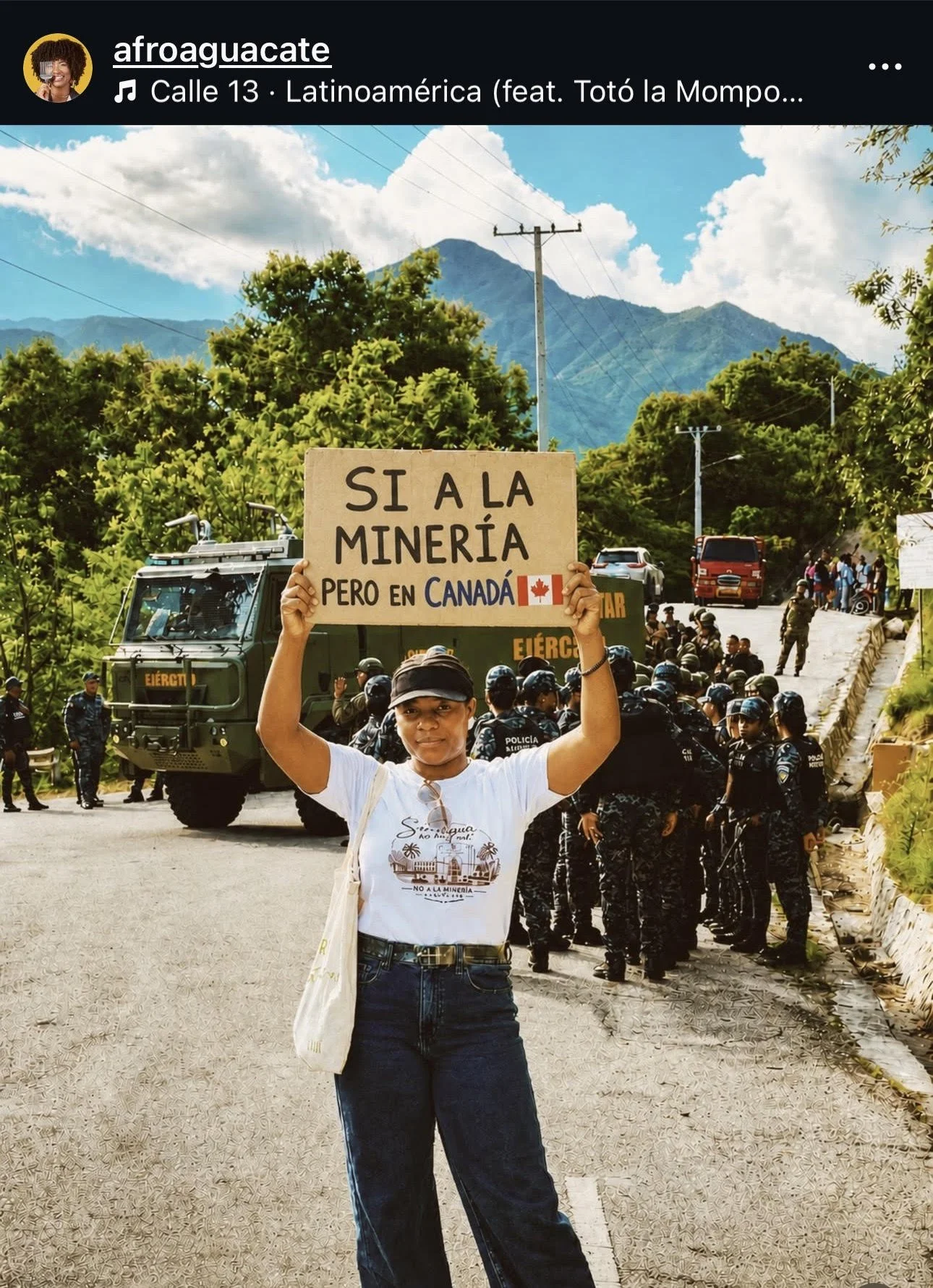
And while the Dominican government has used sheer repression to contain and derail the protests with tear gas and water cannons reminiscent of the Chilean dictatorship of Augusto Pinochet, the people of San Juan de la Maguana became more defiant. In addition, the government deployed a propaganda campaign through legacy media and social media, framing the mining exploration project as a part of a progressive economic policy to develop and reinvigorate the local economy in San Juan de la Maguana. Government bocinas (paid hacks) portrayed the movement as one that was misguided, violent and small. But pro-mining propaganda failed miserably to convince people to support the Goldquest extractivist project. And rather than deterring people from protesting, the propaganda campaign made people angrier and more determined to continue the struggle.
Nationwide, anger and defiance were growing at a rapid pace, creating a crisis of governability for Abinader’s conservative regime since the protests coincided with the commemoration of the 1965 revolution and the anti-IMF April of 1984 protests that rocked the Dominican Republic under the government of Salvador Jorge Blanco from the Dominican Revolutionary Party (PRD), the party from which the Dominican Modern Party (PRM), Abinader’s party, originated from in 2014.
Facing calls for more mobilizations, the Dominican government acted fast to quell a mounting crisis.
On May 4th, President Luis Abinader announced to the nation that he was rescinding the mining exploration permit. “In a message to the nation”, according to a press release by the Dominican government, “the president said that this decision is based on the fact that, according to Law 64-00 on the Environment and its regulations, if the population massively rejects a project of that category, it is not viable to continue it.”
Orlando Mateo, a NYC-based activist, explained to Esendom the significance of this environmental win:
“San Juan dealt a historic defeat to Gold Quest, Abinader and the ruling class, all of whom miscalculated the fighting spirit of the San Juanera and the opposition to extractivism and mining among the Southwest and the general Dominican population.
“As someone with roots in San Juan, I experienced firsthand how agriculture and cattle ranching are essential for the majority of sanjuaneros’ livelihood. I now see a new generation of people that are exploring the ecotourism model mountains, rivers and valleys. All of these essential industries would be affected by this mining project, which is why San Juan stood firm in rejection of extractivism and in defense of nature.”