By Nelson Santana
September 27, 2010
Lea en español: Junot Díaz visita Bronx Community College
The week of September 20th opened with a literary event that proved why Junot Díaz remains one of the most electrifying voices in American letters. The Pulitzer Prize-winning author visited Bronx Community College, brought to campus by the Dominican Club, and delivered exactly what students needed: raw honesty, historical clarity, and unapologetic art.
"I'm Here as an Artist"
Díaz made his stance clear from the start: “I wasn't asked to come here as a professor. They asked me to come because I am an artist. They asked me to talk about my art.” That art—his 2007 novel The Brief Wondrous Life of Oscar Wao—earned him the Pulitzer Prize for Fiction and redefined how Dominican history could be told.
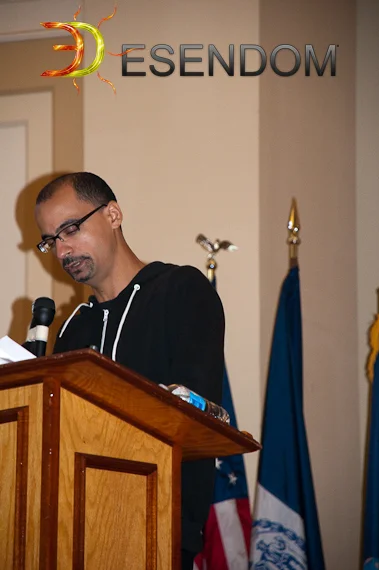
Junot Díaz reads his short story “Alma”
His reading that evening featured “Alma,” a short story about a relationship destroyed by infidelity. Delivered in Díaz's signature blend of colloquial English and Spanish, the performance connected immediately with the predominantly young audience.
The Language Question
Not everyone was comfortable. Muffled whispers rippled through the crowd as Díaz's unapologetically street-inflected language filled the room. During the Q&A, one audience member finally voiced the concern: Why use "bad words" in literature, onstage, and presumably in the classroom?
Díaz's response cut through the pretension: "When my students can command the English language as well as me, then will I allow them to curse in my class."
The answer wasn't about permission—it was about mastery. Most of the audience, particularly the younger attendees, understood immediately. Díaz's colloquial English (and Spanish) isn't carelessness; it's precision.
History Lessons: The Breeding Experiment
Beneath the performance, Díaz delivered uncomfortable truths about Dominican identity. He spoke bluntly about 400 years of slavery and what he termed the "breeding experiment"—the systematic rape that capitalism's most heinous invention, slavery, inflicted on the Dominican people.
"Dominicans are a raped people," Díaz stated, explaining that everything Dominican—the physical diversity, the range of skin tones, body types, features—is a consequence of this unwanted violence. It's why Dominicans "come in all shapes and sizes—black, white, yellow, voluptuous, petite, round and brown."
This wasn't abstract theorizing. For young Dominicans in the audience, it was family history reframed with clarity and dignity.
The Masks We Wear
Díaz shifted to something more immediate: survival strategies for minority students navigating multiple worlds.
"All of you know that you spend your life with a stack of masks on your face," he told them. "You have the person you are when you talk to your boss. You have the person you are when you talk to your teacher. You have the person you are when you talk to your boys and girls. You have the person you are when you talk to your absolute, most trustful best friend."
The message wasn't to abandon authenticity—it was to recognize code-switching as a tool, not a betrayal. Wear the masks that help you get your degree. Stay true to your people. You can do both.
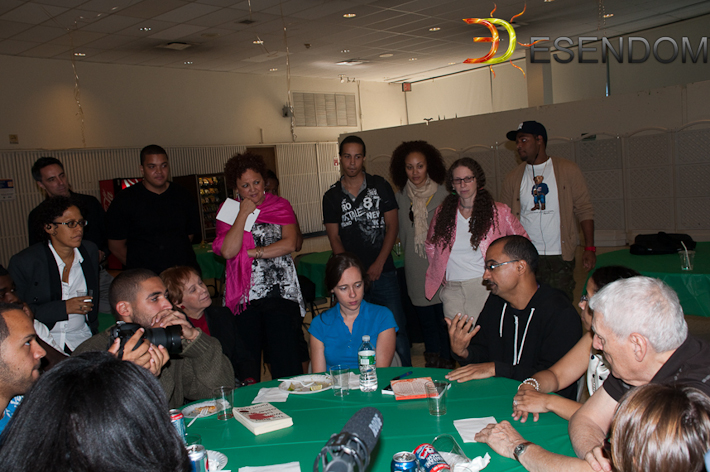
Junot Díaz shares thoughts at the reception following his lecture
Writers Are Artists (and Schools Forget This)
Díaz pivoted to a broader critique of American education. "Most people get very little art education" in the U.S., he argued, because the system prioritizes competition over cultivation. The result? Students learn to see writing as a skill to be tested rather than an art form to be respected.
"There is no culture on Earth that doesn't recognize its literature as art," Díaz said, pointing out that the U.S. does the opposite—and by neglecting this dimension of education, produces graduates culturally impoverished despite their degrees.
The Brief Wondrous Life as Encyclopedia
At the private post-event reception, Díaz described Oscar Wao as an "encyclopedia novel"—one that attempts to compile as much relevant historical information as possible within its fiction. For many in the audience, this approach was revelatory. Several admitted—"to the dismay of insecure Dominican historians," as the author noted—that they learned more Dominican history from Díaz's novel than from formal education.
Are all the historical details flawless? No. Historians quibble over specifics, like Díaz's assertion that former President Joaquín Balaguer never fathered children. (Historically accurate, though posthumous rumors emerged after Balaguer's 2002 death suggesting otherwise.)
But here's what matters: unlike historians who "drain the life out of the history books they write," Díaz "livens the pages on which his words appear on, and in turn stimulates the youth by arousing the history they were taught to despise."
The Ghetto Phenomenon
Junot Díaz is not simply a writer or English professor. He's a ghetto phenomenon who takes time to nurture America's youth—barring race or nationality—and reminds them that their stories, their language, and their history deserve to be told with the full force of art.
That Monday night at Bronx Community College, he proved it again.